Bacteroidales
| Bacteroidales | |
|---|---|
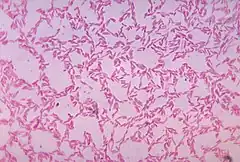 | |
| Bacteroides biacutis anaerobically cultured in blood agar medium | |
| Scientific classification | |
| Domain: | Bacteria |
| Phylum: | |
| Class: | Bacteroidia Krieg 2012[1] |
| Order: | Bacteroidales Krieg 2012[2] |
| Families[3][4][5] | |
| |
| Synonyms | |
| |
Bacteroidales is an order of bacteria.[2][3] Notably it includes the genera Prevotella and Bacteroides , which are commonly found in the human gut microbiota.
Phylogeny
The currently accepted taxonomy is based on the List of Prokaryotic names with Standing in Nomenclature[3] and the phylogeny is based on whole-genome sequences.[8][lower-alpha 1]
| |||||||||||||||||||||||||||||||||||||||||||||||||||||||||||||||||||||||||||||||||||||||||||||||||||||||
Notes
- ↑ Tenuifilaceae is not included in this phylogenetic tree.
References
- ↑ Krieg NR (2010). "Class I. Bacteroidia class. nov.". In Krieg NR, Staley JT, Brown DR, Hedlund BP, Paster BJ, Ward NL, Ludwig W, Whitman WB (eds.). Bergey's Manual of Systematic Bacteriology. Vol. 4 (2nd ed.). New York, NY: Springer. p. 25.
- 1 2 Krieg NR (2010). "Order I. Bacteroidales ord. nov.". In Krieg NR, Staley JT, Brown DR, Hedlund BP, Paster BJ, Ward NL, Ludwig W, Whitman WB (eds.). Bergey's Manual of Systematic Bacteriology. Vol. 4 (2nd ed.). New York, NY: Springer. p. 25.
- 1 2 3 Euzéby JP, Parte AC. "Bacteroidetes". List of Prokaryotic names with Standing in Nomenclature (LPSN). Retrieved June 25, 2021.
- ↑ Sayers; et al. "Bacteroidetes". National Center for Biotechnology Information (NCBI) taxonomy database. Retrieved 2016-03-20.
- ↑ Parker, Charles Thomas; Garrity, George M (19 October 2017). Parker, Charles Thomas; Garrity, George M (eds.). "Williamwhitmaniaceae Pikuta et al. 2017 emend. García-López et al. 2019". NamesforLife. doi:10.1601/tx.30875.
- ↑ Ormerod, Kate L.; Wood, David L. A.; Lachner, Nancy; Gellatly, Shaan L.; Daly, Joshua N.; Parsons, Jeremy D.; Dal'Molin, Cristiana G. O.; Palfreyman, Robin W.; Nielsen, Lars K.; Cooper, Matthew A.; Morrison, Mark; Hansbro, Philip M.; Hugenholtz, Philip (7 July 2016). "Genomic characterization of the uncultured Bacteroidales family S24-7 inhabiting the guts of homeothermic animals". Microbiome. 4 (1): 36. doi:10.1186/s40168-016-0181-2. PMC 4936053. PMID 27388460.
- ↑ Hongoh Y, Sharma VK, Prakash T, Noda S, Toh H, Taylor TD, Kudo T, Sakaki Y, Toyoda A, Hattori M, Ohkuma M (2008). "Genome of an endosymbiont coupling N2 fixation to cellulolysis within protist cells in termite gut". Science. 322 (5904): 1108–9. Bibcode:2008Sci...322.1108H. doi:10.1126/science.1165578. PMID 19008447. S2CID 24961278.
- ↑ García-López M, Meier-Kolthoff JP, Tindall BJ, Gronow S, Woyke T, Kyrpides NC, Hahnke RL, Göker M (2019). "Analysis of 1,000 Type-Strain Genomes Improves Taxonomic Classification of Bacteroidetes". Front Microbiol. 10: 2083. doi:10.3389/fmicb.2019.02083. PMC 6767994. PMID 31608019.
This article is issued from Offline. The text is licensed under Creative Commons - Attribution - Sharealike. Additional terms may apply for the media files.