CD137
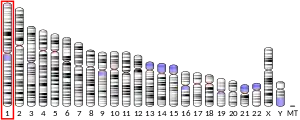



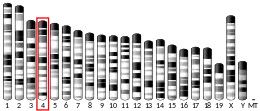

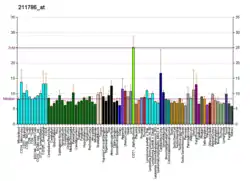
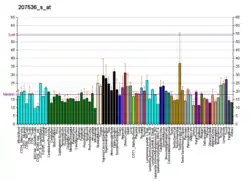
CD137 is a member of the tumor necrosis factor (TNF) receptor family. Its alternative names are tumor necrosis factor receptor superfamily member 9 (TNFRSF9), 4-1BB and induced by lymphocyte activation (ILA). It is of interest to immunologists as a co-stimulatory immune checkpoint molecule.
Expression
CD137 is expressed by activated T cells of both the CD4+ and CD8+ lineages.[5] Although it is thought to function mainly in co-stimulating those cell types to support their activation by antigen presenting cells expressing its ligand (CD137L), CD137 is also expressed on dendritic cells, B cells, NK cells, neutrophils and macrophages.[6]
Specific effects on cells
The best characterized activity of CD137 is its costimulatory activity for activated T cells. Crosslinking of CD137 enhances T cell proliferation, IL-2 secretion, survival and cytolytic activity. Further, it can enhance immune activity to eliminate tumors in mice.
Interactions
As a drug target
Utomilumab
Utomilumab (PF-05082566) targets this receptor to stimulate a more intense immune system attack on cancers.[9] It is a fully human IgG2 monoclonal antibody.[10] It is in early clinical trials.[9] As of June 2016 5 clinical trials are active.[11]
See also
- 4-1BB ligand
- Urelumab
References
- 1 2 3 GRCh38: Ensembl release 89: ENSG00000049249 - Ensembl, May 2017
- 1 2 3 GRCm38: Ensembl release 89: ENSMUSG00000028965 - Ensembl, May 2017
- ↑ "Human PubMed Reference:". National Center for Biotechnology Information, U.S. National Library of Medicine.
- ↑ "Mouse PubMed Reference:". National Center for Biotechnology Information, U.S. National Library of Medicine.
- ↑ Wehler TC, Karg M, Distler E, Konur A, Nonn M, Meyer RG, et al. (November 2008). "Rapid identification and sorting of viable virus-reactive CD4(+) and CD8(+) T cells based on antigen-triggered CD137 expression". Journal of Immunological Methods. 339 (1): 23–37. doi:10.1016/j.jim.2008.07.017. PMID 18760281.
- ↑ Vinay DS, Kwon BS (July 2011). "4-1BB signaling beyond T cells". Cellular & Molecular Immunology. 8 (4): 281–4. doi:10.1038/cmi.2010.82. PMC 4002439. PMID 21217771.
- ↑ Jang IK, Lee ZH, Kim YJ, Kim SH, Kwon BS (January 1998). "Human 4-1BB (CD137) signals are mediated by TRAF2 and activate nuclear factor-kappa B". Biochemical and Biophysical Research Communications. 242 (3): 613–20. doi:10.1006/bbrc.1997.8016. PMID 9464265.
- ↑ Arch RH, Thompson CB (January 1998). "4-1BB and Ox40 are members of a tumor necrosis factor (TNF)-nerve growth factor receptor subfamily that bind TNF receptor-associated factors and activate nuclear factor kappaB". Molecular and Cellular Biology. 18 (1): 558–65. doi:10.1128/MCB.18.1.558. PMC 121523. PMID 9418902.
- 1 2 Pfizer cancer drug shows promise in combo with Merck's Keytruda. May 2016
- ↑ Phase 1 Study of Utomilumab (PF-05082566) In Combination with Rituximab in Patients with CD20+ NHL (Study B1641001)
- ↑ PF-05082566 trials
External links
Further reading
- Kwon BS, Weissman SM (March 1989). "cDNA sequences of two inducible T-cell genes". Proceedings of the National Academy of Sciences of the United States of America. 86 (6): 1963–7. Bibcode:1989PNAS...86.1963K. doi:10.1073/pnas.86.6.1963. PMC 286825. PMID 2784565.
- Schwarz H, Tuckwell J, Lotz M (December 1993). "A receptor induced by lymphocyte activation (ILA): a new member of the human nerve-growth-factor/tumor-necrosis-factor receptor family". Gene. 134 (2): 295–8. doi:10.1016/0378-1119(93)90110-O. PMID 8262389.
- Sica G, Chen L (2000). "Biochemical and immunological characteristics of 4-1BB (CD137) receptor and ligand and potential applications in cancer therapy". Archivum Immunologiae et Therapiae Experimentalis. 47 (5): 275–9. PMID 10604232.
- Schwarz H (March 2005). "Biological activities of reverse signal transduction through CD137 ligand". Journal of Leukocyte Biology. 77 (3): 281–6. doi:10.1189/jlb.0904558. PMID 15618293.
- Kwon BS, Weissman SM (March 1989). "cDNA sequences of two inducible T-cell genes". Proceedings of the National Academy of Sciences of the United States of America. 86 (6): 1963–7. Bibcode:1989PNAS...86.1963K. doi:10.1073/pnas.86.6.1963. PMC 286825. PMID 2784565.
- Zhou Z, Kim S, Hurtado J, Lee ZH, Kim KK, Pollok KE, Kwon BS (February 1995). "Characterization of human homologue of 4-1BB and its ligand". Immunology Letters. 45 (1–2): 67–73. doi:10.1016/0165-2478(94)00227-I. PMID 7622190.
- Alderson MR, Smith CA, Tough TW, Davis-Smith T, Armitage RJ, Falk B, et al. (September 1994). "Molecular and biological characterization of human 4-1BB and its ligand". European Journal of Immunology. 24 (9): 2219–27. doi:10.1002/eji.1830240943. PMID 8088337. S2CID 35822854.
- Schwarz H, Tuckwell J, Lotz M (December 1993). "A receptor induced by lymphocyte activation (ILA): a new member of the human nerve-growth-factor/tumor-necrosis-factor receptor family". Gene. 134 (2): 295–8. doi:10.1016/0378-1119(93)90110-O. PMID 8262389.
- Schwarz H, Blanco FJ, von Kempis J, Valbracht J, Lotz M (April 1996). "ILA, a member of the human nerve growth factor/tumor necrosis factor receptor family, regulates T-lymphocyte proliferation and survival". Blood. 87 (7): 2839–45. doi:10.1182/blood.V87.7.2839.bloodjournal8772839. PMID 8639902.
- Loo DT, Chalupny NJ, Bajorath J, Shuford WW, Mittler RS, Aruffo A (March 1997). "Analysis of 4-1BBL and laminin binding to murine 4-1BB, a member of the tumor necrosis factor receptor superfamily, and comparison with human 4-1BB". The Journal of Biological Chemistry. 272 (10): 6448–56. doi:10.1074/jbc.272.10.6448. PMID 9045669.
- Schwarz H, Arden K, Lotz M (June 1997). "CD137, a member of the tumor necrosis factor receptor family, is located on chromosome 1p36, in a cluster of related genes, and colocalizes with several malignancies". Biochemical and Biophysical Research Communications. 235 (3): 699–703. doi:10.1006/bbrc.1997.6870. PMID 9207223.
- Arch RH, Thompson CB (January 1998). "4-1BB and Ox40 are members of a tumor necrosis factor (TNF)-nerve growth factor receptor subfamily that bind TNF receptor-associated factors and activate nuclear factor kappaB". Molecular and Cellular Biology. 18 (1): 558–65. doi:10.1128/MCB.18.1.558. PMC 121523. PMID 9418902.
- Jang IK, Lee ZH, Kim YJ, Kim SH, Kwon BS (January 1998). "Human 4-1BB (CD137) signals are mediated by TRAF2 and activate nuclear factor-kappa B". Biochemical and Biophysical Research Communications. 242 (3): 613–20. doi:10.1006/bbrc.1997.8016. PMID 9464265.
- Kim YJ, Kim SH, Mantel P, Kwon BS (March 1998). "Human 4-1BB regulates CD28 co-stimulation to promote Th1 cell responses". European Journal of Immunology. 28 (3): 881–90. doi:10.1002/(SICI)1521-4141(199803)28:03<881::AID-IMMU881>3.0.CO;2-0. PMID 9541583.
- Saoulli K, Lee SY, Cannons JL, Yeh WC, Santana A, Goldstein MD, et al. (June 1998). "CD28-independent, TRAF2-dependent costimulation of resting T cells by 4-1BB ligand". The Journal of Experimental Medicine. 187 (11): 1849–62. doi:10.1084/jem.187.11.1849. PMC 2212301. PMID 9607925.
- Langstein J, Michel J, Schwarz H (November 1999). "CD137 induces proliferation and endomitosis in monocytes". Blood. 94 (9): 3161–8. doi:10.1182/blood.V94.9.3161. PMID 10556203.
- Jang LK, Lee ZH, Kim HH, Hill JM, Kim JD, Kwon BS (December 2001). "A novel leucine-rich repeat protein (LRR-1): potential involvement in 4-1BB-mediated signal transduction". Molecules and Cells. 12 (3): 304–12. PMID 11804328.
- Cooper D, Bansal-Pakala P, Croft M (February 2002). "4-1BB (CD137) controls the clonal expansion and survival of CD8 T cells in vivo but does not contribute to the development of cytotoxicity". European Journal of Immunology. 32 (2): 521–9. doi:10.1002/1521-4141(200202)32:2<521::AID-IMMU521>3.0.CO;2-X. PMID 11828369.
- Wilcox RA, Chapoval AI, Gorski KS, Otsuji M, Shin T, Flies DB, et al. (May 2002). "Cutting edge: Expression of functional CD137 receptor by dendritic cells". Journal of Immunology. 168 (9): 4262–7. doi:10.4049/jimmunol.168.9.4262. PMID 11970964.
- Shulzhenko N, Morgun A, Chinellato AP, Rampim GF, Diniz RV, Almeida DR, Gerbase-DeLima M (March 2002). "CD27 but not CD70 and 4-1BB intragraft gene expression is a risk factor for acute cardiac allograft rejection in humans". Transplantation Proceedings. 34 (2): 474–5. doi:10.1016/S0041-1345(02)02600-3. PMID 12009595.
- Pauly S, Broll K, Wittmann M, Giegerich G, Schwarz H (July 2002). "CD137 is expressed by follicular dendritic cells and costimulates B lymphocyte activation in germinal centers". Journal of Leukocyte Biology. 72 (1): 35–42. PMID 12101260.