The Kingsley and Kate Tufts Poetry Awards
The Kingsley and Kate Tufts Poetry Awards are a pair of American prizes based at Claremont Graduate University. They are given to poets for their collections of poetry written in the English language, by a citizen or legal resident alien of the United States.[1]
| The Kingsley and Kate Tufts Poetry Awards | |
|---|---|
 | |
| Location | Claremont, California |
| Country | United States |
| Presented by | Claremont Graduate University |
| First awarded | 1993/1994 |
| Website | The Kingsley and Kate Tufts Poetry Awards |
The Kingsley Tufts Poetry Award is a $100,000 prize presented to a mid-career, emerging poet who already possesses an established body of work. The Kingsley Tufts award is known to be one of the world's most lucrative poetry prizes.
Its counterpart, the Kate Tufts Discovery Award, is given to a poet who demonstrates genuine promise in their first book of published poetry, with an attached purse of $10,000.
History
Kingsley Tufts Poetry Award

Kingsley Tufts held executive positions in the Los Angeles shipyards and wrote poetry as his avocation. His poetry has been featured in The New Yorker, Esquire, and Harpers, among other publications.
Following his death in 1991, Kingsley's wife, Kate, sold her home and the majority of the couple's estate in order to fund an endowment to help poets further their craft. She established the Kingsley Tufts Poetry Award in 1993 at Claremont Graduate University in Claremont, California.
Initially, the award was for $50,000, and has subsequently doubled due to increases in the endowment. It is intended for an emerging poet who is past the very beginning but has not yet reached the acknowledged pinnacle of their career.
Kate Tufts had no prior affiliation with Claremont Graduate University, but when she met then-university President John Maguire and visited the campus, she became convinced that it was the perfect home for her poetry prize.[2]
Unlike many literary awards, which are coronations for a successful career or body of work, the Kingsley Tufts award was created to both honor the poet and provide the resources that allow artists to continue working.
Kate Tufts said she wanted to create a prize "that would enable a poet to work on his or her craft for a while without paying bills."
The Kate Tufts Discovery Award
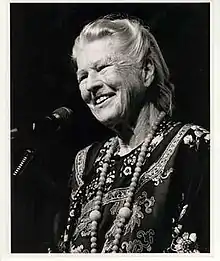
In 1994, just a year after the inauguration of the Kingsley Tufts Poetry Award, Kate Tufts founded the Kate Tufts Discovery Award, which began in the amount of $5,000, but has since doubled to $10,000.
Kate Tufts died in June 1997, at the age of 86. While she did not live to see her awards grow to become some of the largest poetry prizes in the world, she certainly took pride in their inception while she was alive.
Doug Anderson, 1995 Kate Tufts Discovery Award recipient, remembers her sardonic wit when meeting her that year: "She came into the room at the Claremont Graduate School grumbling that she couldn't smoke in there, and then she stopped and looked at Tom Lux [that year's Kingsley Tufts award recipient] and myself. Kate Tufts looked at us and said, 'You don't know how glad I am that this year's awards were given to a couple of really disreputable poets.'"[2]
Judging
Both awards go through two phases of judging. A preliminary panel of three judges screens the approximately 400 combined applications that are received for both awards. They then pass on finalists to the final judges.
The final panel is composed of five distinguished judges, representing a cross-section of the American poetry community.
2020
The panel of final judges for the 2017 Kingsley and Kate Tufts Poetry Awards is:
Timothy Donnelly, chair; poet, associate professor at Columbia University, and previous editor of the Boston Review
Cathy Park Hong, poet, poetry editor at the New Republic, and professor at Rutgers University–Newark.
Meghan O’Rourke, poet, essayist, memoirist, and editor of the Yale Review.
Luis J. Rodriguez, poet, writer, and founding editor of Tia Chucha Press
Sandy Solomon, poet and teacher at Vanderbilt University
2019
The panel of final judges for the 2017 Kingsley and Kate Tufts Poetry Awards is:
Timothy Donnelly, chair; poet, associate professor at Columbia University, and previous editor of the Boston Review
Cathy Park Hong, poet, poetry editor at the New Republic, and professor at Rutgers University–Newark.
Khadijah Queen, poet, playwright, and Assistant Professor at the University of Colorado at Boulder.
Luis J. Rodriguez, poet, writer, and founding editor of Tia Chucha Press
Sandy Solomon, poet and teacher at Vanderbilt University
2017
The panel of final judges for the 2017 Kingsley and Kate Tufts Poetry Awards[3] is:
Don Share, chair; poet and editor of Poetry magazine
Elena Karina Byrne, poet, poetry curator/moderator for the Los Angeles Times Festival of Books
Terrance Hayes, 2000 Kate Tufts Discovery Award recipient, poet, and professor at the University of Pittsburgh
Meghan O'Rourke, poet, essayist, editor, and literary critic
Brian Kim Stefans, poet and professor of English at University of California, Los Angeles
2012
The panel of final judges for the 2012 Kingsley and Kate Tufts Poetry Awards[4] is:
Linda Gregerson, poet, professor at the University of Michigan, and past Kingsley Tufts Poetry Award recipient
David Barber, poet, poetry editor of The Atlantic Monthly
Kate Gale, poet, novelist, managing editor of Red Hen Press
Ted Genoways, award-winning poet and Editor of the Virginia Quarterly Review
Carl Phillips, poet, professor at Washington University in St. Louis, and past Kingsley Tufts Poetry Award recipient
The panel of preliminary judges for the 2012 competition includes:
Jericho Brown, poet, Assistant Professor of English at the University of San Diego
Andrew Feld, poet, editor of the Seattle Review, and assistant professor at the University of Washington
Jennifer Chang, poet, Assistant Professor of creative writing at Bowling Green State University
Distinguished past judges
Paul Muldoon, Pulitzer Prize for Poetry winner, and poetry editor of The New Yorker
Robert Pinsky, poet, past Poet Laureate Consultant in Poetry to the Library of Congress, and poetry editor at Slate
Charles Harper Webb, Guggenheim Fellowship recipient in 2001, and professor at California State University Long Beach
Submission requirements/deadlines
Submissions are due annually on July 1, and eligible work has to have been published the previous year (between July and June). Manuscripts, CDs, and chapbooks are not accepted.
Awards ceremony
Award winners are announced in the February following the July deadline, with a ceremony and presentation of the awards in April, national poetry month. The ceremony takes place on the Claremont Graduate University Campus, and winners are required to accept their award in person.
Distinguished speakers at the Awards Ceremony have included Kathy Bates in 2002,[5] Leonard Nimoy in 2007,[6] and Maxine Hong Kingston in 2012.
Restrictions
A single work may be submitted for either award only once, although the winner of the Kate Tufts Discovery Award may submit another work in a later year for the Kingsley Tufts Poetry Award.
The Kingsley Tufts Poetry Award winner, by accepting the award, agrees to spend one week in residence at Claremont Graduate University for lectures and poetry readings in Claremont and the greater Los Angeles area.
The poet must be an American citizen or legal resident alien of the United States.[7]
Winners
| Year | Kingsley Tufts Poetry Award | Kate Tufts Discovery Award |
|---|---|---|
| 2020 | Ariana Reines — A Sand Book | Tiana Clark — I Can’t Talk About the Trees Without the Blood |
| 2019 | Dawn Lundy Martin — Good Stock Strange Blood | Diana Khoi Nguyen — Ghost Of |
| 2018 | Patricia Smith — Incendiary Art | Donika Kelly — Bestiary |
| 2017 | Vievee Francis — Forest Primeval | Phillip B. Williams — Thief in the Interior |
| 2016 | Ross Gay — Catalog of Unabashed Gratitude | Danez Smith — [insert] boy |
| 2015 | Angie Estes — Enchantée | Brandon Som — The Tribute Horse |
| 2014 | Afaa Michael Weaver — The Government of Nature | Yona Harvey — Hemming the Water |
| 2013 | Marianne Boruch — The Book of Hours | Heidy Steidlmayer — Fowling Piece |
| 2012 | Timothy Donnelly — The Cloud Corporation | Katherine Larson — Radial Symmetry |
| 2011 | Chase Twichell — Horses Where the Answers Should Have Been | Atsuro Riley — Romey's Order |
| 2010 | D.A. Powell — Chronic | Beth Bachmann — Temper |
| 2009 | Matthea Harvey — Modern Life | Matthew Dickman — All-American Poem |
| 2008 | Tom Sleigh — Space Walk | Janice N. Harrington — Even the Hollow My Body Made is Gone |
| 2007 | Rodney Jones — Salvation Blues | Eric McHenry — Potscrubber Lullabies |
| 2006 | Lucia Perillo — Luck Is Luck | Christian Hawkey — The Book of Funnels |
| 2005 | Michael Ryan — New and Selected Poems | Patrick Phillips — Chattahoochee |
| 2004 | Henri Cole — Middle Earth | Adrian Blevins — The Brass Girl Brouhaha |
| 2003 | Linda Gregerson — Waterborne | Joanie Mackowski —The Zoo |
| 2002 | Carl Phillips — The Tether | Cate Marvin — World's Tallest Disaster |
| 2001 | Alan Shapiro — The Dead Alive and Busy | Jennifer Clarvoe — Invisible Tender |
| 2000 | Robert Wrigley — Reign of Snakes | Terrance Hayes — Muscular Music |
| 1999 | B.H. Fairchild — The Art of the Lathe | Barbara Ras — Bite Every Sorrow |
| 1998 | John Koethe — Falling Water | Charles Harper Webb — Reading the Water |
| 1997 | Campbell McGrath — Spring Comes to Chicago | Lucia Perillo — The Body Mutinies |
| 1996 | Deborah Digges — Rough Music | Barbara Hamby — Delirium |
| 1995 | Thomas Lux — Split Horizon | Doug Anderson — The Moon Reflected Fire |
| 1994 | Yusef Komunyakaa — Neon Vernacular | Catherine Bowman —1-800-HOT-RIBS |
| 1993 | Susan Mitchell — Rapture | Not Awarded |
References
- "About the Awards". Claremont Graduate University. Retrieved 2015-06-09.
- "Tufts Poetry Awards 2008". Claremont Graduate University. Retrieved 2015-06-09.
- "The Tufts Poetry Awards Judges". Claremont Graduate University. Retrieved 2017-01-30.
- "The Tufts Poetry Awards Judges". Claremont Graduate University. Retrieved 2015-06-09.
- "Kathy Bates assists in honoring poets". University of La Verne. 2002-05-02. Retrieved 2015-06-09.
- "Awards". Beyond Spock: Leonard Nimoy Fan Page. Retrieved 2015-06-09.
- "Eligibility", Tufts Poetry Awards, Claremont Graduate University.