Ol Chiki script
The Ol Chiki (ᱚᱞ ᱪᱤᱠᱤ) script, also known as Ol Chemetʼ (Santali: ol 'writing', chemetʼ 'learning'), Ol Ciki, Ol, and sometimes as the Santali alphabet invented by Pandit Raghunath Murmu in the year 1925, is the official writing system for Santali, an Austroasiatic language recognized as an official regional language in India. It is one of the official scripts of the Indian Republic. It has 30 letters, the design of which is intended to evoke natural shapes. The script is written from left to right, and has two styles (the print Chapa style and cursive Usara style). Unicode does not maintain a distinction between these two, as is typical for print and cursive variants of a script. In both styles, the script is unicameral (that is, it does not have separate sets of uppercase and lowercase letters).
The shapes of the letters are not arbitrary, but reflect the names for the letters, which are words, usually the names of objects or actions representing conventionalized form in the pictorial shape of the characters.
— Norman Zide, [1]
| Ol Chiki ᱚᱞ ᱪᱤᱠᱤ | |
|---|---|
 | |
| Script type | Alphabet
|
| Creator | Raghunath Murmu |
| Direction | left-to-right  |
| Languages | Santali language |
| ISO 15924 | |
| ISO 15924 | Olck (261), Ol Chiki (Ol Cemet’, Ol, Santali) |
| Unicode | |
Unicode alias | Ol Chiki |
| U+1C50–U+1C7F | |
| Part of a series on | |
|---|---|
| |
| Officially used writing systems in India | |
| Category | |
| Indic scripts | |
| Arabic derived scripts | |
| Alphabetical scripts | |
| Related | |

.svg.png.webp)


History
The Ol Chiki script was created in 1925 by Raghunath Murmu for the Santali language, and publicized first in 1939 at a Mayurbhanj State exhibition.[2] Unlike most Indic scripts, Ol Chiki is not an abugida, but is a true alphabet: giving the vowels equal representation with the consonants.

Before the invention of Ol Chiki script, Santali was written in Bangla, Devanagari, Kalinga and Latin script. However, Santali is not an Indo-Aryan language and Indic scripts did not have letters for all of Santali's phonemes, especially its stop consonants and vowels, which make it difficult to write the language accurately in an unmodified Indic script.
For example, when missionary and linguist Paul Olaf Bodding, a Norwegian, studied the Santali language and needed to decide how to transcribe it (in producing his widely followed and widely respected reference books such as A Santal Dictionary), he decided to transcribe Santali in the Roman alphabet: despite his observation that Roman script lacks many of the advantages of the Indic scripts, he concluded that the Indic scripts could not adequately serve the Santali language because the Indic scripts lack a way to indicate important features of Santali pronunciation (such as glottalization, combined glottalization and nasalization, and check stops) which can be more easily represented in the Roman alphabet through the use of diacritics.[3]
The phonology of the Santali language had also been similarly analyzed by various other authors, including Byomkes Chakrabarti in Comparative Study of Santali and Bengali and Baghrai Charan Hembram in A Glimpse of Santali Grammar. However, the Ol Chiki alphabet is considered (by many Santali) to be even more appropriate for the language, because its letter-shapes are derived from the sounds of common Santali words and other frequent Santali morphemes[lower-alpha 1]: nouns, demonstratives, adjectives, and verb roots in the Santali language.[4] In other words, each Santali letter’s name is, or is derived from, a common word or other element of the Santali language, and each letter’s shape is derive from a simple drawing of the meaning of that word or other element. For example, the Santali letter “ol” (representing the sound /l/) is written with a shape originally derived from a simplified outline drawing of a hand holding a pen, because the name of this letter is also the Santali word for “writing.”
Print and cursive styles
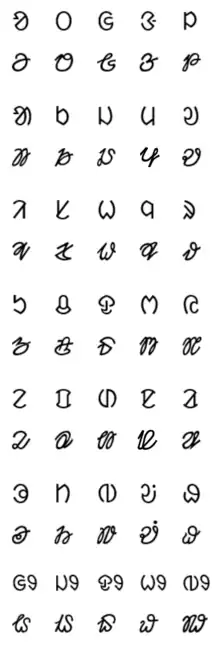
The existence of these two styles of Ol Chiki was mentioned by the script’s creator: Guru Gomke Pandit Raghunath Murmu (also known as Pandit Murmu) in his book Ol Chemed[5] which explains and teaches the Ol Chiki script[lower-alpha 2]. Chapa (Santali for 'print') is used for publication, while usara (Santali for 'quick') is used for handwriting.
Chapa hand
Ol Chiki chapa, or print style, is the more common style for digital fonts, and is used in the printing of books and newspapers.
Usara hand
Usara or usara ol is the cursive style, and is largely limited to pen and paper, though there are digital usara typefaces. Differences include the diacritic ahad, which in print style is used with ᱜ, ᱡ, ᱦ, ᱫ, and ᱵ, all of which can form ligatures with ᱽ in cursive.[6] Further, cursive usara seldom uses several letter-shapes which are formed by combining the letter ᱦ and the four semi-consonants ᱜ, ᱡ, ᱫ, and ᱵ with ahad; instead, these are generally written in a shorter form, as ᱷ.
Comparison
These are various differences and similarities between these two styles of Ol Chiki script.
| Sl. | Chapa & Usara |
|---|---|
| 1. | It consists of 30 letters, 5 diacritical marks, and one special symbol called ahad or ohod. |
| 2. | Use of ᱦ with ᱽ is not found or is negligible, as it is generally written in a shorter form: ᱷ (ᱦ + ᱽ = ᱷ) |
| 3. | Digits are from ᱐ᱼ᱙ |
| 4. | 6 Diacritics (ᱸ , ᱹ , ᱺ , ~ , ᱼ , ᱽ ) are used |
| 5. | Except for the period, all punctuation takes the same form as in English. Instead of using a period, Ol Chiki uses ᱾, a symbol called muchad or mucăd. |
| Diff. | Chapa | Usara |
|---|---|---|
| 1. | Ohod is written with its component letters separate (not joined) | Ohod is written with its component letters joined |
| 2. | ᱜ, ᱡ, ᱦ, ᱫ, and ᱵ does not form ligatures with ᱽ (ᱦᱽ use is not found, instead ᱷ Is used) | ᱜ, ᱡ, ᱦ, ᱫ, and ᱵ form cursive ligatures with ᱽ (ᱦᱽ is not used; instead, ᱷ is used) |
| 3. | Words are written with letters separated from each other, as usual in printed documents, without any cursive form. | Words are written in a cursive style with all letters joined. |
Letters
The values of the Ol Chiki letters are as follows:
| Letter | Name | IPA[7] | Transliteration | Shape[1] | ||||
|---|---|---|---|---|---|---|---|---|
| ALA-LC[8] | Zide[7] | Deva.[6] | Beng.[6] | Odia[6] | ||||
| ᱚ | la | /ɔ/ | a | ọ | अ | অ | ଅ | burning fire |
| ᱛ | at | /t/ | t | t | त | ত | ତ୍ | the Earth |
| ᱜ | ag | /k’/, /g/ | g | k’ | ग | গ | ଗ୍ | vomiting mouth, which produces the same sound as the name of the letter |
| ᱝ | ang | /ŋ/ | ṃ | ṅ | ं | ং | ଂ | blowing air |
| ᱞ | al | /l/ | l | l | ल | ল | ଲ୍ | writing |
| ᱟ | laa | /a/ | ā | a | आ | আ | ଆ | working in the field with a spade |
| ᱠ | aak | /k/ | k | k | क | ক | କ୍ | bird (sound of a swan) |
| ᱡ | aaj | /c’/, /ɟ/ | j | c’ | ज | জ | ଜ୍ | person pointing towards a third person with the right hand (saying “he”) |
| ᱢ | aam | /m/ | m | m | म | ম | ମ୍ | person pointing towards a second person with the left hand (saying “you”) |
| ᱣ | aaw | /w/, /v/ | w | w | व | ওয় | ୱ୍ | opening lips |
| ᱤ | li | /i/ | i | i | इ | ই | ଇ | bending tree |
| ᱥ | is | /s/ | s | s | स | স | ସ୍ | plow |
| ᱦ | ih | /ʔ/, /h/ | ẖ | h | ह | হ | ହ୍ | hands up |
| ᱧ | iny | /ɲ/ | ñ | ñ | ञ | ঞ | ଞ୍ | person pointing towards himself/herself with the left hand |
| ᱨ | ir | /r/ | r | r | र | র | ର୍ | sickle used for cutting or reaping |
| ᱩ | lu | /u/ | u | u | उ | উ | ଉ | vessel used for preparing food |
| ᱪ | uch | /c/ | c | c | च | চ | ଚ୍ | peak of a mountain which is usually high |
| ᱫ | ud | /t’/, /d/ | d | t’ | द | দ | ଦ୍ | mushroom |
| ᱬ | unn | /ɳ/ | ṇ | ṇ | ण | ণ | ଣ୍ | picture of a flying bee (which Is described by Santali speakers as making this sound) |
| ᱭ | uy | /j/ | y | y | य | য় | ୟ୍ | a man bending towards the ground to cut something |
| ᱮ | le | /e/ | e | e | ए | এ | ଏ | overflowing rivers changing course |
| ᱯ | ep | /p/ | p | p | प | প | ପ୍ | person receiving with both hands |
| ᱰ | edd | /ɖ/ | ḍ | ḍ | ड | ড | ଡ୍ | a man with two legs stretching towards his chest and mouth |
| ᱱ | en | /n/ | n | n | न | ন | ନ୍ | threshing grains with two legs |
| ᱲ | err | /ɽ/ | ṛ | ṛ | ड़ | ড় | ଡ଼୍ | a path that turns to avoid an obstruction or a danger |
| ᱳ | lo | /o/ | o | o | ओ | ও | ଓ | a mouth when sounding this letter |
| ᱴ | ott | /ʈ/ | ṭ | ṭ | ट | ট | ଟ୍ | camel hump |
| ᱵ | ob | /p’/, /b/ | b | p’ | ब | ব | ବ୍ | curly hair |
| ᱶ | ov | /w̃/ | ṅ | w̃ | ङ | ঙ | ଙ୍ | nasalized |
| ᱷ | oh | /ʰ/ | h | (C)h | ह | হ | ହ୍ | a man throwing something with one hand |
Aspirated consonants are written as digraphs with the letter ᱷ:[9][6] ᱛᱷ /tʰ/, ᱜᱷ /gʱ/, ᱠᱷ /kʰ/, ᱡᱷ /jʱ/, ᱪᱷ /cʰ/, ᱫᱷ /dʱ/, ᱯᱷ /pʰ/, ᱰᱷ /ɖʱ/, ᱲᱷ /ɽʱ/, ᱴᱷ /ʈʰ/, and ᱵᱷ /bʱ/.
Other marks
Ol Chiki employs several marks which are placed after the letter they modify (there are no combining characters):
| Mark | Name | Description |
|---|---|---|
| ᱹ | găhlă ṭuḍăg | This baseline dot is used to extend three vowel letters for the Santal Parganas dialect of Santali:[9] ᱚᱹ ŏ /ɔ/, ᱟᱹ ă /ə/, and ᱮᱹ ĕ /ɛ/. The phonetic difference between ᱚ and ᱚᱹ is not clearly defined and there may be only a marginal phonemic difference between the two. ᱚᱹ is rarely used. ALA-LC transliterates ᱟᱹ as "ạ̄".[8] |
| ᱸ | mũ ṭuḍăg | This raised dot indicates nasalization of the preceding vowel: ᱚᱸ /ɔ̃/, ᱟᱸ /ã/, ᱤᱸ /ĩ/, ᱩᱸ /ũ/, ᱮᱸ /ẽ/, and ᱳᱸ /õ/. ALA-LC transliteration uses "m̐" after the affected vowel.[8] |
| ᱺ | mũ găhlă ṭuḍăg | This colon-like mark is used to mark a nasalized extended vowel. It is a combination of mũ ṭuḍăg and găhlă ṭuḍăg: ᱚᱺ /ɔ̃/, ᱟᱺ /ə̃/, and ᱮᱺ /ɛ̃/. |
| ᱻ | relā | This tilde-like mark indicates the prolongation of any oral or nasalized vowel. Compare ᱮ /e/ with ᱮᱻ /eː/. It comes after the găhlă ṭuḍăg for extended vowels: ᱮᱹᱻ /ɛː/. It is omitted in ALA-LC transliteration.[8] |
| ᱽ | ahad | This special letter indicates the deglottalization of a consonant in the word-final position. It preserves the morphophonemic relationship between the glottalized (ejective) and voiced equivalents of consonants.[9] For example, ᱜ represents a voiced /g/ when word initial but an ejective /k’/ when in the word-final position. A voiced /g/ in the word-final position is written as ᱜᱽ. The ahad is used with ᱜ, ᱡ, ᱦ, ᱫ, and ᱵ which can form cursive ligatures with ᱽ in handwriting (but not usually in printed text).[6] ALA-LC transliteration uses an apostrophe (’) to represent an ahad.[8] |
| ᱼ | phārkā | This hyphen-like mark serves as a glottal protector (the opposite function as the ahad.) It preserves the ejective sound, even in the word-initial position. Compare ᱜᱚ /gɔ/ with ᱜᱼᱚ /k’ɔ/. The phārkā is only used with ᱜ, ᱡ, ᱫ, and ᱵ. It is omitted in ALA-LC transliteration.[8] |
Digits
Ol Chiki has its own set of digits:
| Digit | 0 | 1 | 2 | 3 | 4 | 5 | 6 | 7 | 8 | 9 |
|---|---|---|---|---|---|---|---|---|---|---|
| Ol Chiki | ᱐ | ᱑ | ᱒ | ᱓ | ᱔ | ᱕ | ᱖ | ᱗ | ᱘ | ᱙ |
| Bengali | ০ | ১ | ২ | ৩ | ৪ | ৫ | ৬ | ৭ | ৮ | ৯ |
| Devanagari | ० | १ | २ | ३ | ४ | ५ | ६ | ७ | ८ | ९ |
| Odia | ୦ | ୧ | ୨ | ୩ | ୪ | ୫ | ୬ | ୭ | ୮ | ୯ |
| Persian | ۰ | ۱ | ۲ | ۳ | ۴ | ۵ | ۶ | ۷ | ۸ | ۹ |
Punctuation
Some Western-style punctuation marks are used with Ol Chiki: the comma (,), exclamation mark (!), question mark (?), and quotation marks (“ and ”).
The period (.) is not used, because it is visually confusible with the găhlă ṭuḍăg mark (ᱹ).[6]; therefore, instead of periods, the script uses single or two Ol Chiki short dandas:
- ᱾ (mucăd) marks a minor break
- ᱿ (double mucăd) marks a major break
Computing
Unicode
Ol Chiki script was added to the Unicode Standard in April, 2008 with the release of version 5.1.
The Unicode block for Ol Chiki is U+1C50–U+1C7F:
| Ol Chiki[1] Official Unicode Consortium code chart (PDF) | ||||||||||||||||
| 0 | 1 | 2 | 3 | 4 | 5 | 6 | 7 | 8 | 9 | A | B | C | D | E | F | |
| U+1C5x | ᱐ | ᱑ | ᱒ | ᱓ | ᱔ | ᱕ | ᱖ | ᱗ | ᱘ | ᱙ | ᱚ | ᱛ | ᱜ | ᱝ | ᱞ | ᱟ |
| U+1C6x | ᱠ | ᱡ | ᱢ | ᱣ | ᱤ | ᱥ | ᱦ | ᱧ | ᱨ | ᱩ | ᱪ | ᱫ | ᱬ | ᱭ | ᱮ | ᱯ |
| U+1C7x | ᱰ | ᱱ | ᱲ | ᱳ | ᱴ | ᱵ | ᱶ | ᱷ | ᱸ | ᱹ | ᱺ | ᱻ | ᱼ | ᱽ | ᱾ | ᱿ |
Notes
| ||||||||||||||||
Mixing the two letter styles
Although Ol Chiki (Chapa) and Ol Chiki (Usara) are normally never mixed, and the original inventor never mentioned mixing these letter styles, there have been some works that mix both forms, using them like English capital and small letters. However, this innovation is yet to be accepted officially.[12]
The invention of a lower case for Ol Chiki
Since 2017, Santali graphic designer, typographer, and film producer Sudip Iglesias Murmu has been working on design principles to provide a lowercase alphabet form for Ol Chiki, which would permit Ok Chiki writing and keyboarding to use a two-case, or bicameral, format (Using both uppercase and lowercase), as is done in many other written languages, including the Roman-alphabet languages such as English (all of which were once unicameral scripts, but evolved into a bicameral stage over time). As the development of a lowercase form is contributed to developing a standardized cursive form (in those writing systems which use one), the evolution of lowercase is likely to allow standardizing cursive to the point of making it type able alongside more rigid "block" printed letterforms forms So far, only Ol Chiki (Chapa) letters are used in keyboarding, typesetting, and publishing (in effect, producing capitals-only text for the entirety of all printed or keyboarded documents). In writing quickly by hand, Ol Chiki (Usara) is used: but, despite Ol Usara’s potential for reaching high speed, the circulation of Ol Usara documents is negligible, and Ol Usara is yet to receive Unicode standardization, thus leaving it still neglected.
In hopes to remedy this situation and to harmonize the two scripts, Sudip Iglesias Murmu has innovated by creating a series of lowercase letters, which he has integrated with the already existing font of Ol Chiki. According to him, providing lowercase letters increases the efficiency of keyboarding, both for Ol Chiki (Chapa) and for Ol Chiki (Usara), and allows keyboarding to reach the same speed that can be obtained when typing Santali in Roman-alphabet letters, which are likewise case-sensitive. However, his work is yet to be accepted officially.[13]
See also
- Byomkes Chakrabarti (a Bengali research worker on ethnic languages)
- Santali Latin alphabet
References
- "Ol Chiki Script". A portal for Santals. 2002. Retrieved 2017-09-12.
- Hembram, Phatik Chandra (2002). Santhali, a Natural Language. U. Hembram. p. 165.
- Hembram, Baghrai Charan (2012). A Glimpse of Santali Grammar. Noha Trust Bahalda Mayurbhanj odisha. p. 05.
- Hembram, Baghrai Charan (2012). A Glimpse of Santali Grammar. Noha Trust Bahalda Mayurbhanj odisha. p. 01.
- Samal, A. P. Subhakanta (2022-01-14). PERSONALITIES OF ODISHA. Shubhdristi Publication. ISBN 978-93-5593-204-4.
- Everson, Michael (2005-09-05). "L2/05-243R: Final proposal to encode the Ol Chiki script in the UCS" (PDF).
- Zide, Norman (1996). Daniels, Peter T.; Bright, William (eds.). The World's Writing Systems. Oxford University Press, Inc. pp. 614-615. ISBN 978-0195079937.
- "Santali (in Ol script)" (PDF). ALA-LC Romanization Tables. Library of Congress. Retrieved 2017-09-12.
- "The Unicode Standard, Chapter 13.10: Ol Chiki" (PDF). Unicode Consortium. March 2020.
- "Noto Sans Ol Chiki". Google Noto Fonts. Retrieved 5 June 2020.
- "Nirmala UI font family - Typography". docs.microsoft.com. Retrieved 5 June 2020.
- News, Global Gov. "Ol Chiki Lower Case Letters Invented by Sudip Iglesias Murmu". PRLog. Retrieved 2022-06-02.
{{cite web}}:|last=has generic name (help) - "Ol Chiki moulded into perfection by invention of lowercase letters - Ajanta Heritage & Culture". 2021-08-09. Retrieved 2022-06-02.
- smallest unit of meaningful speech sound
- The process is described in Ol Chemed (A Santali Primer), and also in his book Ronod (A Santali Grammar in Santali), in his description of Ol Chiki's chapa and usara styles.