īlens
See also: ilens
Latvian
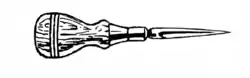
Īlens
Etymology
Traditionally, this word is seen as borrowed from Gothic 𐌴𐌻𐌰 (ēla, “awl”), perhaps via Old Prussian ylo (“awl”). The Gothic e was very narrow (tense), so it was replaced by ī when borrowed. This loanword is first mentioned in 17th-century dictionaries. A more recent theory, however, connects īlens to ilknis (“fang, tusk”), ilkss (“shaft”), and with Hittite illuyanka (“dragon; snake”), where il- apparently refers to something sharp (fang, horn, stinger), in which case īlens might be a retention rather than a borrowing, ultimately from Proto-Indo-European *eil-, *il-, *īl-, from *ei-, *h₁ei- (“sharp, pointed”), via a probable Proto-Baltic *īl- + -ens.[1]
Pronunciation
- IPA(key): [īːlæns]
| (file) |
Noun
īlens m (1st declension)
Declension
Declension of īlens (1st declension)
References
- Karulis, Konstantīns (1992), “īlens”, in Latviešu Etimoloģijas Vārdnīca (in Latvian), Rīga: AVOTS, →ISBN
This article is issued from Wiktionary. The text is licensed under Creative Commons - Attribution - Sharealike. Additional terms may apply for the media files.