вече
Bulgarian
Etymology
Inherited from Old Church Slavonic вѧще (vęšte), вѧщьше (vęštĭše, “more”), from Proto-Slavic *vęťьjь, probably through intermediate forms *вещше (*veštše) → *ветше (*vetše). Compare Macedonian веќе (veḱe).
Pronunciation
- IPA(key): [ˈvɛt͡ʃe]
Alternative forms
- веч (več) – contracted, poetic
- ве́ще (véšte) – dialectal, historical
- ве́кье (vékje) – dialectal
Related terms
- пове́че (povéče, “more”)
- преве́че (prevéče, “much more”) (dialectal)
References
- вече in Rečnik na bǎlgarskija ezik (Institut za bǎlgarski ezik)
- вече in Rečnik na bǎlgarskija ezik (Čitanka.Info)
- вѧще in Исторически речник на българския език, Sofia University "St. Clement Ohridsky"
- Georgiev V. I., editor (1971), “вече”, in Български етимологичен речник [Bulgarian Etymological Dictionary] (in Bulgarian), volume 1, Sofia: Bulgarian Academy of Sciences, page 139
- Georgiev V. I., editor (1971), “вещ(е), вещик”, in Български етимологичен речник [Bulgarian Etymological Dictionary] (in Bulgarian), volume 1, Sofia: Bulgarian Academy of Sciences, page 141
Russian
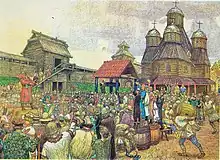
псковское вече
Alternative forms
- вѣ́че (vě́če) – Pre-reform orthography (1918)
Etymology
Inherited from Old East Slavic вѣче (věče), from Proto-Slavic *věťe.
Pronunciation
- IPA(key): [ˈvʲet͡ɕe]
Declension
Declension of ве́че (inan neut-form sibilant-stem accent-a irreg)
Related terms
- вечево́й (večevój)
Serbo-Croatian
Alternative forms
Etymology
From Proto-Slavic *večerъ, from Proto-Balto-Slavic *wékeras, from Proto-Indo-European *wekʷsperos.
Pronunciation
- IPA(key): /ʋêt͡ʃeː/
This article is issued from Wiktionary. The text is licensed under Creative Commons - Attribution - Sharealike. Additional terms may apply for the media files.