конь
Belarusian
Alternative forms
- koń – łacinka
Etymology
Inherited from Old Ruthenian конь.
Pronunciation
- IPA(key): [konʲ]
Audio (file)
Declension
| singular | plural | |
|---|---|---|
| nominative | конь konʹ |
ко́ні kóni |
| genitive | каня́ kanjá |
ко́ней kónjej |
| dative | каню́ kanjú |
ко́ням kónjam |
| accusative | каня́ kanjá |
ко́ней kónjej |
| instrumental | канём kanjóm |
ко́ньмі kónʹmi |
| locative | кані́ kaní |
ко́нях kónjax |
| count form | — | кані́1 kaní1 |
1Used with the numbers 2, 3, 4 and higher numbers after 20 ending in 2, 3, and 4.






Old Church Slavonic
Etymology 1
Inherited from Proto-Slavic *konь.
Declension
| Case | Singular | Dual | Plural |
|---|---|---|---|
| Nominative | конь konĭ |
кони koni |
коньѥ, кониѥ konĭje, konije |
| Accusative | конь konĭ |
кони koni |
кони koni |
| Genitive | кони koni |
конью, конию konĭju, koniju |
коньи, конии konĭi, konii |
| Locative | кони koni |
конью, конию konĭju, koniju |
коньхъ konĭxŭ |
| Dative | кони koni |
коньма konĭma |
коньмъ konĭmŭ |
| Instrumental | коньмь konĭmĭ |
коньма konĭma |
коньми konĭmi |
| Vocative | кони koni |
кони koni |
коньѥ, кониѥ konĭje, konije |

Declension
| Case | Singular | Dual | Plural |
|---|---|---|---|
| Nominative | кон҄ь konʹĭ |
кон҄ꙗ konʹja |
кон҄и konʹi |
| Accusative | кон҄ь, кон҄ꙗ konʹĭ, konʹja |
кон҄ꙗ konʹja |
кон҄ѩ konʹję |
| Genitive | кон҄ꙗ konʹja |
кон҄ю konʹju |
кон҄ь konʹĭ |
| Locative | кон҄и konʹi |
кон҄ю konʹju |
кон҄ихъ konʹixŭ |
| Dative | кон҄ю konʹju |
кон҄ѥма konʹjema |
кон҄ѥмъ konʹjemŭ |
| Instrumental | кон҄ѥмь konʹjemĭ |
кон҄ѥма konʹjema |
кон҄и konʹi |
| Vocative | кон҄ю konʹju |
кон҄ꙗ konʹja |
кон҄и konʹi |
Old East Slavic
Etymology
From Proto-Slavic *kòňь.
Pronunciation
Declension
| Singular | Dual | Plural | |
|---|---|---|---|
| Nominative | конь konĭ |
конꙗ konja |
кони koni |
| Genitive | конꙗ konja |
коню konju |
конь konĭ |
| Dative | коню konju |
конема konema |
конемъ konemŭ |
| Accusative | конь konĭ |
конꙗ konja |
конѣ koně |
| Instrumental | коньмь konĭmĭ |
конема konema |
кони koni |
| Locative | кони koni |
коню konju |
конихъ konixŭ |
| Vocative | коню konju |
конꙗ konja |
кони koni |
Descendants
References
- Sreznevsky, Izmail I. (1893), “конь”, in Матеріалы для Словаря древне-русскаго языка по письменнымъ памятникамъ [Materials for the Dictionary of the Old East Slavic Language Based on Written Monuments] (in Russian), volume 1 (А – К), Saint Petersburg: Department of Russian Language and Literature of the Imperial Academy of Sciences, column 110
Old Ruthenian
Alternative forms
- кунь, кунъ – Old Ukrainian
- конъ, kon
Etymology
Inherited from Old East Slavic конь (konĭ), from Proto-Slavic *kòňь. Cognate with Russian конь (konʹ), Old Novgorodian коне (kone), Old Church Slavonic кон҄ь (konʹĭ) and Old Polish kóń.
Noun
конь • (transliteration needed) m inan
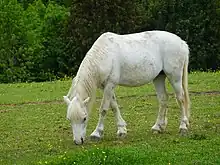
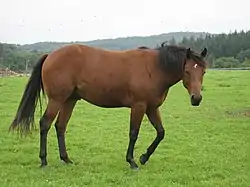
- horse (animal)
- подъ нимъ конь сивъ, а другий конь на поводе ― (please add an English translation of this usage example)
- за конꙗ албо за кобылу три рꙋбли грошеⸯ ― (please add an English translation of this usage example)
Descendants
Further reading
- Hrynchyshyn, D. H., editor (1977), “конь, kon”, in Словник староукраїнської мови XIV–XV ст. [Dictionary of the Old Ukrainian Language of the 14ᵗʰ – 15ᵗʰ cc.] (in Ukrainian), volume 1 (А – М), Kyiv: Naukova Dumka, page 494
- Voitiv, H. V., editor (2008), “конъ; конь”, in Словник української мови XVI – I пол. XVII ст. [Dictionary of the Ukrainian Language: 16ᵗʰ – 1ˢᵗ half of 17ᵗʰ c.] (in Ukrainian), issue 14 (к – конъюрация), Lviv: KIUS, →ISBN, page 252
- Chikalo, M. I., editor (2010), “конь, кунъ”, in Словник української мови XVI – I пол. XVII ст. [Dictionary of the Ukrainian Language: 16ᵗʰ – 1ˢᵗ half of 17ᵗʰ c.] (in Ukrainian), issue 15 (конь – легковѣрны), Lviv: KIUS, →ISBN, page 3
- Chikalo, M. I., editor (2010), “кунь; конь”, in Словник української мови XVI – I пол. XVII ст. [Dictionary of the Ukrainian Language: 16ᵗʰ – 1ˢᵗ half of 17ᵗʰ c.] (in Ukrainian), issue 15 (конь – легковѣрны), Lviv: KIUS, →ISBN, page 182
- Bulyka, A. M., editor (1996), “конь”, in Гістарычны слоўнік беларускай мовы [Historical Dictionary of the Belarusian Language] (in Belarusian), issue 15 (катъ – коречный), Minsk: Belaruskaia navuka, →ISBN, page 288
Russian
Etymology
Inherited from Old East Slavic конь (konĭ), from Proto-Slavic *kòňь.
Pronunciation
- IPA(key): [konʲ]
Audio (file)
Noun
конь • (konʹ) m anim (genitive коня́, nominative plural ко́ни, genitive plural коне́й, related adjective ко́нный or ко́нский, diminutive конёк or ко́ник)
Usage notes
Although конь (konʹ) is sometimes used to refer to a horse of any gender, it has a masculine and noble ring to it, unlike the stylistically neutral ло́шадь (lóšadʹ).
Declension
Related terms
- конезаво́д (konezavód), кони́на (konína), конник (konnik), конова́л (konovál), коновязь (konovjazʹ), конокрад (konokrad), ко́нюх (kónjux), конюший (konjušij)