пищов
Bulgarian
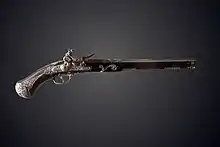
Старовременен пищов
Alternative forms
- плющо́в (pljuštóv), плищо́в (plištóv) – dialectal
- пищо́л (pištól), пищо́ль (pištólʹ) – dated
Etymology
Of onomatopoeic nature, morphologically from пищя́ (pištjá, “to squeak, to scream”) + -ов (-ov), named so due to the shrill sound produced by early fireguns. Merged with dialectal reflexes of Ottoman Turkish پيستول (“pistol”) (of French or German origin), cognate with Romanian pișcol (colloquial), Greek πιστόλι (pistóli)).
Pronunciation
- IPA(key): [piʃˈtɔf]
Noun
пищо́в • (pištóv) m
- pistol, handgun
- (colloquial, figurative) cheat sheet (summary of notes written on a small piece of paper, used as a cheat during written tests)
Usage notes
Typically, referring to old-fashioned handguns.
Declension
Declension of пищо́в
| singular | plural | |
|---|---|---|
| indefinite | пищо́в pištóv |
пищо́ви pištóvi |
| definite (subject form) |
пищо́вът pištóvǎt |
пищо́вите pištóvite |
| definite (object form) |
пищо́ва pištóva | |
| count form | — | пищо́ва pištóva |
Derived terms
- разпищо́вя се (razpištóvja se, “to feast, to celebrate loudly”) (figuratively)
Related terms
- пище́ (pišté, “sparrow, tit”) (dialectal)
- пи́ска (píska), писка́ло (piskálo), писку́н (piskún), пищя́лка (pištjálka, “whistle, hooter”)
- пищя́л (pištjál, “tibia bone”) (originally: “pipe, flute”)
- писка́л (piskál), писка́вец (piskávec, “cyprinid gudgeon”) (dialectal)
- пистоле́т (pistolét, “pistol”) (French borrowing of Slavic origin)
References
- пищов in Rečnik na bǎlgarskija ezik (Institut za bǎlgarski ezik)
- пищов in Rečnik na bǎlgarskija ezik (Čitanka.Info)
- Duridanov I., Račeva M., Todorov T., editor (1996), “пищов”, in Български етимологичен речник [Bulgarian Etymological Dictionary] (in Bulgarian), volume 5, Sofia: Bulgarian Academy of Sciences, page 279
This article is issued from Wiktionary. The text is licensed under Creative Commons - Attribution - Sharealike. Additional terms may apply for the media files.