ҡутыр
Bashkir
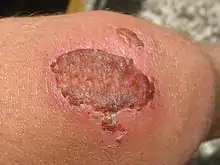
Ҡутыр
Etymology
From Proto-Turkic *kotur (“scab, mange”)[1].
Cognate with Old Uyghur [script needed] (qotur, “scab, mange”)[2]; Tatar кутыр (qutır), Kazakh қотыр (qotyr, “scab, mange”), Kyrgyz котур (kotur, “scab, mange”), Uzbek qo'tir (“scabies”), Uyghur قوتۇر (qotur, “scabies”), Khakas ходыр (xodır, “scabies, scab, mange”), Tuvan кодур (kodur, “scabies, scab, mange”), Turkmen gotur (“scabies, scab, mange”).
Pronunciation
- IPA(key): [quˈtɯ̞r]
- Hyphenation: ҡу‧тыр
Noun
ҡутыр • (qutır)
- scab; an incrustation over a sore, wound, vesicle, or pustule, formed during healing.
Declension
Inflection of ҡутыр (qutır)
| singular | plural | |
|---|---|---|
| absolute | ҡутыр (qutır) | ҡутырҙар (qutırðar) |
| definite genitive | ҡутырҙың (qutırðıŋ) | ҡутырҙарҙың (qutırðarðıŋ) |
| dative | ҡутырға (qutırğa) | ҡутырҙарға (qutırðarğa) |
| definite accusative | ҡутырҙы (qutırðı) | ҡутырҙарҙы (qutırðarðı) |
| locative | ҡутырҙа (qutırða) | ҡутырҙарҙа (qutırðarða) |
| ablative | ҡутырҙан (qutırðan) | ҡутырҙарҙан (qutırðarðan) |
References
- Starostin, Sergei; Dybo, Anna; Mudrak, Oleg (2003), “*Kotur”, in Etymological dictionary of the Altaic languages (Handbuch der Orientalistik; VIII.8), Leiden, New York, Köln: E.J. Brill
- Nadeljajev, V. M.; Nasilov, D. M.; Tenišev, E. R.; Ščerbak, A. M., editors (1969) Drevnetjurkskij slovarʹ [Dictionary of Old Turkic] (in Russian), Leningrad: USSR Academy of Sciences, Nauka, page 461
This article is issued from Wiktionary. The text is licensed under Creative Commons - Attribution - Sharealike. Additional terms may apply for the media files.