دیكن
Ottoman Turkish
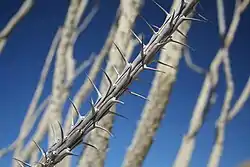
دیكنلر
Alternative forms
- دكن (diken)
Etymology
Inherited from Proto-Turkic *teken, *tikgen, itself from the root *tik- (“to stick something sharp or pointed, to stab; to sew”). From the same root are دیكمك (dikmek, “to sew, stitch”), دیكمه (dikme, “prop or shore”) and دیكیش (dikiş, “stitch, seam, splice”).
Noun
دیكن • (diken)
Derived terms
- آری دیكنی (arı dikeni, “stinger”)
- اشك دیكنی (eşek dikeni, “cotton thistle”)
- بوغا دیكنی (boğa dikeni, “milk thistle”)
- دوه دیكنی (deve dikeni, “camelthorn”)
- دیكنسز (dikensiz, “thornless, spineless”)
- دیكنلك (dikenlik, “plant with many thorns”)
- دیكنلنمك (dikenlenmek, “to become a thorn”)
- دیكنلو (dikenli, “thorny, prickly”)
Descendants
- Turkish: diken
Further reading
- Çağbayır, Yaşar (2007), “diken”, in Ötüken Türkçe Sözlük (in Turkish), volume 1, Istanbul: Ötüken Neşriyat, page 1214
- Kélékian, Diran (1911), “دیكن”, in Dictionnaire turc-français, Constantinople: Mihran, page 599
- Meninski, Franciszek à Mesgnien (1687), “Spina”, in Complementum thesauri linguarum orientalium, seu onomasticum latino-turcico-arabico-persicum, simul idem index verborum lexici turcico-arabico-persici, quod latinâ, germanicâ, aliarumque linguarum adjectâ nomenclatione nuper in lucem editum, Vienna, column 1583
- Meninski, Franciszek à Mesgnien (1680), “دیكن”, in Thesaurus linguarum orientalium, Turcicae, Arabicae, Persicae, praecipuas earum opes à Turcis peculiariter usurpatas continens, nimirum Lexicon Turkico-Arabico-Persicum, Vienna, columns 2215–2216
- Nişanyan, Sevan (2002–), “diken”, in Nişanyan Sözlük
- Redhouse, James W. (1890), “دیكن”, in A Turkish and English Lexicon, Constantinople: A. H. Boyajian, page 938
This article is issued from Wiktionary. The text is licensed under Creative Commons - Attribution - Sharealike. Additional terms may apply for the media files.