䯎
| ||||||||
| ||||||||
Translingual
Alternative forms
- In mainland China, the right component is written ⿱𠆢干, which is the historical form found in the Kangxi dictionary.
- In Taiwan, the right component is written ⿱八干 instead.
Han character
䯎 (Kangxi radical 188, 骨+5, 15 strokes in traditional Chinese, 14 strokes in mainland China, cangjie input 月月金一十 (BBCMJ) or 月月人一十 (BBOMJ), composition ⿰骨𫢉(G) or ⿰骨⿱八干(T))
References
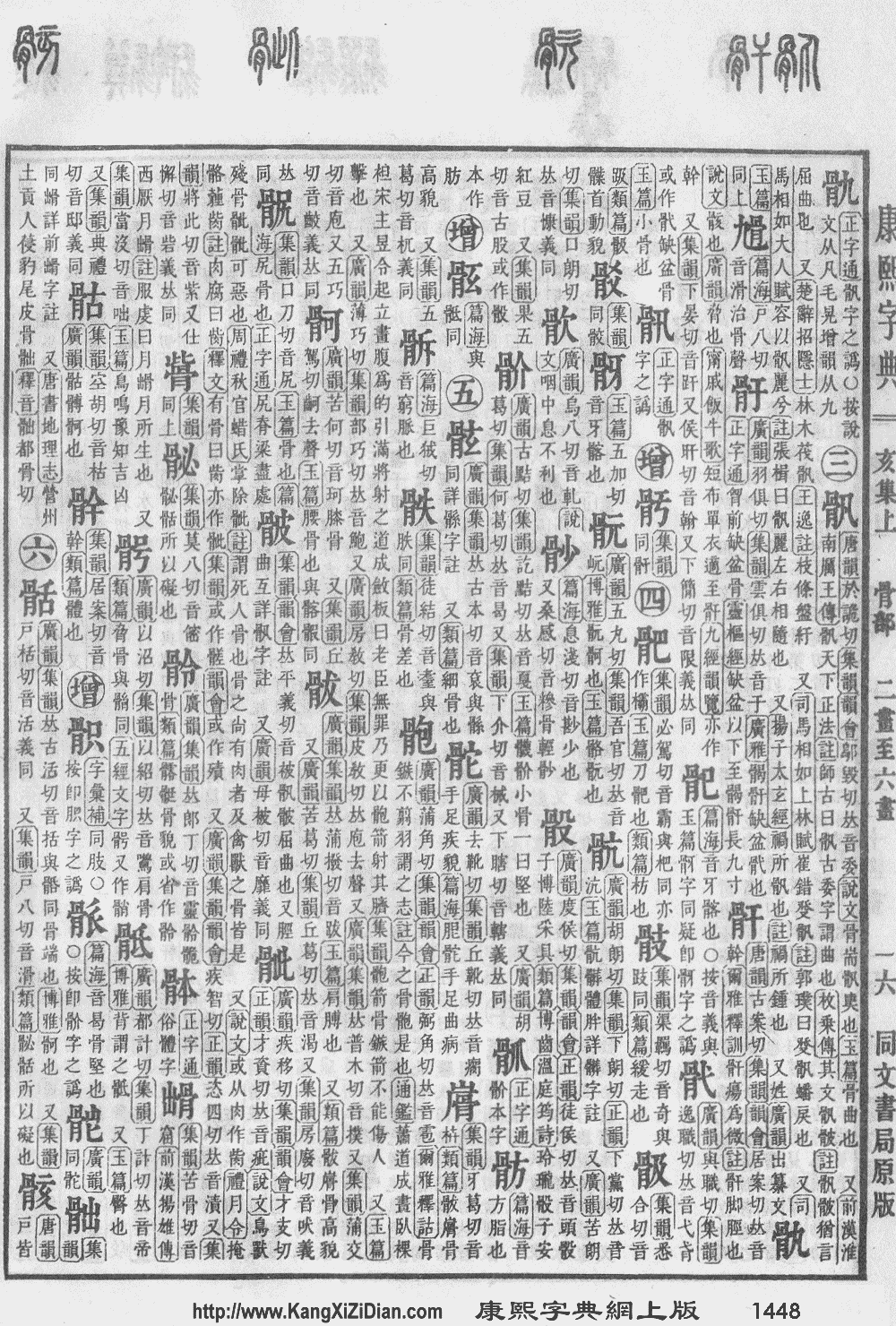
- KangXi: page 1448, character 44
- Hanyu Da Zidian (first edition): volume 7, page 4409, character 14
- Unihan data for U+4BCE
- Unihan data for U+2FA08
Chinese
Glyph origin
- Etymology 1
- Found in the Zuo zhuan 《左傳》 (Commentary on the Spring and Autumn Annals) from the 4th century BC.
- Etymology 2
- Found in the Longkan Shoujian 《龍龕手鑑》 dictionary compiled in 997 AD.
This article is issued from Wiktionary. The text is licensed under Creative Commons - Attribution - Sharealike. Additional terms may apply for the media files.