懐剣
Japanese
| Kanji in this term | |
|---|---|
| 懐 | 剣 |
| かい Grade: S |
けん Grade: S |
| kan’on | |
| Alternative spelling |
|---|
| 懷劍 (kyūjitai) |
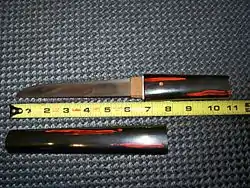
懐剣 (kaiken): a traditional Japanese kaiken or hidden dagger, with a blade of roughly six inches or 15 centimeters.
Etymology
/kwaiken/ → /kaiken/
Appears to be a coinage in Japanese of Middle Chinese-derived roots, as a compound of 懐 (kai, “bosom; the chest area of a kimono above the 帯 (obi, “sash”) and inside the collar”) + 剣 (ken, “sword”). Appears in texts from the 1300s.[1]
Noun
懐剣 • (kaiken) ←くわいけん (kwaiken)?
- (historical) a kind of dagger used by the samurai class, carried in the 懐 (futokoro, “chest area of a kimono above the 帯 (obi, “sash”) and inside the collar”) for self-defense
- Synonyms: 懐刀 (futokoro-gatana), 一尺三寸 (isshaku sanzun)
- (modern) a replica dagger as part of certain ceremonial costume, such as the formal wear of boys for the 七五三 (shichi-go-san, “seven-five-three”) festival
- Synonyms: 懐刀 (futokoro-gatana), 一尺三寸 (isshaku sanzun)
- (poetry) working on possible response lines for a 連歌 (renga, “linked poem”), 俳諧 (haikai, “amusing style of waka Japanese poetry”), or similar call and response style of performed poetry, prior to a performance; any lines prepared before such a performance
Coordinate terms
- see Thesaurus:短刀
References
- 1988, 国語大辞典(新装版) (Kokugo Dai Jiten, Revised Edition) (in Japanese), Tōkyō: Shogakukan
- 2006, 大辞林 (Daijirin), Third Edition (in Japanese), Tōkyō: Sanseidō, →ISBN
This article is issued from Wiktionary. The text is licensed under Creative Commons - Attribution - Sharealike. Additional terms may apply for the media files.