脇差
Japanese
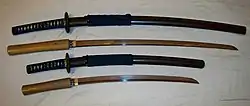
脇差: a wakizashi (with both full koshirae and simpler shirasaya) below a katana (also with koshirae and shirasaya), showing the difference in size.
| Kanji in this term | |
|---|---|
| 脇 | 差 |
| わき Grade: S |
さ(し) > ざ(し) Grade: 4 |
| kun’yomi | |
Etymology
Compound of 脇 (waki, “armpit, side of the torso”) + 差 (sashi, the 連用形 (ren'yōkei, “continuative or stem form”) of verb 差す sasu “to insert, to stick into”), from the way the wakizashi would be stuck at one's side through the 帯 (obi, “belt or sash”).[1] The sashi changes to zashi as an instance of rendaku (連濁).
Noun

Coordinate terms
References
- 1988, 国語大辞典(新装版) (Kokugo Dai Jiten, Revised Edition) (in Japanese), Tōkyō: Shogakukan
- 2006, 大辞林 (Daijirin), Third Edition (in Japanese), Tōkyō: Sanseidō, →ISBN
This article is issued from Wiktionary. The text is licensed under Creative Commons - Attribution - Sharealike. Additional terms may apply for the media files.