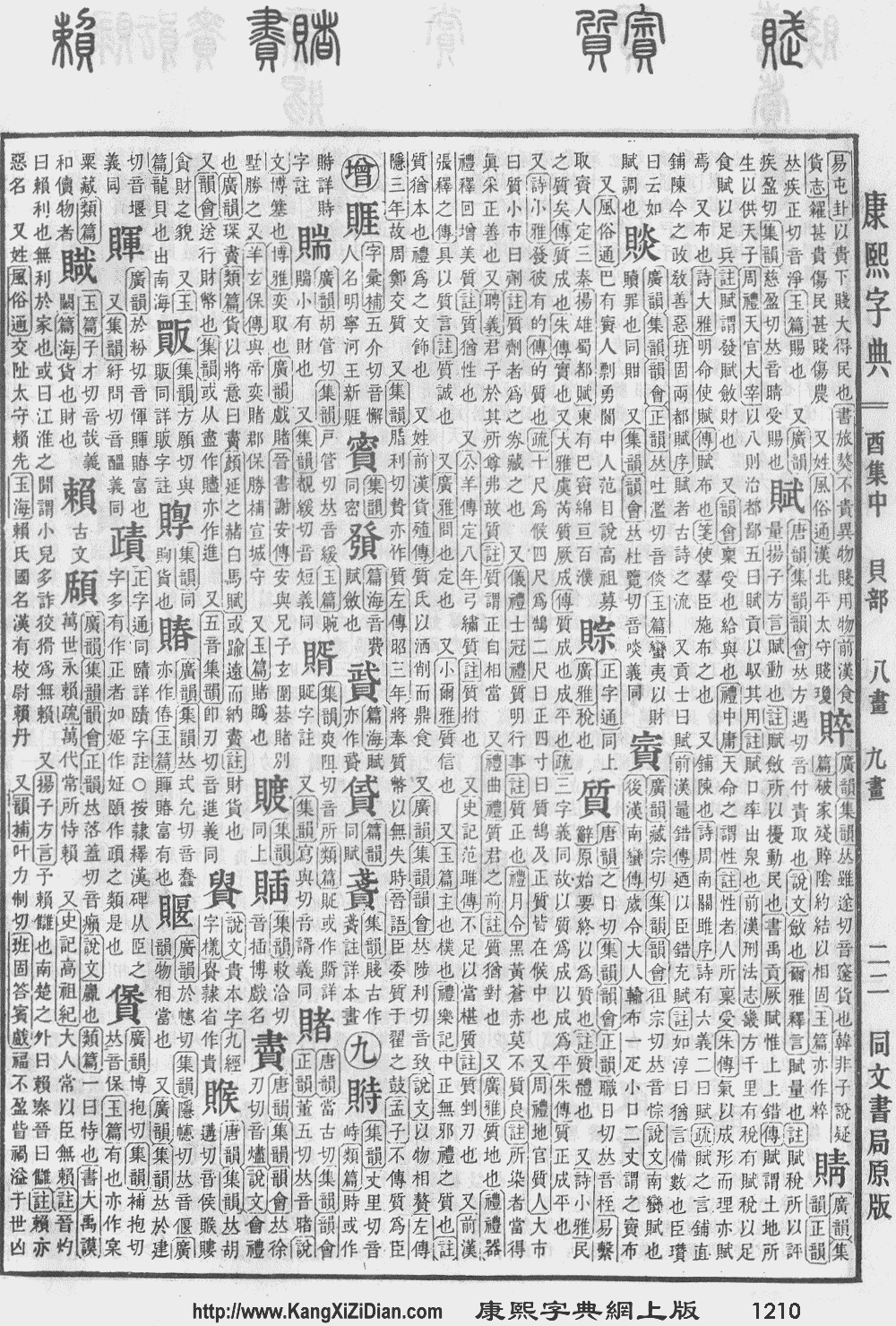
賦

See also: 赋
賦 U+8CE6, 賦
CJK UNIFIED IDEOGRAPH-8CE6
← 賥
[U+8CE5]
CJK Unified Ideographs 賧 →
[U+8CE7]

Translingual

Han character

賦 (Kangxi radical 154, 貝+8, 15 strokes, cangjie input 月金一心一 (BCMPM), four-corner 63840, composition ⿰貝武)

Derived characters

  • 𫂩

References

Chinese

trad. 賦
simp. 赋
alternative forms 䝾

Glyph origin

Historical forms of the character 賦
Western Zhou Warring States Shuowen Jiezi (compiled in Han) Liushutong (compiled in Ming)
Bronze inscriptions Chu slip and silk script Small seal script Transcribed ancient scripts

Pronunciation


Rime
Character 賦
Reading # 1/1
Initial (聲) 幫 (1)
Final (韻) 虞 (24)
Tone (調) Departing (H)
Openness (開合) Closed
Division (等) III
Fanqie 方遇切
Reconstructions
Zhengzhang
Shangfang
/pɨoH/
Pan
Wuyun
/pioH/
Shao
Rongfen
/pioH/
Edwin
Pulleyblank
/puə̆H/
Li
Rong
/pioH/
Wang
Li
/pĭuH/
Bernard
Karlgren
/pi̯uH/
Expected
Mandarin
Reflex
fù
Expected
Cantonese
Reflex
fu3
Baxter–Sagart system 1.1 (2014)
Character 賦 賦
Reading # 1/2 2/2
Modern
Beijing
(Pinyin)
fù fù
Middle
Chinese
‹ pjuH › ‹ pjuH ›
Old
Chinese
/*p(r)a-s/ /*p(r)a-s/
English tax ballad

Notes for Old Chinese notations in the Baxter–Sagart system:

* Parentheses "()" indicate uncertain presence;
* Square brackets "[]" indicate uncertain identity, e.g. *[t] as coda may in fact be *-t or *-p;
* Angle brackets "<>" indicate infix;
* Hyphen "-" indicates morpheme boundary;

* Period "." indicates syllable boundary.
Zhengzhang system (2003)
Character 賦
Reading # 1/1
No. 13182
Phonetic
component
武
Rime
group
魚
Rime
subdivision
0
Corresponding
MC rime
付
Old
Chinese
/*mpas/

Definitions

賦

  1. to bestow upon; to give
  2. to compose or sing
  3. to spread; to disseminate
  4. to collect; to impose; to levy
  5. taxation; revenue
  6. natural endowment
  7. fu, a literature form developed during the Han dynasty that combines prose and poetry, sometimes translated as ode or rhapsody

Compounds

Japanese

Kanji

賦

(common “Jōyō” kanji)

  1. levy
  2. ode
  3. prose

Readings

Etymology

Kanji in this term
賦
ふ
Grade: S
on’yomi

Pronunciation

Noun

賦(ふ) • (fu) 

  1. fu (Chinese literary form developed during the times of the Han dynasty that combines prose and poetry)

References

  1. 2006, 大辞林 (Daijirin), Third Edition (in Japanese), Tōkyō: Sanseidō, →ISBN

Korean

Etymology

From Middle Chinese 賦 (MC pɨoH).

Hanja

賦 (eumhun 부세 부 (buse bu))

  1. Hanja form? of 부 (“tax”).
  2. Hanja form? of 부 (“give, endow, bestow”).

Vietnamese

Han character

賦: Hán Nôm readings: phú

  1. This term needs a translation to English. Please help out and add a translation, then remove the text {{rfdef}}.
This article is issued from Wiktionary. The text is licensed under Creative Commons - Attribution - Sharealike. Additional terms may apply for the media files.