Ganymede
English
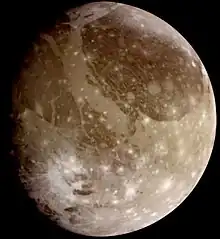
The moon Ganymede.
Etymology
From Ancient Greek Γανυμήδης (Ganumḗdēs, “meant to please”), from γάνυμαι (gánumai, “I rejoice, I am glad”) + μήδεα (mḗdea, “thought, intention”). Doublet of catamite.
Pronunciation
- IPA(key): /ˈɡænɪmiːd/
Proper noun
Ganymede
Derived terms
Translations
in Greek mythology
|
satellite of Jupiter
|
See also
| Solar System in English · Solar System (layout · text) | ||||||||||||||||||
|---|---|---|---|---|---|---|---|---|---|---|---|---|---|---|---|---|---|---|
| Star | Sun | |||||||||||||||||
| IAU planets and notable dwarf planets |
Mercury | Venus | Earth | Mars | Ceres | Jupiter | Saturn | Uranus | Neptune | Pluto | Eris | |||||||
| Notable moons |
— | — | Moon | Phobos Deimos |
— | Io Europa Ganymede Callisto |
Mimas Enceladus Tethys Dione Rhea Titan Iapetus |
Miranda Ariel Umbriel Titania Oberon |
Triton | Charon | Dysnomia | |||||||
Noun
Ganymede (plural Ganymedes)
- A servant boy or young waiter, particularly one who serves liquor.
- A boy kept for pederastic purposes; a catamite.
Further reading
 Ganymede (mythology) on Wikipedia.Wikipedia
- Ganymede (moon) on Wikipedia.Wikipedia
Anagrams
This article is issued from Wiktionary. The text is licensed under Creative Commons - Attribution - Sharealike. Additional terms may apply for the media files.