briedis
Latvian
Etymology
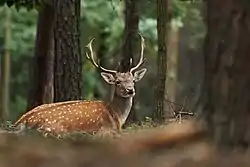
From Proto-Baltic *breid-, *bried-, from Proto-Indo-European *bʰreydʰ-, together with a variant *bʰrent-, both from the stem *bʰer (“to swell”) (whence also briest (“to swell”), q.v.). The meaning apparently changed as follows: “swollen, big” > “having a big, well-developed body” > “strong, imposing (animal).” At first this word apparently referred to elks, and only later to deer; the meaning “elk” is still found in folklore. Cognates include Lithuanian bríedis (“elk”), Old Prussian braydis (“elk”) (< *breidis), Sudovian brid (“deer”), Elfdalian brinde (“elk”), Messapic brénthon (“elk, deer”) (< *brénton), [1] Messapic bréndon (“deer”), Albanian bri (“horn, antler”), Thracian toponym Brendike, Swedish brinde (“elk”).[2][3]
Pronunciation
- IPA(key): [bɾiɛ̂dis]
Audio (file)
Noun
briedis m (2nd declension)
Declension
| singular (vienskaitlis) | plural (daudzskaitlis) | |
|---|---|---|
| nominative (nominatīvs) | briedis | brieži |
| accusative (akuzatīvs) | briedi | briežus |
| genitive (ģenitīvs) | brieža | briežu |
| dative (datīvs) | briedim | briežiem |
| instrumental (instrumentālis) | briedi | briežiem |
| locative (lokatīvs) | briedī | briežos |
| vocative (vokatīvs) | briedi | brieži |
Derived terms
References
- Karulis, Konstantīns (1992), “briedis”, in Latviešu Etimoloģijas Vārdnīca (in Latvian), Rīga: AVOTS, →ISBN
- Orel, Vladimir. Albanian Etymological Dictionary. Leiden, Netherlands: Brill, 1998.
- Orel, Vladimir. A Concise Historical Grammar of the Albanian Language: Reconstruction of Proto-Albanian. Leiden, Netherlands: Brill, 2000.