Cloxacillin
 | |
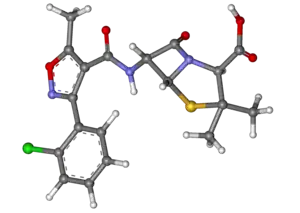 | |
| Names | |
|---|---|
| Trade names | Cloxapen, others |
IUPAC name
| |
| Clinical data | |
| Pregnancy category |
|
| Routes of use | By mouth, IM |
| Defined daily dose | 2 gm[1] |
| External links | |
| AHFS/Drugs.com | Micromedex Detailed Consumer Information |
| US NLM | Cloxacillin |
| Pharmacokinetics | |
| Bioavailability | 37 to 90% |
| Protein binding | 95% |
| Elimination half-life | 30 minutes to 1 hour |
| Excretion | Kidney and biliary |
| Chemical and physical data | |
| Formula | C19H18ClN3O5S |
| Molar mass | 435.88 g·mol−1 |
| 3D model (JSmol) | |
SMILES
| |
InChI
| |

Cloxacillin is an antibiotic useful for the treatment of a number of bacterial infections.[2] This includes impetigo, cellulitis, pneumonia, septic arthritis, and otitis externa.[2] It is not effective for methicillin-resistant Staphylococcus aureus (MRSA).[3] It is used by mouth and by injection.[2]
Side effects include nausea, diarrhea, and allergic reactions including anaphylaxis.[2] Clostridium difficile diarrhea may also occur.[3] It is not recommended in people who have previously had a penicillin allergy.[2] Use during pregnancy appears to be relatively safe.[2] Cloxacillin is in the penicillin family of medications.[3]
Cloxacillin was patented in 1960 and approved for medical use in 1965.[4] It is on the World Health Organization's List of Essential Medicines.[5] The wholesale cost in the developing world is about US$0.16 per day for the pills.[6] It is not commercially available in the United States.[3]
Medical uses
Dosage
The defined daily dose is 2 gm by mouth and by injection.[1] In adults the typical dose is 1 gram three times per day by mouth while in children over the age of 10 the dose is 15 mg/kg three times per day.[7] Treatment duration for impetigo is 7 days.[7]
The injectable form is typically given as 2 gm every 6 hours in adults, though 3 grams every 6 hours may be used for certain cases.[8] In children over a month the dose is 25 to 50 mg/kg by injection every six hours.[8] When the injectable form is no longer required, switching to oral cloxacillin is not recommended. People should instead be switched from the injectable treatment to either oral cephalexin or amoxicillin/clavulanic acid as soon as possible, to complete the treatment course.[8]
For erysipelas and cellulitis, the doses of cloxacillin is usually half that for severe infections.[8]
| Age category | Weight (kg) | By mouth | By injection over 60 min (500 mg vial, diluted in 4 ml, 125 mg/ml) |
|---|---|---|---|
| 1 to 3 mths | 4 to 6 | 1 ml 4 times/day[8] | |
| 3 to 12 mths | 6 to 10 | 2 ml 4 times/day[8] | |
| 1 to 5 yrs | 10 to 20 | 4 ml 4 times/day[8] | |
| 5 to 8 yrs | 20 to 28 | 8 ml 4 times/day[8] | |
| 8 to 12 yrs | 28 to 38 | 12 ml 4 times/day[7] | |
| 12 to 13 yrs | 38 to 45 | 500 mg 3 times/day[7] | 16 ml 4 times/day[8] |
| 13 to 15 yrs | 45 to 55 | 750 mg 3 times/day[7] | 16 ml 4 times/day[8] |
| Adult | ≥ 55 | 1 gm three 3 times/day[7] | 2 gm 4 times/day[8] |
Mechanism of action
It is semisynthetic and in the same class as penicillin.[9] Cloxacillin is used against staphylococci that produce beta-lactamase. Cloxacillin's side chain acts as a barrier to the bacteria's enzyme and it works by breaking down the bacterial cell wall. Its absorption is reduced by food.[10] Staph. aureus has shown resistance to cloxacillin, hence requiring alternative antibiotics.[10]
Society and culture
Beecham (now GlaxoSmithKline) discovered and developed cloxacillin by making modifications to methicillin in the early 1960s.[9]
Cloxacillin is sold under a number of trade names, including Cloxapen,[11] Cloxacap,[12] Tegopen,[13] and commonly for veterinary use, Orbenin.[14] It is not commercially available in the United States.[3] It is available in Canada.[10]
See also
References
- 1 2 "WHOCC - ATC/DDD Index". www.whocc.no. Archived from the original on 21 January 2021. Retrieved 30 August 2020.
- 1 2 3 4 5 6 World Health Organization (2009). Stuart MC, Kouimtzi M, Hill SR (eds.). WHO Model Formulary 2008. World Health Organization. pp. 98, 100, 110–111, 586, 602, 614, 623. hdl:10665/44053. ISBN 9789241547659.
- 1 2 3 4 5 "Cloxacillin (Professional Patient Advice)". www.drugs.com. Archived from the original on 20 December 2016. Retrieved 10 December 2016.
- ↑ Fischer, Janos; Ganellin, C. Robin (2006). Analogue-based Drug Discovery. John Wiley & Sons. p. 490. ISBN 9783527607495. Archived from the original on 2016-12-20.
- ↑ World Health Organization (2019). World Health Organization model list of essential medicines: 21st list 2019. Geneva: World Health Organization. hdl:10665/325771. WHO/MVP/EMP/IAU/2019.06. License: CC BY-NC-SA 3.0 IGO.
- ↑ "Cloxacillin Sodium". International Drug Price Indicator Guide. Archived from the original on 25 August 2018. Retrieved 8 December 2016.
- 1 2 3 4 5 6 "Cloxacillin oral - Essential drugs". medicalguidelines.msf.org. Archived from the original on 29 August 2021. Retrieved 30 August 2020.
- 1 2 3 4 5 6 7 8 9 10 11 "Cloxacillin injectable - Essential drugs". medicalguidelines.msf.org. Archived from the original on 29 August 2021. Retrieved 1 September 2020.
- 1 2 David Greenwood (2008). Antimicrobial drugs: chronicle of a twentieth century medical triumph. Oxford University Press US. pp. 124–. ISBN 978-0-19-953484-5. Archived from the original on 6 June 2013. Retrieved 18 November 2010.
- 1 2 3 Sealock, Kara; Seneviratne, Cydnee; Lilley, Linda Lane; Collins, Shelly Rainforth; Snyder, Julie S. (2021). "43. Antibiotics Part 1. Sulfonamides, penicillins, cephalosporins, macrocodes and tetracyclines". Lilley's Pharmacology for Canadian Health Care Practice - E-Book (4th ed.). Elsevier. pp. 700–701. ISBN 978-0-323-69480-3. Archived from the original on 2021-08-29. Retrieved 2020-12-30.
- ↑ "Cloxapen". pubchem.ncbi.nlm.nih.gov. Archived from the original on 29 August 2021. Retrieved 30 December 2020.
- ↑ "Cloxacap Full Prescribing Information, Dosage & Side Effects | MIMS Singapore". www.mims.com. Archived from the original on 2021-08-29. Retrieved 2020-12-30.
- ↑ "Tegopen Drug Interactions". Drugs.com. Archived from the original on 12 August 2020. Retrieved 30 December 2020.
- ↑ "Orbenin". Drugs.com. Archived from the original on 12 August 2020. Retrieved 30 December 2020.
External links
| External sites: |
|
|---|---|
| Identifiers: |