Portal:East Germany

"Gruß" and welcome!
The East Germany portal offers an overview of the most important and newest articles on the subject of East Germany, the former Communist state officially known as the German Democratic Republic or GDR The portal contains links to a cross-section of articles from the areas of history and politics, geography and economy, art and culture, and some of the important personalities from the region.
Introduction
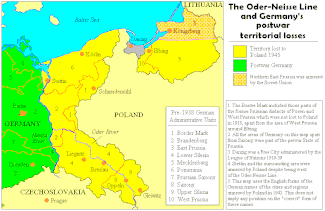
East Germany (German: Ostdeutschland), officially the German Democratic Republic (GDR; Deutsche Demokratische Republik, pronounced [ˈdɔʏtʃə demoˈkʁaːtɪʃə ʁepuˈbliːk] ⓘ, DDR), was a country in Central Europe that existed from its creation on 7 October 1949 until its dissolution on 3 October 1990. Until 1989, it was generally viewed as a communist state, and it described itself as a socialist "workers' and peasants' state". Before its establishment, the country's territory was administered and occupied by Soviet forces with the autonomy of the native communists following the Berlin Declaration abolishing German sovereignty in World War II; when the Potsdam Agreement established the Soviet-occupied zone, bounded on the east by the Oder–Neisse line. The GDR was dominated by the Socialist Unity Party of Germany (SED), a communist party from 1949 to 1989, before being democratized and liberalized under the impact of the Revolutions of 1989 against the communist states, helping East Germany be united with the West. Unlike West Germany, SED did not see its state as the successor of the German Reich (1871–1945) and abolished the goal of unification in the constitution (1974). Under the SED rule, GDR was often judged as a Soviet satellite state; Western scholars and academics described it as a totalitarian regime. The GDR was established in the Soviet-occupied zone of former Nazi Germany (1933–1945) by the SED on 7 October 1949, while the Federal Republic of Germany (FRG) (preceded by the fragmentary self-governance of West German politicians), commonly referred to as West Germany, was established as a liberal democracy in the three Western US–UK–French occupied zones before. It was a satellite state of the Soviet Union. Soviet occupation authorities began transferring administrative responsibility to German communist leaders in 1948 and the GDR began to function as an independent state on 7 October 1949, gaining nearly full sovereignty from the Soviet Union in 1955, although the Soviet Union maintained troops in and substantial political influence over the country. In 1972, East Germany was recognized by West Germany and vice versa as well as these two German independent countries together became two separate members of the United Nations the following year. Until 1989, the GDR was governed by the Socialist Unity Party of Germany, a communist party founded in the Soviet-occupied zone in 1946; although other parties nominally participated in its alliance organization, the National Front of the German Democratic Republic. The SED made the teaching of Marxism–Leninism and the Russian language compulsory in schools in the GDR. (Full article...) | ||||
|
Selected article -
 Berlin Wall falls at the Brandenburg Gate, 10 November 1989 The Peaceful Revolution (German: Friedliche Revolution), as a part of the Revolutions of 1989, was the process of sociopolitical change that led to the opening of East Germany's borders with the West, the end of the ruling of the Socialist Unity Party of Germany (SED) in the German Democratic Republic (GDR or "East Germany") in 1989 and the transition to a parliamentary democracy, which later enabled the reunification of Germany in October 1990. This happened through non-violent initiatives and demonstrations. This period of change is referred to in German as Die Wende (German pronunciation: [diː ˈvɛndə], "the turning point"). These events were closely linked to Soviet leader Mikhail Gorbachev's decision to abandon Soviet hegemony in Eastern Europe as well as the reformist movements that spread through Eastern Bloc countries. In addition to the Soviet Union's shift in foreign policy, the GDR's lack of competitiveness in the global market, as well as its sharply rising national debt, hastened the destabilization of the SED's one-party state. Those driving the reform process within the GDR included intellectuals and church figures who had been in underground opposition for several years, people attempting to flee the country, and peaceful demonstrators who were no longer willing to yield to the threat of violence and repression. (Full article...)Geography and nature
 East German administrative divisions or Bezirke The German Democratic Republic, which consisted geographically of what is now eastern Germany, had an area of 107,771 km2 (41,610 mi2), bordering Czechoslovakia in the south, West Germany in the south and west, the Baltic Sea to the north, and Poland in the east. Much of the territory of the former East Germany lay on the North German Plain and was largely flat and agricultural apart from low morainic hills left by the ice age. However in the south the land rose to the Ore Mountains and Elbe Sandstone Mountains that formed the border with its Communist neighbour, Czechoslovakia. Administration divisions (Bezirke): Berlin – Cottbus – Dresden – Erfurt – Frankfurt (Oder) – Gera – Halle – Karl-Marx-Stadt – Leipzig – Magdeburg – Neubrandenburg – Potsdam – Rostock – Schwerin – Suhl Cities and towns: Altenburg – Apolda – Bautzen – Brandenburg/Havel – Cottbus – Dessau – Dresden – Eberswalde – Eisenach – Stalinstadt/Eisenhüttenstadt – Erfurt – Frankfurt (Oder) – Freiberg – Gera – Görlitz – Gotha – Greifswald – Halberstadt – Halle – Halle-Neustadt – Hoyerswerda – Jena – Chemnitz/Karl-Marx-Stadt – Leipzig – Magdeburg – Merseburg – Neubrandenburg – Plauen – Potsdam – Rostock – Schwedt – Schwerin – Stralsund – Suhl – Weimar – Wismar – Wittenberg – Zittau – Zwickau Rivers and canals: Elbe – Gera - Havel – Neiße – Oder – Saale – Spree – Unstrut – White Elster – Black Elster – Mittelland Canal – Werra Waterbodies: Müritz – Schweriner See – Plauer See – Kummerower See – Scharmützelsee – Werbellinsee – Großer Müggelsee – Bay of Greifswald – Oderhaff Islands: Rügen – Poel – Usedom – Hiddensee – Greifswalder Oie Mountain and hill ranges: Ore Mountains – Harz – Elbe Sandstone Mountains – Thuringian Forest – Thuringian Highland – Vogtland – Kyffhäuser – Rhön – Zittau Mountains Regions: Dresden Elbe Valley – Lusatia – Spreewald – Mecklenburg Lake District – Barnim – Fläming – Magdeburg Börde – Altmark – Saxon Switzerland – Eichsfeld History, politics and religion
 Border installations at Marienborn History: 1953 Uprising – Dacha – Four Power Agreement on Berlin – Basic Treaty, 1972 – Permanent representative – Palace of the Republic – Begrüßungsgeld GDR border: Treaty of Zgorzelec – Berlin Wall – Inner German border – Border crossings – Berlin Friedrichstraße station – Checkpoint Charlie – Marienborn border crossing – Spring-gun – Republikflucht – Mindestumtausch Die Wende: Monday demonstrations – Social Democratic Party – 1990 General Election – Treuhand – Two Plus Four Agreement – Reunification (Einigungsvertrag) – Stasi Records Agency – Ostalgie  Logo of the Socialist Unity Party (SED) Politics: State flag – National Emblem – National hymn – Constitution – Volkskammer (People's Chamber) – State Council – Council of Ministers – National Front – Socialist Unity Party – Bloc party – Christian Democratic Union – Liberal Democratic Party – Democratic Farmers' Party – National Democratic Party – Administrative divisions (Bezirke) "Mass organisations": Free German Youth – Free German Trade Union Federation – Cultural Association of the GDR – Democratic Women's League of Germany – People's Solidarity – Society for German–Soviet Friendship – Ernst Thälmann Pioneer Organisation Armed bodies: National People's Army – Border Troops – Schießbefehl – Stasi – Hauptverwaltung Aufklärung (Main Directorate for Reconnaissance) – Volkspolizei – Combat Groups – Volksmarine – Armeegeneral – Marshal – Warsaw Pact – Construction soldier Other orders: Orders, decorations, and medals of East Germany – Banner of Labour – Order of Karl Marx – National Prize of the German Democratic Republic – Scharnhorst Order – Star of People's Friendship – Blücher Order .jpg.webp) Dresden's Roman Catholic Cathedral (the Hofkirche) at night Religion: Evangelical Church in Berlin, Brandenburg and Silesian Upper Lusatia – Evangelical Lutheran Church of Mecklenburg – Pomeranian Evangelical Church – Evangelical Church of the Church Province of Saxony– Evangelical Lutheran Church in Thuringia – Roman Catholic Archdiocese of Berlin – Roman Catholic Diocese of Dresden-Meissen – Roman Catholic Diocese of Erfurt – Roman Catholic Diocese of Görlitz – Roman Catholic Diocese of Magdeburg
Education, culture and sport
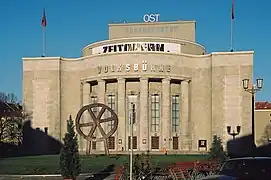
 Education and science: Education in East Germany – Academy of Sciences of the German Democratic Republic– Charité – Humboldt University of Berlin – Erweiterte Oberschule – Polytechnic Secondary School – Tierpark Berlin – Muttiheft Language: German – Berlinerisch – Sorbian Culture: Culture of East Germany – Classical Weimar Art: Theater am Schiffbauerdamm – Semperoper Architecture: Bauhaus World Heritage Site - Fernsehturm Berlin - Krämerbrücke - Plattenbau - Prora Music: List of classical composers – Ostrock Film: DEFA – DEFA Film Library - Kino International - List of films set in Berlin Places of interest: Dresden Castle – Sanssouci – Dessau-Wörlitz Garden Realm Cathedrals and churches: Berlin Cathedral – Erfurt Cathedral – Naumburg Cathedral  Museums and collections: DDR Museum - German Hygiene Museum - Memorial and Education Centre Andreasstrasse - Museum Island – Old Synagogue (Erfurt) - Pergamon Museum - Stasi Museum - Tränenpalast Sport: List of football clubs – GDR Football Association – DDR-Oberliga – FDGB-Pokal – 1. FC Union Berlin – Berliner FC Dynamo – Dynamo Dresden – FC Carl Zeiss Jena – Red Bull Arena East German people
 Erich Mielke, Head of the Stasi Politicians: Benjamin – Bergmann-Pohl – Böhme – Dertinger – Dieckmann – Fechner – Gerlach – Götting – G. Gysi – Hager – H. Hoffmann – Th. Hoffmann – E. Honecker – M. Honecker – Keßler – Krack – Krenz – de Maizière – Maleuda – Mielke – Mittag – Modrow – Neumann – Norden – Schabowski – Schalck-Golodkowski – Sindermann – Stoph – Tisch – Ulbricht – Verner – M. Wolf – Wollweber – Zaisser Opposition and resistance: Bahro – Biermann – M. Birthler – Bohley – Brüsewitz – Eppelmann – Fuchs – Führer – Gauck – Havemann – Ullmann Scientists: von Ardenne Artists, playwrights, poets, writers: Andersen Nexø – Baierl – Brecht – Busch – Esche – Hacks – Heym – Kant – H. Müller – Noll – Plenzdorf – Anna Seghers – Strittmatter – Tübke – Weigel – Chr. Wolf – Womacka Athletes: Cierpinski – Emmrich – Geyer – Hoppe – Langhammer – Laser – Recknagel – Sammer – Täve Schur – Siegl – Sparwasser – Streich – Weißflog – Witt |
General images
The following are images from various East Germany-related articles on Wikipedia.
Quick start
 Wikimedia Commons has media related to East Germany.
Wikipedia in the local dialects
Category tree
Did you know?
... that Ostalgie is a German term referring to nostalgia for aspects of the old life in East Germany?
Image of the month
Related portals
Wanted articles
The following are wanted articles, related to East Germany, that exist on German Wikipedia, or are otherwise wanted.
| |||
|
Economy and transport
 An East German Deutsche Reichsbahn express locomotive, the Class 01.5 Finance: Mindestumtausch – Forum check – East German mark – Staatsbank Cuisine: Broiler – Ketwurst – Soljanka Media: Censorship in East Germany Newspapers and magazines: Berliner Zeitung – Neues Deutschland – Junge Welt – Der Morgen – Sputnik – Mosaik – FRÖSI Radio: Rundfunk der DDR – Berliner Rundfunk – Radio DDR 1 – Radio DDR 2 – Deutschlandsender – Radio Berlin International – DT64 Television: Fernsehen der DDR – Aktuelle Kamera – Sandmännchen – Der schwarze Kanal Cinema and films: DEFA – Solo Sunny – Die Legende von Paul und Paula – Traces of Stones – Bear Ye One Another's Burden Postal: Deutsche Post of the GDR Justice: Brandenburg-Görden Prison Transport: Alexanderplatz – Karl-Marx-Allee – Barkas – Interflug – Reichsbahn – Robur – Trabant – Wartburg Economy: Genex - Industrieverband Fahrzeugbau (IFA) – Intershop – Combine – Leipzig Trade Fair – Landwirtschaftliche Produktionsgenossenschaft (LPG) – Minol – ORWO – Pentacon – Planned economy - Praktica – Comecon – VEB Robotron – Kombinat Mikroelektronik Erfurt - SDAG Wismut – Treuhand – Volkseigener Betrieb (VEB) – Public property New and expanded articles
The following are articles, related to East Germany, added in the last six months.
All articles on East Germany are here;
Articles on East German people are here.
|
Wikimedia
The following Wikimedia Foundation sister projects provide more on this subject:
Discover Wikipedia using portals
| ||||