دوه
Ottoman Turkish
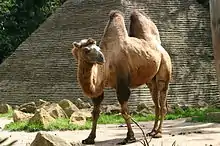
دوه
Etymology
Inherited from Proto-Turkic *tebe; cognate with Azerbaijani dəvə, Bashkir дөйә (döyä), Chuvash тӗве (tĕve), Kazakh түйе (tüie), Kyrgyz төө (töö), Turkmen düýe, Uyghur تۆگە (töge) and Uzbek tuya.
Derived terms
Descendants
Further reading
- Çağbayır, Yaşar (2007), “deve”, in Ötüken Türkçe Sözlük (in Turkish), volume 1, Istanbul: Ötüken Neşriyat, page 1185
- Kélékian, Diran (1911), “دوه”, in Dictionnaire turc-français, Constantinople: Mihran, page 593
- Meninski, Franciszek à Mesgnien (1687), “Camelus”, in Complementum thesauri linguarum orientalium, seu onomasticum latino-turcico-arabico-persicum, simul idem index verborum lexici turcico-arabico-persici, quod latinâ, germanicâ, aliarumque linguarum adjectâ nomenclatione nuper in lucem editum, Vienna, column 139
- Meninski, Franciszek à Mesgnien (1680), “دوه”, in Thesaurus linguarum orientalium, Turcicae, Arabicae, Persicae, praecipuas earum opes à Turcis peculiariter usurpatas continens, nimirum Lexicon Turkico-Arabico-Persicum, Vienna, columns 2195–2196
- Nişanyan, Sevan (2002–), “deve”, in Nişanyan Sözlük
- Redhouse, James W. (1890), “دوه”, in A Turkish and English Lexicon, Constantinople: A. H. Boyajian, page 929
Pashto
| < ١ | ٢ | ٣ > |
|---|---|---|
| Cardinal : دوه | ||
Etymology
From Proto-Pathan *dwa, from an ancestral Middle Iranian form *dwa[1], from Proto-Iranian *dwáH (compare Persian دو (do), Pashto دوه (dwa), Avestan 𐬛𐬎𐬎𐬀 (duua)), from Proto-Indo-Iranian *dwáH (compare Sanskrit द्व (dvá), Hindi दो (do)/Urdu دو (do), Punjabi ਦੋ (do)), from Proto-Indo-European *dwóh₁ (compare Russian два (dva), Lithuanian du, Greek δύο (dýo), Spanish dos, English two).
Pronunciation
- IPA(key): /dwa/
Audio (file)
References
- Julian Kreidl (2021), “Lambdacism and the development of Old Iranian *t in Pashto”, in Iran and the Caucasus
This article is issued from Wiktionary. The text is licensed under Creative Commons - Attribution - Sharealike. Additional terms may apply for the media files.