قیو
Ottoman Turkish
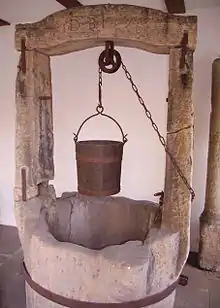
قیو
Alternative forms
- قویو (kuyu), قویی (kuyi)
Etymology
Inherited from Proto-Turkic *kudug (“well”); cognate with Azerbaijani quyu, Bashkir ҡоҙоҡ (qoðoq), Kazakh құдық (qūdyq), Kyrgyz кудук (kuduk), Tatar кое (qoye), Turkmen guýy, Uyghur قۇدۇق (quduq), Uzbek quduq and Yakut кудук (kuduk).
Noun
قیو • (kuyu)
Derived terms
- زنجیرلو قیو (zincirli kuyu, “well worked by a well-sweep and chain”)
- قار قیوسی (kar kuyusu, “snowpit”)
- قیو صویی (kuyu suyu, “hard water”)
- قیو قازمق (kuyu kazmak, “to work against someone”)
- قیو كناری (kuyu kenarı, “stone forming the edge of a well”)
- قیو گبی (kuyu gibi, “gloomy, dark”)
- قیوجق (kuyucuk, “little well or pit”)
- قیوجی (kuyucu, “well-digger”)
- كیرچ قیوسی (kireç kuyusu, “pit into which lime is run”)
- لغم قیوسی (lağım kuyusu, “sinkhole to a sewer”)
Descendants
- Turkish: kuyu
Further reading
- Çağbayır, Yaşar (2007), “kuyu”, in Ötüken Türkçe Sözlük (in Turkish), volume 1, Istanbul: Ötüken Neşriyat, page 2875
- Kélékian, Diran (1911), “قیو”, in Dictionnaire turc-français, Constantinople: Mihran, page 994
- Meninski, Franciszek à Mesgnien (1687), “Puteus”, in Complementum thesauri linguarum orientalium, seu onomasticum latino-turcico-arabico-persicum, simul idem index verborum lexici turcico-arabico-persici, quod latinâ, germanicâ, aliarumque linguarum adjectâ nomenclatione nuper in lucem editum, Vienna, column 1412
- Meninski, Franciszek à Mesgnien (1680), “قویی”, in Thesaurus linguarum orientalium, Turcicae, Arabicae, Persicae, praecipuas earum opes à Turcis peculiariter usurpatas continens, nimirum Lexicon Turkico-Arabico-Persicum, Vienna, column 3812
- Nişanyan, Sevan (2002–), “kuyu”, in Nişanyan Sözlük
- Redhouse, James W. (1890), “قیو”, in A Turkish and English Lexicon, Constantinople: A. H. Boyajian, page 1512
This article is issued from Wiktionary. The text is licensed under Creative Commons - Attribution - Sharealike. Additional terms may apply for the media files.