گوگم
Ottoman Turkish
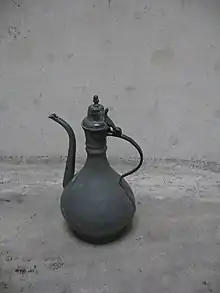
Etymology 1
From Ancient Greek κουκκούμιον (koukkoúmion), κούκκουμα (koúkkouma), from Classical Syriac ܩܘܿܩܡܳܐ (qūqəmā, “pot”), absolute state ܩܘܿܩܽܡ (qūqum), from Imperial Aramaic 𐡒𐡅𐡒𐡌 (qwqm), from Akkadian 𒂁𒆪𒆪𒁍 (/kukkubu, quqquba/, “a smaller container used as an alabastron, libation jar, or drinking flask; originally a drinking pouch made from an animal’s stomach, any similar pouch with a small opening”), suspected to have been loaned or developed from Sumerian 𒂁𒃻𒋫𒆸 (/gugguru/, “tall earthen vessel with a narrow opening”). Via Aramaic קוּמְקְמָא (qumqəmā, “boiling kettle”) it has also been borrowed into Latin cucuma (“kettle, boiling-vessel”), Arabic قُمْقُم (qumqum, “bulbous flask with a neck used for dispersing perfume”), and Middle Persian [Book Pahlavi needed] (KWKMʾ), Persian قمقمه (qomqome).
Alternative forms
- گوگوم (güğüm)
Descendants
- Turkish: güğüm
- → Crimean Tatar: gügüm
- → Greek: γκιούμι (gkioúmi)

Alternative forms
- گووم (gövem, güvem), گوم (gövem, güvem)
Descendants
- Turkish: güvem, gövem, göğem, güğem