夂
| ||||||||
| ||||||||
Translingual
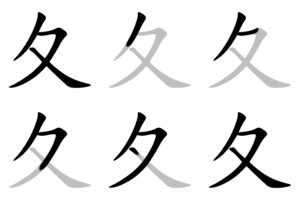
| Stroke order | |||
|---|---|---|---|
 | |||
Han character
夂 (Kangxi radical 34, 夂+0, 3 strokes, cangjie input 竹水 (HE) or X竹水 (XHE), four-corner 27400, composition ⿻𠂊㇏)
- Kangxi radical #34, ⼡.
References
- KangXi: page 244, character 17
- Dai Kanwa Jiten: character 5691
- Dae Jaweon: page 484, character 22
- Hanyu Da Zidian (first edition): volume 2, page 867, character 15
- Unihan data for U+5902

Usage notes
This character is usually written as the top component of a character such as in 冬, 各, 㣊, 夅, 夆, 备 or as a side component in 处, 処 and is not to be confused with 夊 which is often written as the bottom component of a character or 攵 which is often written as the right component of a character.
Chinese
| simp. and trad. |
夂 | |
|---|---|---|
Glyph origin
- Etymology 1
| Historical forms of the character 夂 |
|---|
| Shuowen Jiezi (compiled in Han) |
| Small seal script |
 |
Pronunciation
Etymology 2
| For pronunciation and definitions of 夂 – see 終 (“end; ending; termination; to come to an end; etc.”). (This character, 夂, is a variant form of 終.) |
Etymology 3
| For pronunciation and definitions of 夂 – see 夊 (“of going, slow; etc.”). (This character, 夂, is a variant form of 夊.) |
Usage notes
As a component of other characters, 夂 can be referred to as 折文兒/折文儿 or 冬字頭/冬字头.
Japanese
Vietnamese
This article is issued from Wiktionary. The text is licensed under Creative Commons - Attribution - Sharealike. Additional terms may apply for the media files.