ㄜ
 | ||||||||
Translingual
| Stroke order | |||
|---|---|---|---|
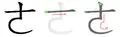 | |||
Letter
ㄜ
- type: monophthong rhyme
- general transliteration: e
- keyboard key: K

Chinese
Glyph origin

Old variant of ㄜ (around 1932)

Old variant of ㄜ (around 1949)
In the late twenties or early thirties of the 20th century, it appeared as a simplification of ㄮ, writing the dot and the second stoke of the bottom part ㄛ with one stroke. ㄮ was itself derived from ㄛ in 1920, when a new allophone appeared, writing a dot to differentiate between them. The letter ㄛ is itself derived from 𠀀, inhalation, the reverse of 丂 (kǎo) and an ancient form of 呵 (Mandarin: hē).
Etymology
Derived from ㄛ(Mandarin: ō), which was derived from 𠀀, inhalation, the reverse of 丂 (kǎo) and an ancient form of 呵 (Mandarin: hē), because Mandarin: ē is its allophone in Standard Chinese.
Pronunciation
Letter
- 24th letter of the Zhuyin alphabet
- 36th letter of the extended Zhuyin alphabet
Phoneme
- (general) Sound IPA(key): /ɤ/
(Pinyin: e), which is present only in Standard Chinese. - (Standard Chinese when pronounced with the neutral tone) IPA(key): /ə/ (Pinyin: e)
- (when pronounced alone) Sound IPA(key): /ˀɤ/
(Pinyin: e) - (some dialects, notably Hakka and Wenzhounese) Sound IPA(key): /ə/ (Pinyin: e).
References
- 全國主要方言區方音對照表, Chinese Character Reform Commission, Beijing: ZhonghuaBook Company, 1954
- Unicode Bopomofo block description: https://www.unicode.org/charts/PDF/U3100.pdf
Northern Qiandong Miao
Letter
- 33rd letter of the Hmu Zhuyin alphabet.
Phoneme
- sound IPA(key): /ə/ (Hutton): eh
References
- Joakim Enwall, A Myth Become Reality Vol.1 (Stockholm, 1994) page 198
This article is issued from Wiktionary. The text is licensed under Creative Commons - Attribution - Sharealike. Additional terms may apply for the media files.