投

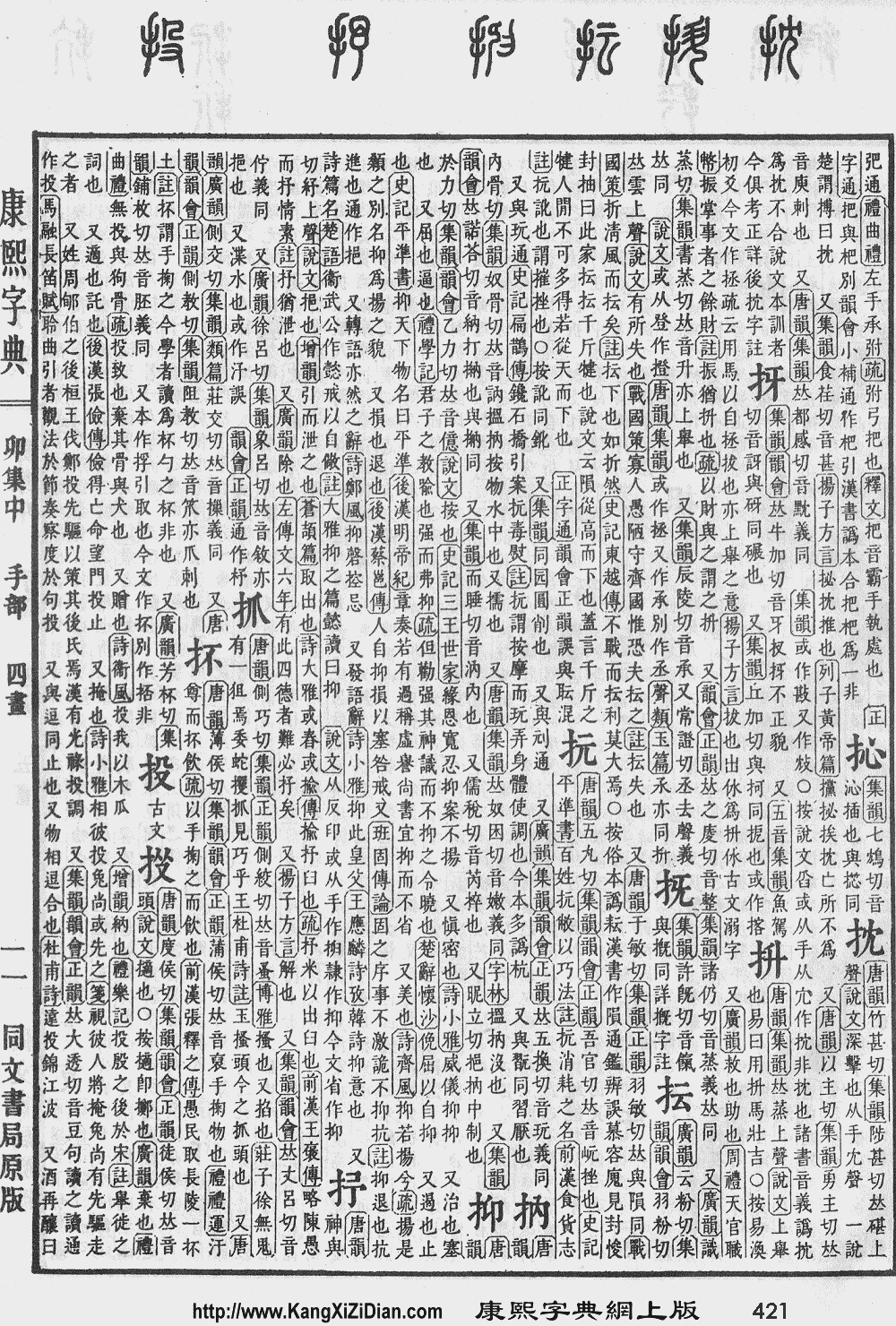
投 U+6295, 投
CJK UNIFIED IDEOGRAPH-6295
← 抔
[U+6294]
CJK Unified Ideographs 抖 →
[U+6296]

Translingual

Stroke order
7 strokes

Han character

投 (Kangxi radical 64, 手+4, 7 strokes, cangjie input 手竹弓水 (QHNE), four-corner 57047, composition ⿰扌殳)

Derived characters

  • 𠲴, 𫽌, 𫽟, 𡷠, 𥦆, 𭠚

References

  • KangXi: page 421, character 13
  • Dai Kanwa Jiten: character 11887
  • Dae Jaweon: page 768, character 13
  • Hanyu Da Zidian (first edition): volume 3, page 1842, character 3
  • Unihan data for U+6295

Chinese

simp. and trad.
投

Glyph origin

Historical forms of the character 投
Shuowen Jiezi (compiled in Han) Liushutong (compiled in Ming)
Small seal script Transcribed ancient scripts

Phono-semantic compound (形聲, OC *doː) : semantic 扌 (“hand”) + phonetic 殳 (OC *djo).

Etymology

Compare Tibetan འདོར་བ ('dor ba, “to throw away; to eject; to reject”), Tibetan གཏོར་བ (gtor ba, “to strew; to scatter”) (Unger, 1986).

Pronunciation


Note:
  • dèu - literary;
  • dàu - vernacular.
Note:
  • tiô/tô͘ - literary;
  • tâu - vernacular.

Rime
Character 投
Reading # 1/1
Initial (聲) 定 (7)
Final (韻) 侯 (137)
Tone (調) Level (Ø)
Openness (開合) Open
Division (等) I
Fanqie 度侯切
Reconstructions
Zhengzhang
Shangfang
/dəu/
Pan
Wuyun
/dəu/
Shao
Rongfen
/dəu/
Edwin
Pulleyblank
/dəw/
Li
Rong
/du/
Wang
Li
/dəu/
Bernard
Karlgren
/dʱə̯u/
Expected
Mandarin
Reflex
tóu
Expected
Cantonese
Reflex
tau4
Baxter–Sagart system 1.1 (2014)
Character 投
Reading # 1/1
Modern
Beijing
(Pinyin)
tóu
Middle
Chinese
‹ duw ›
Old
Chinese
/*[d]ˁo/
English throw

Notes for Old Chinese notations in the Baxter–Sagart system:

* Parentheses "()" indicate uncertain presence;
* Square brackets "[]" indicate uncertain identity, e.g. *[t] as coda may in fact be *-t or *-p;
* Angle brackets "<>" indicate infix;
* Hyphen "-" indicates morpheme boundary;

* Period "." indicates syllable boundary.
Zhengzhang system (2003)
Character 投
Reading # 1/1
No. 11716
Phonetic
component
殳
Rime
group
侯
Rime
subdivision
0
Corresponding
MC rime
頭
Old
Chinese
/*doː/

Definitions

投

  1. to throw; to fling; to pitch
    投標槍/投标枪  ―  tóu biāoqiāng  ―  to throw a javelin
  2. to throw oneself into
    投井  ―  tóujǐng  ―  to jump into a well (to drown oneself)
  3. to put in; to drop
    投票  ―  tóupiào  ―  to cast a ballot
    投資/投资  ―  tóuzī  ―  to invest (literally, “to put in capital”)
  4. to fit in with
    脾氣相投/脾气相投  ―  píqì xiàngtóu  ―  to be alike in temperament
  5. to send
    投稿  ―  tóugǎo  ―  to submit a piece of writing
  6. to cast; to project
    同學們紛紛把目光投向他。 [MSC, trad.]
    同学们纷纷把目光投向他。 [MSC, simp.]
    Tóngxué men fēnfēn bǎ mùguāng tóu xiàng tā. [Pinyin]
    The classmates one by one cast their gaze towards him.
  7. to join; to go to
    投宿  ―  tóusù  ―  to lodge
    棄暗投明/弃暗投明  ―  qì'àntóumíng  ―  to give up one's wrong way of life and turn to a better one (literally, “to forsake darkness and come to the light”)
  8. (colloquial) to rinse (clothes) in water
  9. † Alternative form of 骰 (tóu, “dice; die”).

Compounds

Japanese

Kanji

投

(grade 3 “Kyōiku” kanji)

  1. to throw
  2. to discard
  3. abandon

Readings

Counter

投(とう) • (-tō) 

  1. (baseball) pitches

Korean

Hanja

投 • (tu) (hangeul 투)

  1. This term needs a translation to English. Please help out and add a translation, then remove the text {{rfdef}}.

Vietnamese

Han character

投: Hán Nôm readings: đầu, nhầu

  1. This term needs a translation to English. Please help out and add a translation, then remove the text {{rfdef}}.
This article is issued from Wiktionary. The text is licensed under Creative Commons - Attribution - Sharealike. Additional terms may apply for the media files.