湯桶
Japanese
Etymology 1
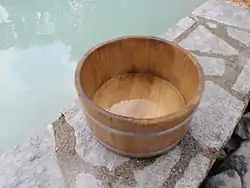
湯桶 (yuoke): A wooden hot-water basin for bathing.
| Kanji in this term | |
|---|---|
| 湯 | 桶 |
| ゆ Grade: 3 |
おけ Jinmeiyō |
| kun’yomi | |
/juwoke/ → /juoke/
From Old Japanese. Compound of 湯 (yu, “warm or hot water”) + 桶 (oke, “a bucket or pail; a tub”),[1] itself a compound of 麻 (o, “flax, ramie”) + 笥 (ke, “a container, especially for foodstuffs or tableware”).[1]
Pronunciation
Noun
湯桶 • (yuoke) ←ゆをけ (yuwoke)?
- A basin or small tub used to douse oneself with hot or warm water while bathing.
- A tub or basin for holding hot water, such as when cooking.
- A tool used during cold-weather 茶道 (sadō, “tea ceremony”): a wooden container of warm water with a spout, placed at the entrance for washing and warming the hands of arriving guests.
Derived terms
Derived terms
- 湯桶石 (yuoke ishi): A stone to the side of the 手水鉢 (chōzubachi, “hand-washing basin”) at the entrance to a 茶道 (sadō, “tea ceremony”) room, on which the yuoke is placed for cold-weather tea ceremony.
Etymology 2

| Kanji in this term | |
|---|---|
| 湯 | 桶 |
| ゆ Grade: 3 |
とう Jinmeiyō |
| yutōyomi | |
Origin less clear. Old Japanese 湯 (yu, “warm or hot water”) + Chinese-derived on'yomi 桶 (tō, “a bucket or pail; a tub”).
Alternative forms
Noun
湯桶 • (yutō)
Derived terms
Derived terms
- 湯桶読み (yutōyomi): A reading of a kanji compound, consisting of a kun'yomi for the first kanji and an on'yomi for the second kanji.
- 湯桶言葉 (yutōkotoba): A word read with a yutōyomi.
- 湯桶石 (yutō ishi): A stone to the side of the 手水鉢 (chōzubachi, “hand-washing basin”) at the entrance to a 茶道 (sadō, “tea ceremony”) room, on which the yuoke (see above) is placed for cold-weather tea ceremony.
References
- 1988, 国語大辞典(新装版) (Kokugo Dai Jiten, Revised Edition) (in Japanese), Tōkyō: Shogakukan
- 2006, 大辞林 (Daijirin), Third Edition (in Japanese), Tōkyō: Sanseidō, →ISBN
This article is issued from Wiktionary. The text is licensed under Creative Commons - Attribution - Sharealike. Additional terms may apply for the media files.