綴
See also: 缀
| ||||||||
Translingual
Han character
綴 (Kangxi radical 120, 糸+8, 14 strokes, cangjie input 女火水水水 (VFEEE), four-corner 27947, composition ⿰糹叕)
References
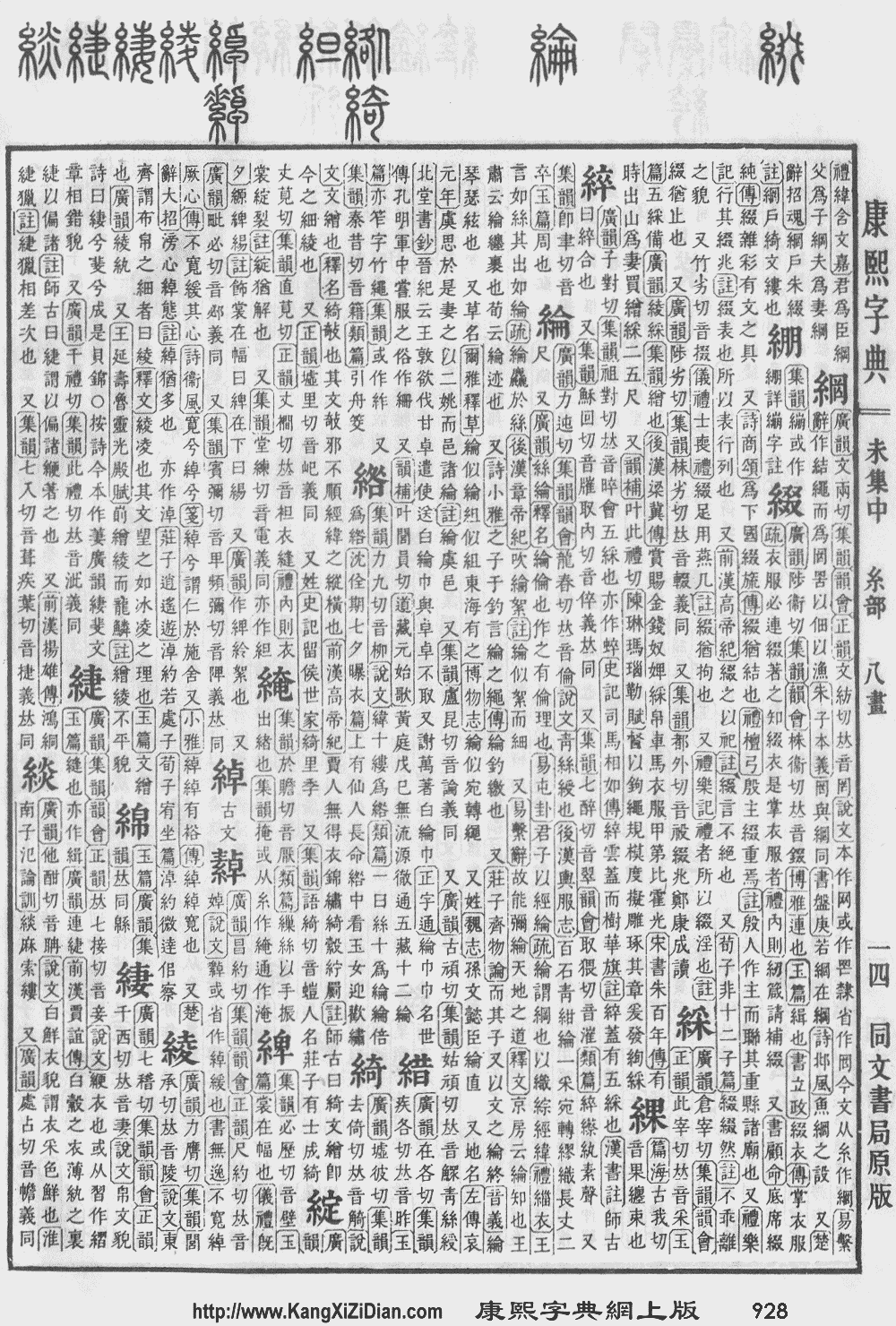
- KangXi: page 928, character 3
- Dai Kanwa Jiten: character 27579
- Dae Jaweon: page 1365, character 3
- Hanyu Da Zidian (first edition): volume 5, page 3422, character 1
- Unihan data for U+7DB4
Chinese
Glyph origin
| Historical forms of the character 綴 |
|---|
| Shuowen Jiezi (compiled in Han) |
| Small seal script |
 |
Characters in the same phonetic series (叕) (Zhengzhang, 2003)
| Old Chinese | |
|---|---|
| 蝃 | *tɯːds, *tjod |
| 欼 | *sʰrɯʔ |
| 綴 | *tods, *tod |
| 醊 | *tods, *tod |
| 畷 | *tods, *tod |
| 啜 | *tods, *djods, *tod, *tʰjod, *djod |
| 餟 | *tods, *tod |
| 腏 | *tods, *toːd, *tod |
| 錣 | *tods, *rtoːd |
| 輟 | *tods, *tod |
| 娺 | *tul, *rtoːd |
| 窡 | *rtoːd, *rtoːd |
| 鵽 | *rtoːd, *rtoːd, *toːd |
| 掇 | *toːd, *tod |
| 剟 | *toːd, *tod |
| 裰 | *toːd |
| 敠 | *toːd, *sʰlod |
| 惙 | *tod |
| 罬 | *tod, *ktod |
| 叕 | *tod |
| 歠 | *tʰjod |
| 逫 | *tud |
Phono-semantic compound (形聲, OC *tods, *tod) : semantic 糸 (“silk”) + phonetic 叕 (OC *tod)
Pronunciation 1
Compounds
Synonyms
Dialectal synonyms of 跟 (“to follow”) [map]
| Variety | Location | Words |
|---|---|---|
| Formal (Written Standard Chinese) | 跟, 跟隨, 跟從 | |
| Mandarin | Beijing | 跟 |
| Taiwan | 跟 | |
| Jinan | 跟 | |
| Xi'an | 跟 | |
| Wuhan | 跟 | |
| Chengdu | 跟 | |
| Yangzhou | 跟 | |
| Hefei | 跟 | |
| Singapore | 跟 | |
| Cantonese | Guangzhou | 跟 |
| Hong Kong | 跟 | |
| Yangjiang | 跟 | |
| Singapore (Guangfu) | 跟 | |
| Gan | Nanchang | 跟 |
| Hakka | Meixian | 跈, 跟 |
| Miaoli (N. Sixian) | 跈 | |
| Pingtung (Neipu; S. Sixian) | 跈 | |
| Hsinchu County (Zhudong; Hailu) | 跈 | |
| Taichung (Dongshi; Dabu) | 跈 | |
| Hsinchu County (Qionglin; Raoping) | 跈 | |
| Yunlin (Lunbei; Zhao'an) | 跈 | |
| Jin | Taiyuan | 跟, 相跟 |
| Min Bei | Jian'ou | 跟 |
| Min Dong | Fuzhou | 跟, 跇 |
| Min Nan | Xiamen | 綴 |
| Quanzhou | 綴 | |
| Shishi | 綴 | |
| Zhangzhou | 綴 | |
| Taipei | 綴 | |
| New Taipei (Sanxia) | 綴 | |
| Kaohsiung | 綴 | |
| Yilan | 綴 | |
| Changhua (Lukang) | 綴 | |
| Taichung | 綴 | |
| Tainan | 綴 | |
| Hsinchu | 綴 | |
| Kinmen | 綴 | |
| Penghu (Magong) | 綴 | |
| Penang (Hokkien) | 綴 | |
| Singapore (Hokkien) | 綴 | |
| Manila (Hokkien) | 綴 | |
| Chaozhou | 綴 | |
| Singapore (Teochew) | 綴 | |
| Wu | Suzhou | 跟 |
| Wenzhou | 跟 | |
| Xiang | Changsha | 跟 |
| Shuangfeng | 跟 | |
Compounds
Pronunciation
References
- “Entry #10781”, in 臺灣閩南語常用詞辭典 [Dictionary of Frequently-Used Taiwan Minnan] (in Chinese and Min Nan), Ministry of Education, R.O.C., 2011.
Japanese
Korean
Etymology
From a corrupted or unorthodox reading influenced by 綴 (MC ʈˠiuᴇt̚).
| Historical readings |
|---|
|
The original reading is 체 (che) based on Middle Chinese 綴 (MC ʈˠiuᴇiH).
| Historical readings |
|---|
|
Pronunciation
- (SK Standard/Seoul) IPA(key): [t͡ɕʰʌ̹ɭ]
- Phonetic hangul: [철]
Vietnamese
This article is issued from Wiktionary. The text is licensed under Creative Commons - Attribution - Sharealike. Additional terms may apply for the media files.