觀音

See also: 观音

Chinese

observing sound(s)
cry(/ies)
trad. (觀音) 觀 音
simp. (观音) 观 音
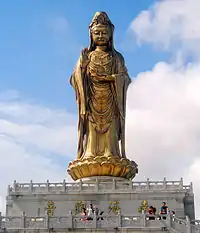
The statue of "Guanyin of the South China Sea" on Putuoshan Island off Zhejiang, China. Chinese Buddhism credits the location as her first appearance in China.

Etymology

“[One who] Observes Sounds”, in reference to the prayers and cries of sentient beings who need help, a Calque of Sanskrit अवलोकितस्वर (avalokitasvara, literally “down-observe-sound”), the original form of अवलोकितेश्वर (avalokiteśvara, “Avalokiteśvara”), the bodhisattva who embodies the compassion of all Buddhas.

Synonymous with 觀世音/观世音 (Guānshìyīn, “One who Observes the Sounds of the World”), which interpreted the middle element of the Sanskrit compound as लोक (loka, “world”). The shorter form became more common during the Tang dynasty to avoid naming the taboo personal name of Emperor Taizong of Tang, 李世民.

Compare Tibetan སྤྱན་རས་གཟིགས (spyan ras gzigs, literally “one who looks down with an unwavering eye”).

Pronunciation


Note:
  • guêng1 im1 - Chaohzou;
  • guang1 im1 - Jieyang.
  • Wu
    • (Shanghainese)
      • Wiktionary: 1kuoe-in
      • Sinological IPA (key): /kv̩ʷø⁵⁵ ɪɲ²¹/

Rime
Character 觀 音
Reading # 1/2 1/1
Initial (聲) 見 (28) 影 (34)
Final (韻) 桓 (62) 侵 (140)
Tone (調) Level (Ø) Level (Ø)
Openness (開合) Closed Open
Division (等) I III
Fanqie 古丸切 於金切
Reconstructions
Zhengzhang
Shangfang
/kuɑn/ /ʔˠiɪm/
Pan
Wuyun
/kʷɑn/ /ʔᵚim/
Shao
Rongfen
/kuɑn/ /ʔiem/
Edwin
Pulleyblank
/kwan/ /ʔjim/
Li
Rong
/kuɑn/ /ʔjəm/
Wang
Li
/kuɑn/ /ĭĕm/
Bernard
Karlgren
/kuɑn/ /ʔi̯əm/
Expected
Mandarin
Reflex
guān yīn
Expected
Cantonese
Reflex
gun1 jam1

Proper noun

觀音

  1. (~菩薩) (Buddhism) Guanyin
  2. (~區, formerly ~鄉) Guanyin (a district of Taoyuan, Taiwan, formerly a rural township)
  3. (~鎮) Guanyin (a town in Yunxi, Shiyan, Hubei, China)

Usage notes

Although Avalokiteśvara was reckoned a male figure and Guanyin was first depicted as a male in Chinese art, she is now almost always understood to be and referenced as a goddess or female boddhisattva.

Synonyms

Derived terms

  • 觀音柳/观音柳
  • 觀音棕竹/观音棕竹
  • 觀音法會/观音法会
  • 觀音竹/观音竹 (guānyīnzhú)
  • 觀音粉/观音粉
  • 觀音素/观音素
  • 觀音經/观音经
  • 觀音草/观音草
  • 觀音菊/观音菊
  • 觀音菩薩/观音菩萨 (Guānyīn Púsà)
  • 觀音蓮/观音莲
  • 觀音衲/观音衲
  • 觀音誕/观音诞 (Guānyīndàn)
  • 送子觀音/送子观音
  • 鎖骨觀音/锁骨观音
  • 鐵觀音/铁观音 (tiěguānyīn)
  • 魚籃觀音/鱼篮观音

Descendants

Sino-Xenic (觀音):

Others:

  • → Burmese: ကွမ်ယင် (kwam-yang)
  • → English: Guanyin
  • → Indonesian: Kwan Im
  • → Thai: กวนอิม

Japanese

Kanji in this term
觀 音
かん
Hyōgaiji
おん > のん
Grade: 1

Proper noun

觀(かん)音(のん) • (Kannon) 

  1. Kyūjitai form of 観音

Korean

Hanja in this term
觀音

Proper noun

觀音 or 觀音 or 觀音 • (Gwaneum or McCune-Reischauer: Kwanŭm or Yale: Kwan.um) (hangeul 관음)

  1. Hanja form? of 관음 (“Guanyin”).

Vietnamese

Hán tự in this term
觀音

Proper noun

觀音

  1. chữ Hán form of Quan Âm (“Guanyin”).
This article is issued from Wiktionary. The text is licensed under Creative Commons - Attribution - Sharealike. Additional terms may apply for the media files.