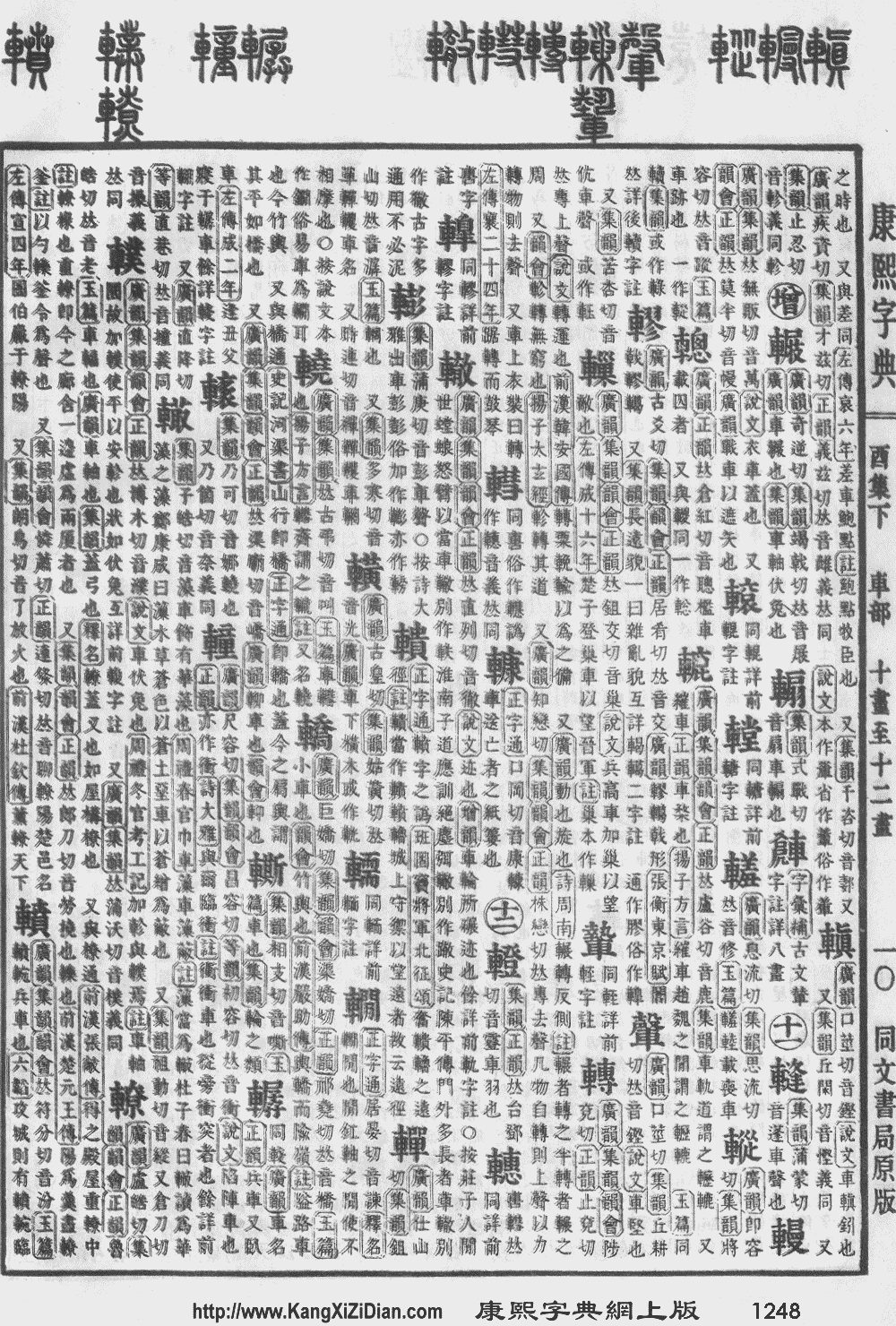
轏

轏 U+8F4F, 轏
CJK UNIFIED IDEOGRAPH-8F4F
← 轎
[U+8F4E]
CJK Unified Ideographs 轐 →
[U+8F50]

Translingual

Han character

轏 (Kangxi radical 159, 車+12, 19 strokes, cangjie input 十十尸弓木 (JJSND), four-corner 57047, composition ⿰車孱)

  1. sleeping cart

References

Chinese

trad. 轏
simp. 𰺞

Glyph origin

Pronunciation


Rime
Character 轏
Reading # 1/1
Initial (聲) 崇 (20)
Final (韻) 山 (73)
Tone (調) Rising (X)
Openness (開合) Open
Division (等) II
Fanqie 士限切
Reconstructions
Zhengzhang
Shangfang
/d͡ʒˠɛnX/
Pan
Wuyun
/ɖ͡ʐᵚænX/
Shao
Rongfen
/d͡ʒænX/
Edwin
Pulleyblank
/ɖ͡ʐəɨnX/
Li
Rong
/d͡ʒɛnX/
Wang
Li
/d͡ʒænX/
Bernard
Karlgren
/ɖ͡ʐʱănX/
Expected
Mandarin
Reflex
zhàn
Expected
Cantonese
Reflex
zaan6
Baxter–Sagart system 1.1 (2014)
Character 轏
Reading # 1/1
Modern
Beijing
(Pinyin)
zhàn
Middle
Chinese
‹ dzrɛnX ›
Old
Chinese
/*[dz]r[a][n]ʔ/ (dzrj- > dzr-)
English a kind of carriage

Notes for Old Chinese notations in the Baxter–Sagart system:

* Parentheses "()" indicate uncertain presence;
* Square brackets "[]" indicate uncertain identity, e.g. *[t] as coda may in fact be *-t or *-p;
* Angle brackets "<>" indicate infix;
* Hyphen "-" indicates morpheme boundary;

* Period "." indicates syllable boundary.
Zhengzhang system (2003)
Character 轏
Reading # 1/1
No. 1206
Phonetic
component
孱
Rime
group
元
Rime
subdivision
2
Corresponding
MC rime
棧
Old
Chinese
/*sɡreːnʔ/

Definitions

轏

  1. This term needs a translation to English. Please help out and add a translation, then remove the text {{rfdef}}.

Japanese

Kanji

轏

(uncommon “Hyōgai” kanji)

  1. This term needs a translation to English. Please help out and add a translation, then remove the text {{rfdef}}.

Readings

  • On (unclassified): さん (san), ぜん (zen)
This article is issued from Wiktionary. The text is licensed under Creative Commons - Attribution - Sharealike. Additional terms may apply for the media files.