K-DK
Hungarian
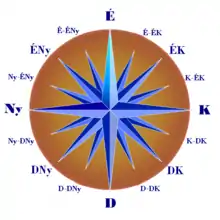
Compass rose
Etymology
Abbreviation of kelet-délkelet (“east-southeast”).
Pronunciation
- IPA(key): [ˈkɛlɛt ˌdeːlkɛlɛt]
Declension
| Inflection (stem in -e-, front unrounded harmony) | ||
|---|---|---|
| singular | plural | |
| nominative | K-DK | — |
| accusative | K-DK-et | — |
| dative | K-DK-nek | — |
| instrumental | K-DK-tel | — |
| causal-final | K-DK-ért | — |
| translative | K-DK-té | — |
| terminative | K-DK-ig | — |
| essive-formal | K-DK-ként | — |
| essive-modal | — | — |
| inessive | K-DK-ben | — |
| superessive | K-DK-en | — |
| adessive | K-DK-nél | — |
| illative | K-DK-be | — |
| sublative | K-DK-re | — |
| allative | K-DK-hez | — |
| elative | K-DK-ből | — |
| delative | K-DK-ről | — |
| ablative | K-DK-től | — |
| non-attributive possessive - singular |
K-DK-é | — |
| non-attributive possessive - plural |
K-DK-éi | — |
| Possessive forms of K-DK | ||
|---|---|---|
| possessor | single possession | multiple possessions |
| 1st person sing. | K-DK-em | — |
| 2nd person sing. | K-DK-ed | — |
| 3rd person sing. | K-DK-e | — |
| 1st person plural | K-DK-ünk | — |
| 2nd person plural | K-DK-etek | — |
| 3rd person plural | K-DK-ük | — |

This article is issued from Wiktionary. The text is licensed under Creative Commons - Attribution - Sharealike. Additional terms may apply for the media files.