< Reconstruction:Proto-Slavic
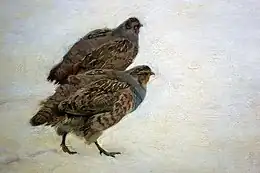
Reconstruction:Proto-Slavic/arębъ

Proto-Slavic
*arębi – Perdix perdix
Etymology
*a- + *rębъ (“speckled, spotted”). Found with an unprefixed analogue in Latvian irbe (“partridge”) against an adjective raibs (“variegated, spotted”), which is in Lithuanian raibas (“variegated, spotted”), to be juxtaposed with Proto-Germanic *erpaz (“light brown”) (which has derivations denoting the similar-looking hazel grouse) and Old Irish riabach (“spotted, variegated”); note also Old Norse rjúpa (“ptarmigan”).
Declension
Declension of *arębъ (hard o-stem)
| Singular | Dual | Plural | |
|---|---|---|---|
| Nominative | *arębъ | *aręba | *arębi |
| Accusative | *arębъ | *aręba | *aręby |
| Genitive | *aręba | *arębu | *arębъ |
| Locative | *arębě | *arębu | *aręběxъ |
| Dative | *arębu | *aręboma | *arębomъ |
| Instrumental | *arębъmь, *arębomь* | *aręboma | *aręby |
| Vocative | *arębe | *aręba | *arębi |
* -ъmь in North Slavic, -omь in South Slavic.
Derived terms
- *arębatъ
- *arębica
- *arębina
Descendants
- East Slavic:
- South Slavic:
- West Slavic:
Further reading
- Boryś, Wiesław (2005), “jarząb”, in Słownik etymologiczny języka polskiego (in Polish), Kraków: Wydawnictwo Literackie, →ISBN, page 204
- Trubachyov, Oleg, editor (1974), “*arębъ”, in Этимологический словарь славянских языков [Etymological Dictionary of Slavic Languages] (in Russian), issue 1 (*a – *besědьlivъ), Moscow: Nauka, page 73
- Vasmer, Max (1964–1973), “ярябь”, in Этимологический словарь русского языка [Etymological Dictionary of the Russian Language] (in Russian), transl. and suppl. by Oleg Trubachyov, Moscow: Progress
- “Rebhuhn” in Digitales Wörterbuch der deutschen Sprache
This article is issued from Wiktionary. The text is licensed under Creative Commons - Attribution - Sharealike. Additional terms may apply for the media files.