互

See also: 亙
互 U+4E92, 互
CJK UNIFIED IDEOGRAPH-4E92
← 云
[U+4E91]
CJK Unified Ideographs 亓 →
[U+4E93]

Translingual

Stroke order
0 strokes

Han character

互 (Kangxi radical 7, 二+2, 4 strokes, cangjie input 一女弓一 (MVNM), four-corner 10107, composition ⿱一彑)

Derived characters

  • 仾 冱 坘 枑 沍 䊺 魱 宐 䇘 𠯞 𪥦 𢎸 𢗝 𢪔 𣅥 𪸒 𤜷 𥘡 𦍞 𦙁 𦨝 𧘢 𧥮 𧿟 𨋆 𨠂 𨥛 𨸧 𩉱 𩚢 𪏳 𧺳 𨚎 𩿍 𡗨 𦊂 𦊍 𦬚 𠀕

References

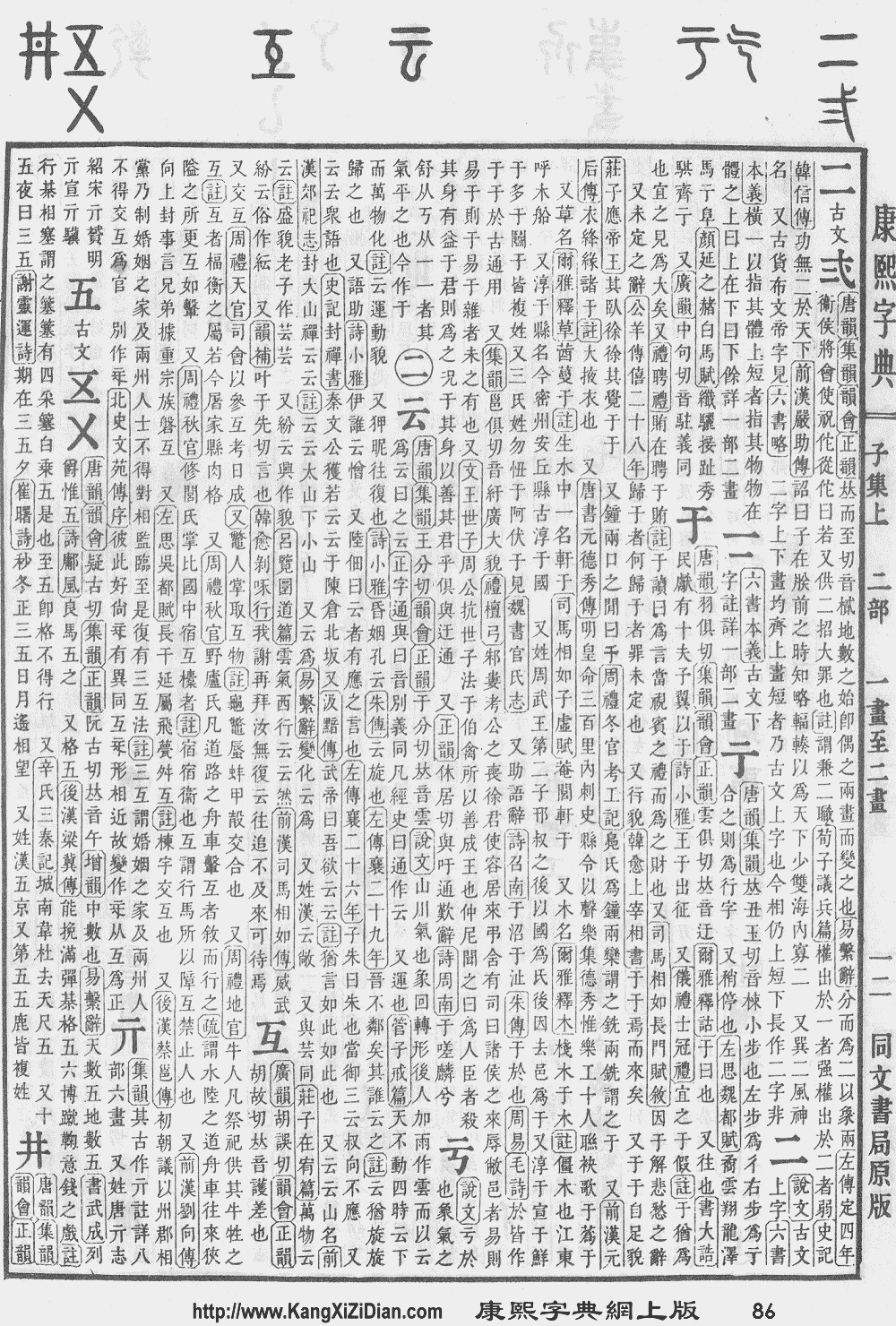
  • KangXi: page 86, character 9
  • Dai Kanwa Jiten: character 255
  • Dae Jaweon: page 178, character 2
  • Hanyu Da Zidian (first edition): volume 1, page 14, character 1
  • Unihan data for U+4E92

Chinese

simp. and trad.
互

Glyph origin

Historical forms of the character 互


References:

Mostly from Richard Sears' Chinese Etymology site (authorisation),
which in turn draws data from various collections of ancient forms of Chinese characters, including:

  • Shuowen Jiezi (small seal),
  • Jinwen Bian (bronze inscriptions),
  • Liushutong (Liushutong characters) and
  • Yinxu Jiaguwen Bian (oracle bone script).

Pictogram (象形) . A spool to wind up rope (like a modern garden hose spool). Original character for 䇘

Pronunciation


Note:
  • hu5 - Chaozhou;
  • hu6 - Shantou.

Rime
Character 互
Reading # 1/1
Initial (聲) 匣 (33)
Final (韻) 模 (23)
Tone (調) Departing (H)
Openness (開合) Open
Division (等) I
Fanqie 胡誤切
Reconstructions
Zhengzhang
Shangfang
/ɦuoH/
Pan
Wuyun
/ɦuoH/
Shao
Rongfen
/ɣoH/
Edwin
Pulleyblank
/ɦɔH/
Li
Rong
/ɣoH/
Wang
Li
/ɣuH/
Bernard
Karlgren
/ɣuoH/
Expected
Mandarin
Reflex
hù
Expected
Cantonese
Reflex
wu6
Baxter–Sagart system 1.1 (2014)
Character 互
Reading # 1/1
Modern
Beijing
(Pinyin)
hù
Middle
Chinese
‹ huH ›
Old
Chinese
/*m-qˁaʔ-s/
English intertwining

Notes for Old Chinese notations in the Baxter–Sagart system:

* Parentheses "()" indicate uncertain presence;
* Square brackets "[]" indicate uncertain identity, e.g. *[t] as coda may in fact be *-t or *-p;
* Angle brackets "<>" indicate infix;
* Hyphen "-" indicates morpheme boundary;

* Period "." indicates syllable boundary.
Zhengzhang system (2003)
Character 互
Reading # 1/1
No. 5288
Phonetic
component
互
Rime
group
魚
Rime
subdivision
0
Corresponding
MC rime
護
Old
Chinese
/*ɡaːs/

Definitions

互

  1. mutually; reciprocally
  2. mutual
  3. crisscrossing; intertwining
  4. † Alternative form of 䇘 (hù, “a tool to wind up cord”).
  5. † Alternative form of 枑 (hù, “wooden rack”).
  6. † error; mistake
  7. † gate
  8. † crustacean
  9. a surname
Usage notes
  • 互 (hù) usually modifies a verb of one syllable, while its negative 互不 usually modifies a verb of two.

Compounds

  • 互不侵犯
  • 互保
  • 互信 (hùxìn)
  • 互切互磋
  • 互利 (hùlì)
  • 互助 (hùzhù, “to help each other”)
  • 互助合作
  • 互勉 (hùmiǎn)
  • 互定
  • 互市 (hùshì)
  • 互惠 (hùhuì)
  • 互物
  • 互生
  • 互用
  • 互相 (hùxiāng, “each other”)
  • 互粉 (hùfěn, “to follow or friend each other”)
  • 互角
  • 互通 (hùtōng)
  • 交互作用
  • 平等互惠
  • 互見/互见 (hùjiàn)
  • 互訓/互训
  • 互託肝膽/互托肝胆
  • 互調/互调 (hùdiào)
  • 互讓/互让 (hùràng)
  • 互質/互质 (hùzhì)
  • 互通有無/互通有无
  • 互選/互选
  • 互鄉/互乡
  • 仁智互見/仁智互见
  • 共榮互利/共荣互利 (“to benefit mutually and prosper together”)
  • 利弊互見/利弊互见
  • 反目互毆/反目互殴
  • 瑕瑜互見/瑕瑜互见
  • 盤互/盘互
  • 社會互動/社会互动 (shèhuì hùdòng)
  • 輪互/轮互
  • 轚互/𰺟互
  • 館際互借/馆际互借

Pronunciation


Definitions

互

  1. (Min Nan) Alternative form of 予.

Japanese

Kanji

互

(common “Jōyō” kanji)

  1. mutually, reciprocally

Readings

Compounds

Korean

Hanja

互 (eum 호 (ho))

  1. This term needs a translation to English. Please help out and add a translation, then remove the text {{rfdef}}.

Vietnamese

Han character

互: Hán Nôm readings: hỗ, hổ

  1. This term needs a translation to English. Please help out and add a translation, then remove the text {{rfdef}}.

References

This article is issued from Wiktionary. The text is licensed under Creative Commons - Attribution - Sharealike. Additional terms may apply for the media files.