停車
See also: 停车
Chinese
| to stop; to halt; to park (a car) | vehicle on land; car; machine vehicle on land; car; machine; to shape with a lathe | ||
|---|---|---|---|
| trad. (停車) | 停 | 車 | |
| simp. (停车) | 停 | 车 | |
| 2nd round simp. | 仃车 | ||
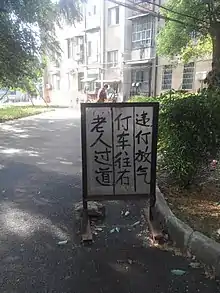
Pronunciation
Verb
停⫽車 (verb-object)
- to park a vehicle
- to stop a vehicle; to pull up
- to stop a machine
Synonyms
- (to park a vehicle):
Dialectal synonyms of 停車 (“to park a vehicle”) [map]
| Variety | Location | Words |
|---|---|---|
| Formal (Written Standard Chinese) | 停車 | |
| Mandarin | Taiwan | 停車, 泊車 |
| Singapore | 停車 | |
| Dagudi (Maliba) | 停車 | |
| Reshuitang (Longling) | 停車 | |
| Mae Salong (Lancang) | 停車 | |
| Mae Sai (Tengchong) | 停車 | |
| Cantonese | Guangzhou | 停車, 泊車, 停泊 |
| Hong Kong | 泊車 | |
| Taishan | 泊車 | |
| Singapore (Guangfu) | 泊車 | |
| Hakka | Meixian | 停車 |
| Min Nan | Xiamen | 拋車, 𣹇車 |
| Tainan | 停車 | |
| Singapore (Hokkien) | 拋車 | |
| Manila (Hokkien) | 拋車 | |
| Chaozhou | 停車 | |
| Shantou | 停車 | |
| Jieyang | 歇車 | |
| Singapore (Teochew) | 拋車 | |
| Pontianak (Teochew) | 歇車 | |
| Wu | Shanghai | 停車, 停車子 |
Derived terms
See also
- 停置 (tíngzhì)
Japanese
| Kanji in this term | |
|---|---|
| 停 | 車 |
| てい Grade: 5 |
しゃ Grade: 1 |
| on’yomi | |
Verb
停車する • (teisha suru) ←ていしや (teisya)?intransitive suru (stem 停車し (teisha shi), past 停車した (teisha shita))
- (of a train or vehicle) to stop
Conjugation
Conjugation of "停車する" (See Appendix:Japanese verbs.)
| Katsuyōkei ("stem forms") | ||||
|---|---|---|---|---|
| Mizenkei ("imperfective") | 停車し | ていしゃし | teisha shi | |
| Ren’yōkei ("continuative") | 停車し | ていしゃし | teisha shi | |
| Shūshikei ("terminal") | 停車する | ていしゃする | teisha suru | |
| Rentaikei ("attributive") | 停車する | ていしゃする | teisha suru | |
| Kateikei ("hypothetical") | 停車すれ | ていしゃすれ | teisha sure | |
| Meireikei ("imperative") | 停車せよ¹ 停車しろ² |
ていしゃせよ¹ ていしゃしろ² |
teisha seyo¹ teisha shiro² | |
| Key constructions | ||||
| Passive | 停車される | ていしゃされる | teisha sareru | |
| Causative | 停車させる 停車さす |
ていしゃさせる ていしゃさす |
teisha saseru teisha sasu | |
| Potential | 停車できる | ていしゃできる | teisha dekiru | |
| Volitional | 停車しよう | ていしゃしよう | teisha shiyō | |
| Negative | 停車しない | ていしゃしない | teisha shinai | |
| Negative continuative | 停車せず | ていしゃせず | teisha sezu | |
| Formal | 停車します | ていしゃします | teisha shimasu | |
| Perfective | 停車した | ていしゃした | teisha shita | |
| Conjunctive | 停車して | ていしゃして | teisha shite | |
| Hypothetical conditional | 停車すれば | ていしゃすれば | teisha sureba | |
| ¹ Written imperative ² Spoken imperative | ||||
This article is issued from Wiktionary. The text is licensed under Creative Commons - Attribution - Sharealike. Additional terms may apply for the media files.