戶

See also: 户, 戸, and 尸
戶 U+6236, 戶
CJK UNIFIED IDEOGRAPH-6236
← 戵
[U+6235]
CJK Unified Ideographs 户 →
[U+6237]
⼾ U+2F3E, ⼾
KANGXI RADICAL DOOR
← ⼽
[U+2F3D]
Kangxi Radicals ⼿ →
[U+2F3F]

Translingual

Stroke order
Traditional 戶
Shinjitai 戸
Simplified 户

Alternative forms

Note the regionally different forms of this character which are encoded separately in Unicode:

  • 戶 (top stroke connects to left stroke, as found in the historical Kangxi dictionary) - used in Taiwan and South Korea.
  • 戸 (top stroke is a horizontal line that does not connect to other strokes) - used in Japan.
  • 户 (top stroke is a slanting dot) - used in mainland China, Hong Kong, Singapore and Malaysia.

Note also the different stroke order: 户 and 戸 have the leftmost 丿 as the final (fourth) stroke, while 戶 (this character) has 丿 as the second stroke.

Han character

戶 (Kangxi radical 63, 戶+0, 4 strokes, cangjie input 竹尸 (HS), four-corner 30277, composition ⿸𠂆コ)

  1. Kangxi radical #63, ⼾.
  2. Shuowen Jiezi radical №437

Derived characters

  • Appendix:Chinese radical/戶
  • 𠯖, 𡉴, 𡵘, 𦙅, 𥄅, 𧦈, 𢻻, 𩢉, 𩿇, 𥫿

Further reading

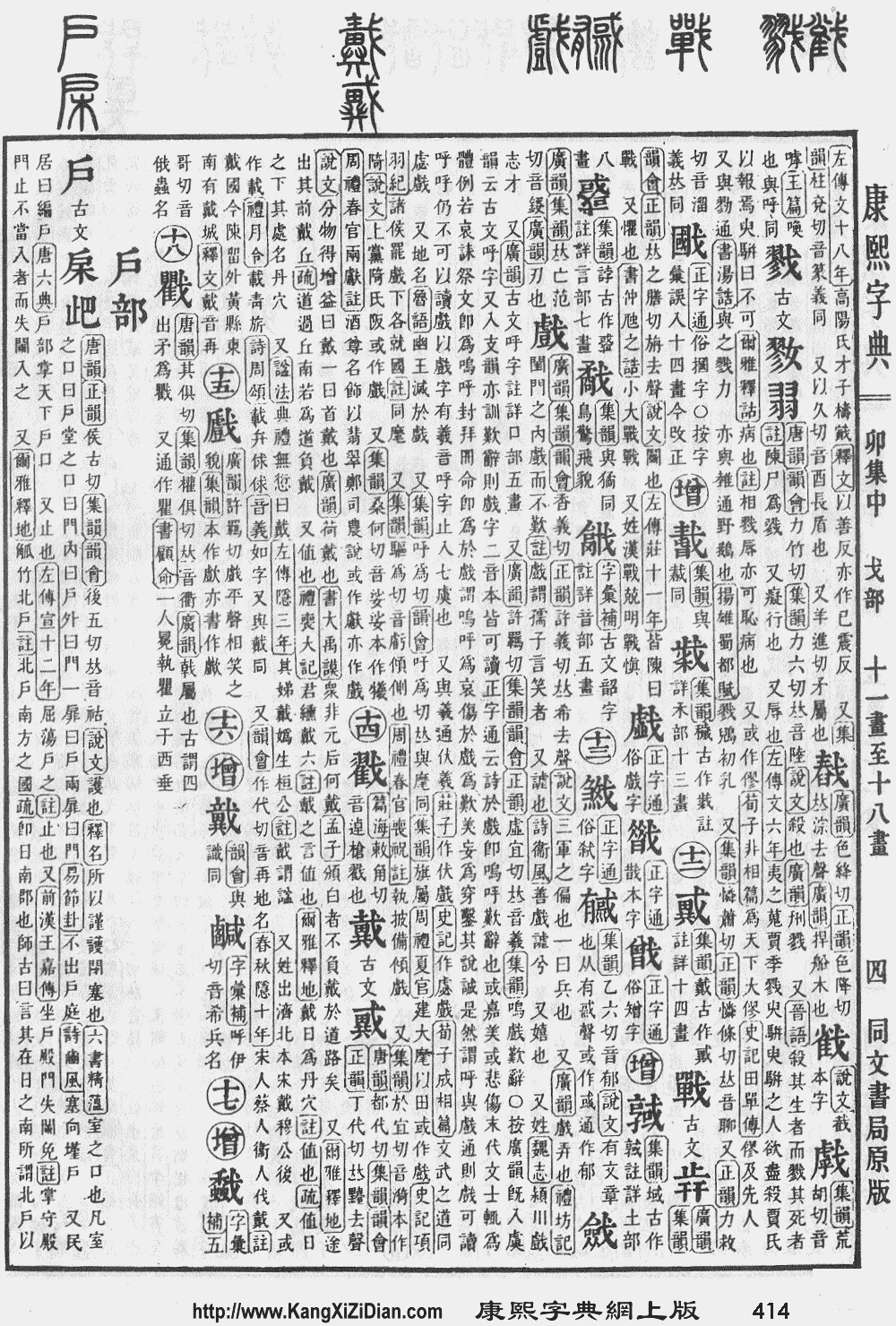
  • KangXi: page 414, character 32
  • Dai Kanwa Jiten: character 11696
  • Dae Jaweon: page 759, character 3
  • Hanyu Da Zidian (first edition): volume 3, page 2257, character 1
  • Unihan data for U+6236

Chinese

trad. 戶/户
simp. 户
alternative forms 戸

Glyph origin

Historical forms of the character 戶
Shang Western Zhou Warring States Shuowen Jiezi (compiled in Han) Liushutong (compiled in Ming)
Oracle bone script Bronze inscriptions Chu slip and silk script Small seal script Transcribed ancient scripts

Pictogram (象形) : half of 門 (“door”).

Etymology

From Proto-Sino-Tibetan *m/s-k(w)a-j (“mouth; opening; spread; door; face; jaw”). Cognate with Tibetan སྒོ (sgo, “door”). Please compare with Burmese အဝ (a.wa., “opening, mouth”).

Pronunciation


Note:
  • fu5 - vernacular;
  • fu4 - literary.

  • Dialectal data
Variety Location 戶
Mandarin Beijing /xu⁵¹/
Harbin /xu⁵³/
Tianjin /xu⁵³/
Jinan /xu²¹/
Qingdao /xu⁴²/
Zhengzhou /xu³¹²/
Xi'an /xu⁴⁴/
Xining /xv̩²¹³/
Yinchuan /xu¹³/
Lanzhou /xu¹³/
Ürümqi /xu²¹³/
Wuhan /xu³⁵/
Chengdu /fu¹³/
/xu¹³/
Guiyang /fu²¹³/
Kunming /xu²¹²/
Nanjing /xu⁴⁴/
Hefei /xu⁵³/
Jin Taiyuan /xu⁴⁵/
Pingyao /xu³⁵/
Hohhot /xu⁵⁵/
Wu Shanghai /vu²³/
Suzhou /ɦəu³¹/
Hangzhou /ɦu¹³/
Wenzhou /vu³⁵/
Hui Shexian /xu²²/
Tunxi /xu²⁴/
Xiang Changsha /fu⁵⁵/
Xiangtan /ɸu⁵⁵/
Gan Nanchang /fu²¹/
Hakka Meixian /fu⁵³/
Taoyuan /fu⁵⁵/
Cantonese Guangzhou /wu²²/
Nanning /wu²²/
Hong Kong /wu²²/
Min Xiamen (Min Nan) /hɔ²²/
Fuzhou (Min Dong) /hou²⁴²/
Jian'ou (Min Bei) /xu⁴⁴/
Shantou (Min Nan) /hou³⁵/
Haikou (Min Nan) /hu³³/
/hɔu³³/

Rime
Character 戶
Reading # 1/1
Initial (聲) 匣 (33)
Final (韻) 模 (23)
Tone (調) Rising (X)
Openness (開合) Open
Division (等) I
Fanqie 侯古切
Baxter huX
Reconstructions
Zhengzhang
Shangfang
/ɦuoX/
Pan
Wuyun
/ɦuoX/
Shao
Rongfen
/ɣoX/
Edwin
Pulleyblank
/ɦɔX/
Li
Rong
/ɣoX/
Wang
Li
/ɣuX/
Bernard
Karlgren
/ɣuoX/
Expected
Mandarin
Reflex
hù
Expected
Cantonese
Reflex
wu6
Baxter–Sagart system 1.1 (2014)
Character 戶 戶
Reading # 1/2 2/2
Modern
Beijing
(Pinyin)
hù hù
Middle
Chinese
‹ huX › ‹ huX ›
Old
Chinese
/*m-qˁaʔ/ /*m-qˁaʔ/
English to stop, to check door

Notes for Old Chinese notations in the Baxter–Sagart system:

* Parentheses "()" indicate uncertain presence;
* Square brackets "[]" indicate uncertain identity, e.g. *[t] as coda may in fact be *-t or *-p;
* Angle brackets "<>" indicate infix;
* Hyphen "-" indicates morpheme boundary;

* Period "." indicates syllable boundary.
Zhengzhang system (2003)
Character 戶
Reading # 1/1
No. 5296
Phonetic
component
戸
Rime
group
魚
Rime
subdivision
0
Corresponding
MC rime
戸
Old
Chinese
/*ɡʷaːʔ/

Definitions

戶

  1. † door
    戶外/户外  ―  hùwài  ―  outdoors
  2. ⁜ family; household
    戶籍/户籍  ―  hùjí  ―  household register
    專業戶/专业户  ―  zhuānyèhù  ―  expert (literally, “family which engages in a specialized trade”)
    釘子戶/钉子户  ―  dìngzǐhù  ―  nail house
  3. Classifier for households.
  4. (only in compounds) bank account
    賬戶/账户  ―  zhànghù  ―  account
    開戶/开户  ―  kāihù  ―  to open an account
  5. a surname

Compounds

Descendants

Sino-Xenic (戶):
  • → Vietnamese: hộ (戶)

Others:

Japanese

Kanji

戶

(uncommon “Hyōgai” kanji)

  1. door

Readings

  • Go-on: ぐ (gu); ご (go)
  • Kan-on: こ (ko)
  • Kun: と (to, 戶); へ (he, 戶)
  • Nanori: え (e); へ (he)

Usage notes

This character lacks JIS support; 戸 (U+6238) is used instead.

Korean

Hanja

戶 (eumhun 지게문 호 (jigemun ho))

  1. house
  2. hole

Vietnamese

Han character

戶: Hán Nôm readings: hộ

  1. This term needs a translation to English. Please help out and add a translation, then remove the text {{rfdef}}.
This article is issued from Wiktionary. The text is licensed under Creative Commons - Attribution - Sharealike. Additional terms may apply for the media files.