沫

沫 U+6CAB, 沫
CJK UNIFIED IDEOGRAPH-6CAB
← 沪
[U+6CAA]
CJK Unified Ideographs 沬 →
[U+6CAC]
See also: 沬

Translingual

Stroke order

Han character

沫 (Kangxi radical 85, 水+5, 8 strokes, cangjie input 水木十 (EDJ), four-corner 35190, composition ⿰氵末)

References

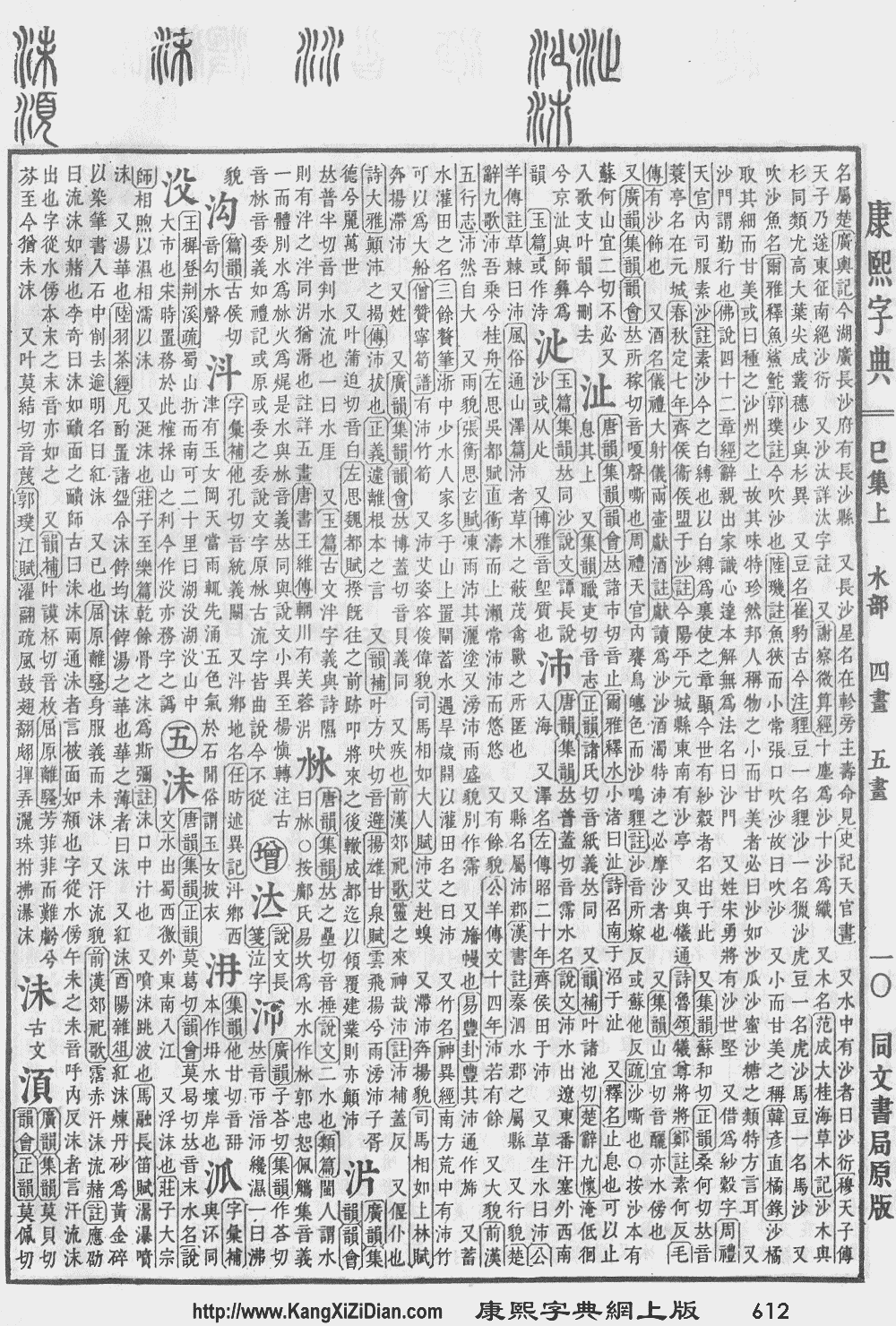
  • KangXi: page 612, character 13
  • Dai Kanwa Jiten: character 17235
  • Dae Jaweon: page 1006, character 1
  • Hanyu Da Zidian (first edition): volume 3, page 1578, character 2
  • Unihan data for U+6CAB

Chinese

Glyph origin

Etymology 1

simp. and trad.
沫

(This etymology is missing or incomplete. Please add to it, or discuss it at the Etymology scriptorium.)

Pronunciation


Note:
  • boa̍h - vernacular;
  • boa̍t - literary.
Note:
  • bhuah8 - vernacular;
  • muag8/muêg8 - literary.

Rime
Character 沫
Reading # 1/1
Initial (聲) 明 (4)
Final (韻) 桓 (64)
Tone (調) Checked (Ø)
Openness (開合) Closed
Division (等) I
Fanqie 莫撥切
Reconstructions
Zhengzhang
Shangfang
/muɑt̚/
Pan
Wuyun
/mʷɑt̚/
Shao
Rongfen
/muɑt̚/
Edwin
Pulleyblank
/mwat̚/
Li
Rong
/muɑt̚/
Wang
Li
/muɑt̚/
Bernard
Karlgren
/muɑt̚/
Expected
Mandarin
Reflex
mò
Expected
Cantonese
Reflex
mut6
Baxter–Sagart system 1.1 (2014)
Character 沫
Reading # 1/1
Modern
Beijing
(Pinyin)
mò
Middle
Chinese
‹ mat ›
Old
Chinese
/*mˁat/
English foam, spittle

Notes for Old Chinese notations in the Baxter–Sagart system:

* Parentheses "()" indicate uncertain presence;
* Square brackets "[]" indicate uncertain identity, e.g. *[t] as coda may in fact be *-t or *-p;
* Angle brackets "<>" indicate infix;
* Hyphen "-" indicates morpheme boundary;

* Period "." indicates syllable boundary.
Zhengzhang system (2003)
Character 沫
Reading # 1/1
No. 9233
Phonetic
component
末
Rime
group
月
Rime
subdivision
1
Corresponding
MC rime
末
Old
Chinese
/*maːd/

Definitions

沫

  1. froth; foam; bubbles; suds
  2. saliva
  3. (literary) to stop

Compounds

  • 流沫
  • 海沫
  • 涎沫 (xiánmò)
  • 煦沫
  • 白沫 (báimò)
  • 相濡以沫 (xiāngrúyǐmò)
  • 肉沫
  • 口沫橫飛/口沫横飞
  • 唾沫直嚥/唾沫直咽
  • 泡沫劑/泡沫剂
  • 泡沫塑膠/泡沫塑胶
  • 泡沫橡膠/泡沫橡胶
  • 泡沫紅茶/泡沫红茶
  • 泡沫經濟/泡沫经济 (pàomò jīngjì)
  • 泡沫車/泡沫车
  • 泡沫髮膠/泡沫发胶
  • 涸鱗濡沫/涸鳞濡沫
  • 濡沫涸轍/濡沫涸辙
  • 飛沫/飞沫 (fēimò)
  • 飛沫傳染/飞沫传染

Etymology 2

simp. and trad.
沫
alternative forms 垡
粕
渤
𨑾

Probably from a Mon-Khmer substrate; compare Vietnamese bọt (“foam; froth”) (Norman and Mei, 1976). Also compare Mizo phûl (“scum; froth; foam”) (Schuessler, 2007).

Pronunciation


Definitions

沫

  1. (Min) scum; froth

Japanese

Kanji

沫

(“Jinmeiyō” kanji used for names)

  1. splash
  2. suds

Readings

  • Go-on: まち (machi); まつ (matsu)
  • Kan-on: ばつ (batsu)
  • Kun: あわ (awa, 沫)

Etymology

Kanji in this term
沫
あわ
Jinmeiyō
kun’yomi
For pronunciation and definitions of 沫 – see the following entry.
【泡あわ】S
[noun] bubble
[noun] foam, head on carbonated beverages such as beer
(This term, 沫, is an alternative spelling of the above term.)

Korean

Etymology

(This etymology is missing or incomplete. Please add to it, or discuss it at the Etymology scriptorium. Particularly: “Middle Korean readings, if any”)

Pronunciation

Hanja

Wikisource 沫 (eum 말 (mal))

  1. This term needs a translation to English. Please help out and add a translation, then remove the text {{rfdef}}.

Compounds

Vietnamese

Han character

沫: Hán Nôm readings: mượt, mát, mạt, mướt

  1. This term needs a translation to English. Please help out and add a translation, then remove the text {{rfdef}}.
This article is issued from Wiktionary. The text is licensed under Creative Commons - Attribution - Sharealike. Additional terms may apply for the media files.