諗
See also: 谂
| ||||||||
Translingual
Han character
諗 (Kangxi radical 149, 言+8, 15 strokes, cangjie input 卜口人戈心 (YROIP), four-corner 08632, composition ⿰訁念)
References
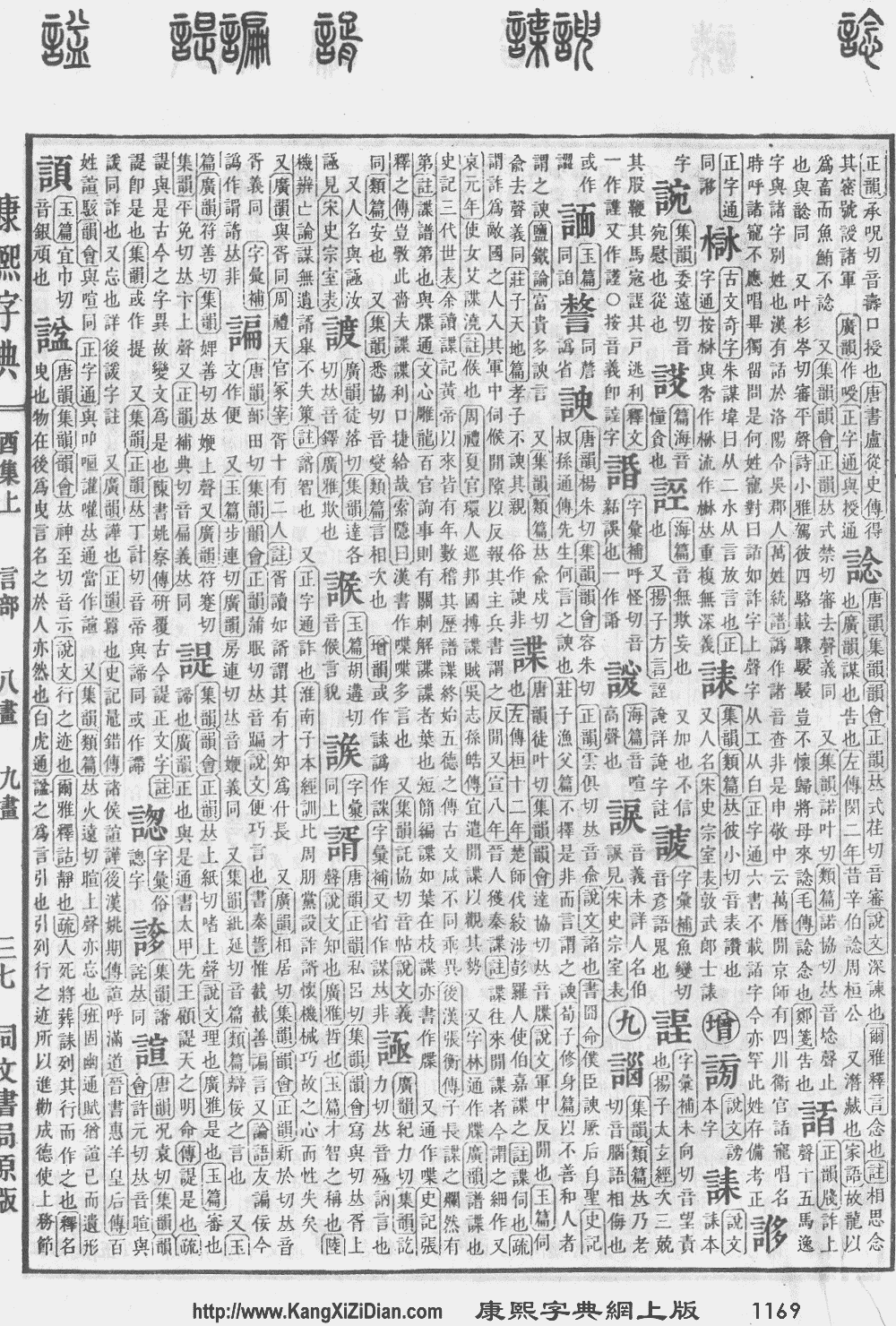
- KangXi: page 1169, character 1
- Dai Kanwa Jiten: character 35660
- Dae Jaweon: page 1634, character 2
- Hanyu Da Zidian (first edition): volume 6, page 3989, character 3
- Unihan data for U+8AD7
Chinese
Glyph origin
Etymology 1
| trad. | 諗 | |
|---|---|---|
| simp. | 谂 | |
| alternative forms | 恁 惗 | |
Probably a Kra-Dai substrate word. Compare Zhuang naemj (“to think”). This root occurs in several Zhuang dialects and Mien, and in Liuzhou Mandarin nɐn⁵⁴.
Bai (1980) associates this word with 恁 (“to think”).
Bauer (1996) argues the direction of borrowing of this word is not certain, and it is just as likely that Zhuang and/or Mien borrowed it from Cantonese as the other way round. This root does not seem to occur in the Tibeto-Burman languages.
Pronunciation
Synonyms
Dialectal synonyms of 想 (“to think”) [map]
| Variety | Location | Words |
|---|---|---|
| Formal (Written Standard Chinese) | 想 | |
| Mandarin | Beijing | 想 |
| Taiwan | 想 | |
| Jinan | 想 | |
| Xi'an | 想 | |
| Wuhan | 想 | |
| Chengdu | 想 | |
| Yangzhou | 想 | |
| Hefei | 想 | |
| Malaysia | 想 | |
| Singapore | 想 | |
| Cantonese | Guangzhou | 諗 |
| Hong Kong | 諗 | |
| Zhongshan (Shiqi) | 諗 | |
| Taishan | 諗 | |
| Kaiping (Chikan) | 諗 | |
| Dongguan | 諗 | |
| Yangjiang | 諗 | |
| Nanning | 諗 | |
| Kuala Lumpur (Guangfu) | 諗 | |
| Penang (Guangfu) | 諗 | |
| Singapore (Guangfu) | 諗 | |
| Gan | Nanchang | 想 |
| Hakka | Meixian | 想, 愐 |
| Wuhua (Huacheng) | 想 | |
| Miaoli (N. Sixian) | 想, 愐 | |
| Pingtung (Neipu; S. Sixian) | 想, 愐 | |
| Hsinchu County (Zhudong; Hailu) | 想, 愐 | |
| Taichung (Dongshi; Dabu) | 想, 愐 | |
| Hsinchu County (Qionglin; Raoping) | 想, 愐 | |
| Yunlin (Lunbei; Zhao'an) | 想 | |
| Jin | Taiyuan | 想 |
| Min Bei | Jian'ou | 想 |
| Min Dong | Fuzhou | 想 |
| Min Nan | Xiamen | 想 |
| Quanzhou | 想 | |
| Zhangzhou | 想 | |
| Taipei | 想 | |
| New Taipei (Sanxia) | 想 | |
| Kaohsiung | 想 | |
| Yilan | 想 | |
| Changhua (Lukang) | 想 | |
| Taichung | 想 | |
| Tainan | 想 | |
| Hsinchu | 想 | |
| Kinmen | 想 | |
| Penghu (Magong) | 想 | |
| Penang (Hokkien) | 想 | |
| Singapore (Hokkien) | 想 | |
| Manila (Hokkien) | 想 | |
| Chaozhou | 想 | |
| Shantou | 想 | |
| Singapore (Teochew) | 想 | |
| Wenchang | 想 | |
| Wu | Suzhou | 想 |
| Ningbo | 忖 | |
| Wenzhou | 想 | |
| Xiang | Changsha | 想 |
| Shuangfeng | 想 | |
Compounds
Pronunciation
Japanese
Kanji
諗
- This term needs a translation to English. Please help out and add a translation, then remove the text
{{rfdef}}.
Korean
Hanja
諗 (eum 심 (sim))
- This term needs a translation to English. Please help out and add a translation, then remove the text
{{rfdef}}.
Vietnamese
Han character
- This term needs a translation to English. Please help out and add a translation, then remove the text
{{rfdef}}.
References
This article is issued from Wiktionary. The text is licensed under Creative Commons - Attribution - Sharealike. Additional terms may apply for the media files.