巳

See also: 己 and 已
巳 U+5DF3, 巳
CJK UNIFIED IDEOGRAPH-5DF3
← 已
[U+5DF2]
CJK Unified Ideographs 巴 →
[U+5DF4]
⺒ U+2E92, ⺒
CJK RADICAL SNAKE
← ⺑
[U+2E91]
CJK Radicals Supplement ⺓ →
[U+2E93]

Translingual

Stroke order

Han character

巳 (Kangxi radical 49, 己+0, 3 strokes, cangjie input 口山 (RU), four-corner 77717, composition ⿺乚コ)

Derived characters

  • Appendix:Chinese radical/己
  • 包 (Chinese form)
  • 导

References

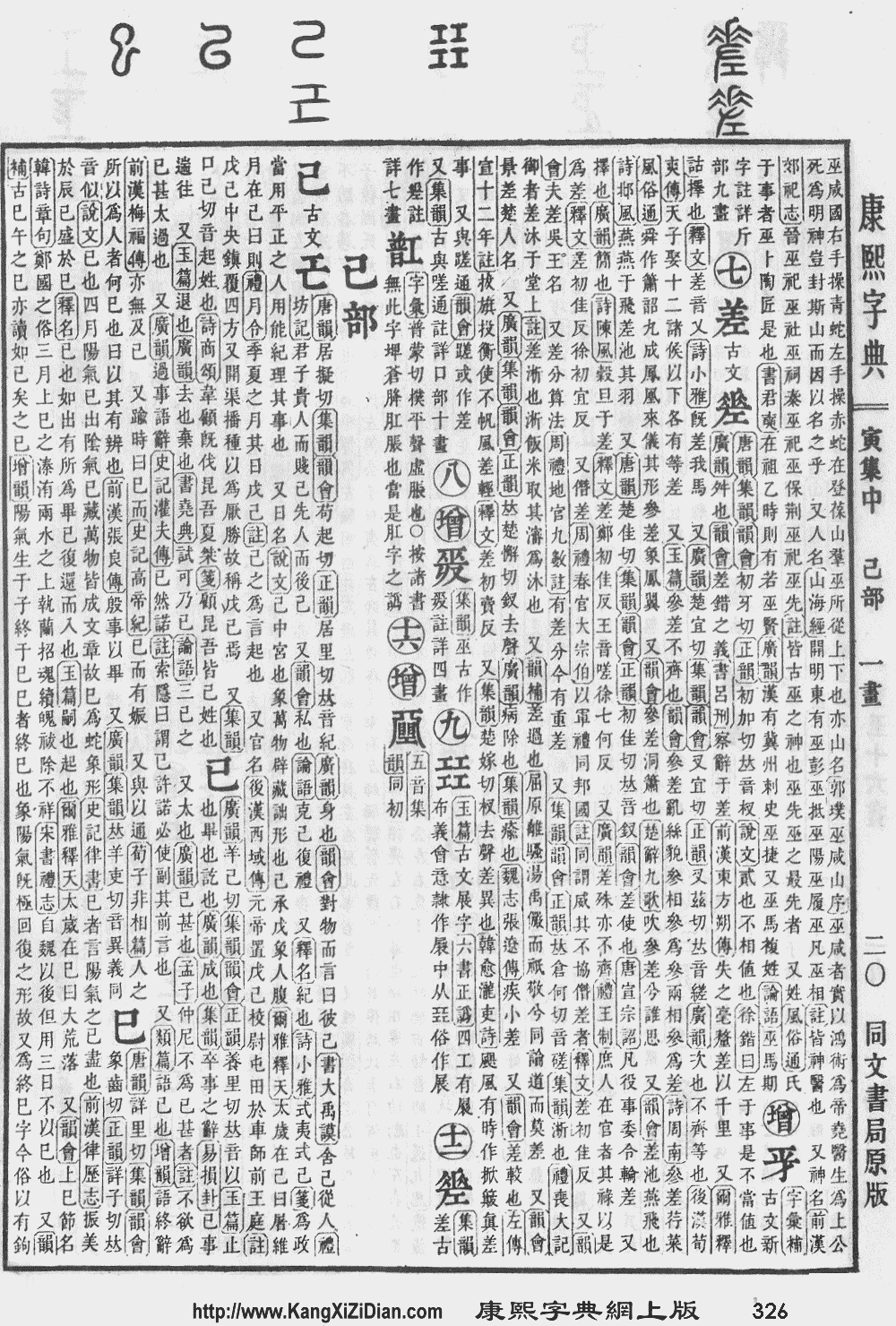
  • KangXi: page 326, character 12
  • Dai Kanwa Jiten: character 8744
  • Dae Jaweon: page 631, character 1
  • Hanyu Da Zidian (first edition): volume 2, page 984, character 2
  • Unihan data for U+5DF3

Chinese

simp. and trad.
巳

Glyph origin

Historical forms of the character 巳
Shuowen Jiezi (compiled in Han)
Small seal script

Two different theories:

  • Pictogram (象形) of a snake (therefore, it should be similar to 巴). This theory is found in the Shuowen Jiezi;
  • Pictogram (象形) of a fetus (it can be seen in 包, 胞. In 包, the radical should represent the placenta. 胞 today means "cell").

The character is similar to 已, which cannot be found in the Shuowen Jiezi.

Etymology 1

巳 (OC s-ləʔ) displaced 子 (OC tsəʔ), the original sixth earthly branch which denoted the moon's "coming forth" stage (i.e. early waning-gibbous phase) "due to phonological closeness (combined with the semantic opacity of the Branch terms at later eras)" (Smith, 2011).

Association with the snake was possibly arbitrary, analogous to how 辰, the fifth earthly branch, was arbitrarily associated with the dragon (Ferlus, 2013).

Pronunciation


Note: chī - vernacular, sū - literary.

Rime
Character 巳
Reading # 2/3
Initial (聲) 邪 (17)
Final (韻) 之 (19)
Tone (調) Rising (X)
Openness (開合) Open
Division (等) III
Fanqie 詳里切
Baxter ziX
Reconstructions
Zhengzhang
Shangfang
/zɨX/
Pan
Wuyun
/zɨX/
Shao
Rongfen
/zieX/
Edwin
Pulleyblank
/zɨX/
Li
Rong
/ziəX/
Wang
Li
/zĭəX/
Bernard
Karlgren
/ziX/
Expected
Mandarin
Reflex
sì
Expected
Cantonese
Reflex
zi6
Baxter–Sagart system 1.1 (2014)
Character 巳
Reading # 1/1
Modern
Beijing
(Pinyin)
sì
Middle
Chinese
‹ ziX ›
Old
Chinese
/*s-[ɢ]əʔ/
English 6th earthly branch

Notes for Old Chinese notations in the Baxter–Sagart system:

* Parentheses "()" indicate uncertain presence;
* Square brackets "[]" indicate uncertain identity, e.g. *[t] as coda may in fact be *-t or *-p;
* Angle brackets "<>" indicate infix;
* Hyphen "-" indicates morpheme boundary;

* Period "." indicates syllable boundary.
Zhengzhang system (2003)
Character 巳
Reading # 1/2
No. 12007
Phonetic
component
巳
Rime
group
之
Rime
subdivision
0
Corresponding
MC rime
似
Old
Chinese
/*ljɯʔ/

Definitions

巳

  1. sixth of twelve earthly branches (十二支)
  2. snake (蛇) of Chinese zodiac
Coordinate terms
Compounds
  • 巳蛇

References

Etymology 2

For pronunciation and definitions of 巳 – see 已 (“to stop; to finish; already; have done something; etc.”).
(This character, 巳, is a variant form of 已.)

Japanese

Kanji

巳

(“Jinmeiyō” kanji used for names)

  1. sign of the snake

Readings

  • Go-on: じ (ji)
  • Kan-on: し (shi)
  • Kun: み (mi, 巳)

Etymology 1

Kanji in this term
巳
み
Jinmeiyō
kun’yomi

Short for 蛇 (hemi, “snake”)

Pronunciation

Proper noun

巳(み) • (Mi) 

  1. the Snake, the sixth of the twelve Earthly Branches

Etymology 2

Kanji in this term
巳
し
Jinmeiyō
on’yomi

From Middle Chinese 巳 (ziX).

Proper noun

巳(し) • (Shi) 

  1. the Snake, the sixth of the twelve Earthly Branches

Korean

Hanja

巳 • (sa) (hangeul 사, revised sa, McCune–Reischauer sa, Yale sa)

  1. the hours from 9 to 11
  2. 6th terrestrial branch

Vietnamese

Han character

巳: Hán Nôm readings: tị

  1. This term needs a translation to English. Please help out and add a translation, then remove the text {{rfdef}}.
This article is issued from Wiktionary. The text is licensed under Creative Commons - Attribution - Sharealike. Additional terms may apply for the media files.