未
| ||||||||
Translingual
| Stroke order | |||
|---|---|---|---|
 | |||
Han character
未 (Kangxi radical 75, 木+1, 5 strokes, cangjie input 十木 (JD), four-corner 50900, composition ⿻一木)
Derived characters
References
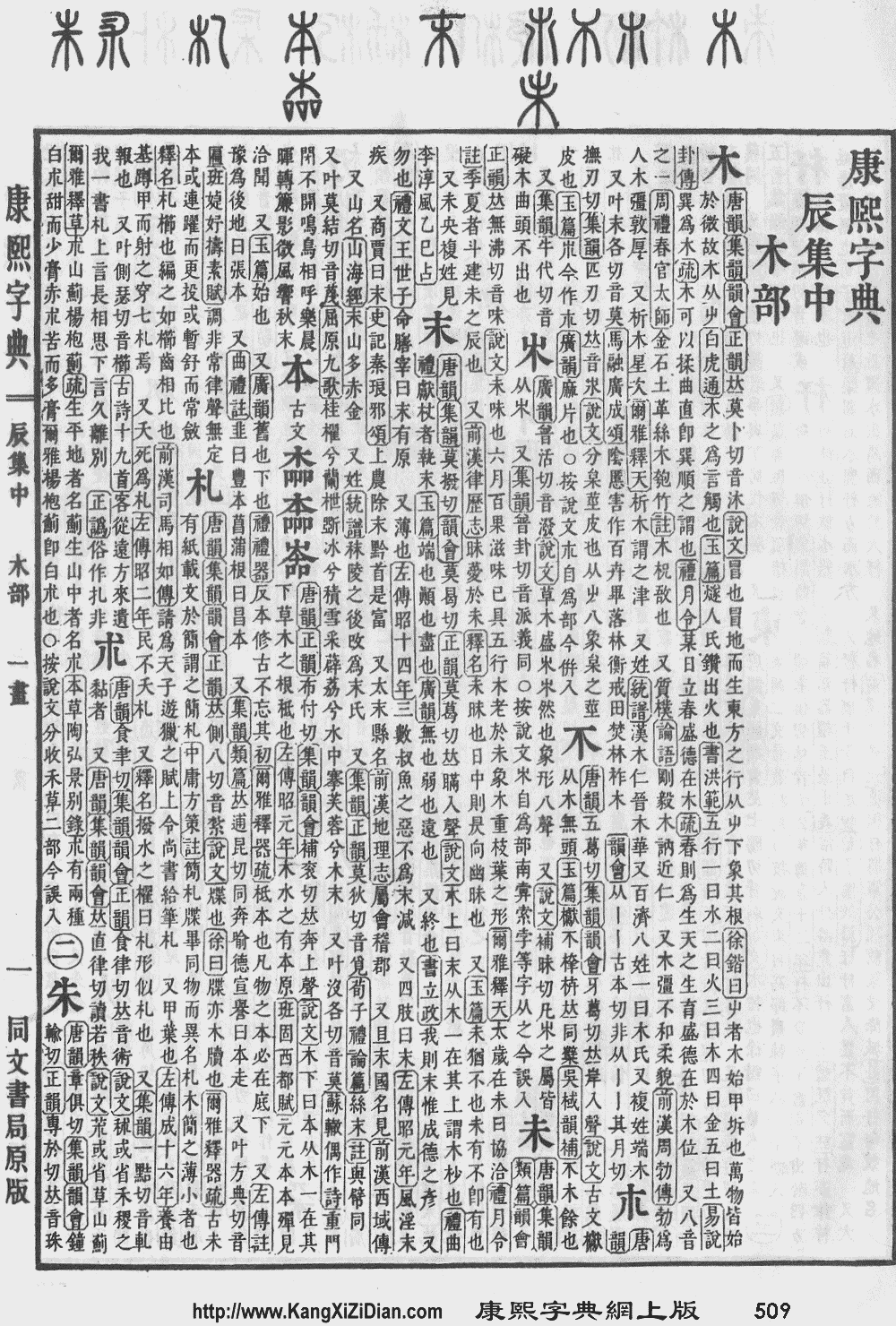
- KangXi: page 509, character 5
- Dai Kanwa Jiten: character 14419
- Dae Jaweon: page 890, character 3
- Hanyu Da Zidian (first edition): volume 2, page 1150, character 1
- Unihan data for U+672A
Chinese
| simp. and trad. |
未 | |
|---|---|---|
Glyph origin
| Historical forms of the character 未 | |||||
|---|---|---|---|---|---|
| Shang | Western Zhou | Warring States | Shuowen Jiezi (compiled in Han) | ||
| Bronze inscriptions | Oracle bone script | Bronze inscriptions | Oracle bone script | Chu slip and silk script | Small seal script |
 |
 |
 |
 |
 |
 |
Characters in the same phonetic series (未) (Zhengzhang, 2003)
Pictogram (象形) – a tree with two layers of branches, or a tree's top branches not yet at full growth, signifying not grown (yet)
Etymology
- "not yet"
- Pulleyblank (1995), apud Schuessler (2007), proposes that this word results from a fusion of negative root *m- with perfective particle 既 (jì, “already”).
- "eighth earthly branch"
- Smith (2011) proposes that 未 (OC *mɯds) denoted the waxing moon's "impending stage" before full moon. 未 (OC *mɯds)'s early sense might be "tip" > "on the tipping point" if it could be connected to 末 (OC *maːd, “tip”), which is similar graphically and phonologically; though what morphological mechanism which can associate them two is unclear.
- As for its association with the goat, Ferlus (2013) notes there is good correspondence with Austronesian Atayal miːts (“lamb”); also compare Lao ມົດ (mot, “year of the lamb”).
Pronunciation
Definitions
未
Synonyms
- (not yet): 還沒/还没 (háiméi), 仍未 (réngwèi); (literary) 尚未 (shàngwèi); (Cantonese) 仲未, 並未/并未 (bìngwèi); (Hakka) 吂曾, 吂識/吂识; (Min Nan) 猶未/犹未; (Wu) 朆
- (not):
Dialectal synonyms of 不 (“not”) [map]
Coordinate terms
Compounds
Derived terms from 未
|
|
|
Further reading
- “Entry #1663”, in 臺灣閩南語常用詞辭典 [Dictionary of Frequently-Used Taiwan Minnan] (in Chinese and Min Nan), Ministry of Education, R.O.C., 2011.
Japanese
Compounds
- 未開 (mikai, “uncivilized”)
- 未完 (mikan, “unfinished”)
- 未婚 (mikon, “unmarried”)
- 未熟 (mijuku, “immature; inexperienced”)
- 未遂 (misui, “attempt”, at a crime)
- 未成年 (miseinen, “minor”)
- 未然 (mizen, “previously”)
- 未然形 (mizenkei, “imperfective form”)
- 未曾有 (mizōu), 未曾有 (mizou, “unprecedented”)
- 未知 (michi, “unknown”)
- 未知数 (michisū, “unknown, variable”, in mathematics)
- 未定 (mitei, “undecided”)
- 未踏 (mitō, “unexplored”)
- 未納 (minō, “payment default”)
- 未必の故意 (mihitsu no koi, “willful negligence”)
- 未亡人 (mibōjin, “widow”)
- 未満 (miman, “insufficient”)
- 未来 (mirai, “future”)
- 未了 (miryō, “unfinished”)
Korean
Etymology
From Middle Chinese 未 (MC mʉiH).
| Historical readings |
|---|
|
Pronunciation
- (in 미안 (未安, mian)):
- (SK Standard/Seoul) IPA(key): [mi]
- Phonetic hangul: [미]
- (not; un-; etc.):
- (SK Standard/Seoul) IPA(key): [mi(ː)]
- Phonetic hangul: [미(ː)]
- Though still prescribed in Standard Korean, most speakers in both Koreas no longer distinguish vowel length.
Compounds
Vietnamese
This article is issued from Wiktionary. The text is licensed under Creative Commons - Attribution - Sharealike. Additional terms may apply for the media files.