囗
| ||||||||
| ||||||||
Translingual
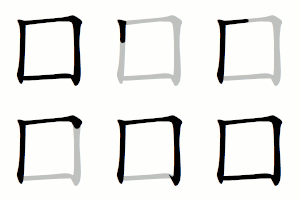
| Stroke order | |||
|---|---|---|---|
 | |||
Han character
囗 (Kangxi radical 31, 囗+0, 3 strokes, cangjie input 月一 (BM) or XX月一 (XXBM), four-corner 60000, composition ⿱冂一)
- Kangxi radical #31, ⼞.
Usage notes
This character (囗) is used for enclosures. If a square is used within a character, then the character is 口 (“mouth”) (U+53E3) instead.
References
- KangXi: page 216, character 14
- Dai Kanwa Jiten: character 4675
- Dae Jaweon: page 439, character 15
- Hanyu Da Zidian (first edition): volume 1, page 710, character 8
- Unihan data for U+56D7

Chinese
Glyph origin
| Historical forms of the character 囗 | |||
|---|---|---|---|
| Shang | Western Zhou | Shuowen Jiezi (compiled in Han) | Liushutong (compiled in Ming) |
| Oracle bone script | Bronze inscriptions | Small seal script | Transcribed ancient scripts |
 |
 |
 |
 |
Etymology 1
| For pronunciation and definitions of 囗 – see 圍 (“to surround; to encircle; to corral; all sides; etc.”). (This character, 囗, is recorded in one or more historical dictionaries as an ancient form of 圍.) |
Japanese
Readings
As a radical and ancient kanji for 国 (“country”):
- Go-on: こく (koku)
- Kan-on: こく (koku)
- Kun: くに (kuni, 囗); くにがまえ (kunigamae, 囗)←くにがまへ (kunigamafe, 囗, historical)
As an ancient kanji for 囲 (“to surround/encircle”):
- Go-on: え (e)←ゑ (we, historical)
- Kan-on: い (i)←ゐ (wi, historical)
- Kun: かこむ (kakomu, 囗む)
Korean
Vietnamese
References
- Trần (2004).
- Bonet (1899).
This article is issued from Wiktionary. The text is licensed under Creative Commons - Attribution - Sharealike. Additional terms may apply for the media files.