舟
| ||||||||
| ||||||||
Translingual
| Stroke order | |||
|---|---|---|---|
 | |||
Alternative forms
Han character
舟 (Kangxi radical 137, 舟+0, 6 strokes, cangjie input 竹月卜戈 (HBYI), four-corner 27440, composition ⿱丿⿻⿵⺆⺀一)
- Kangxi radical #137, ⾈.
Derived characters
See also
References
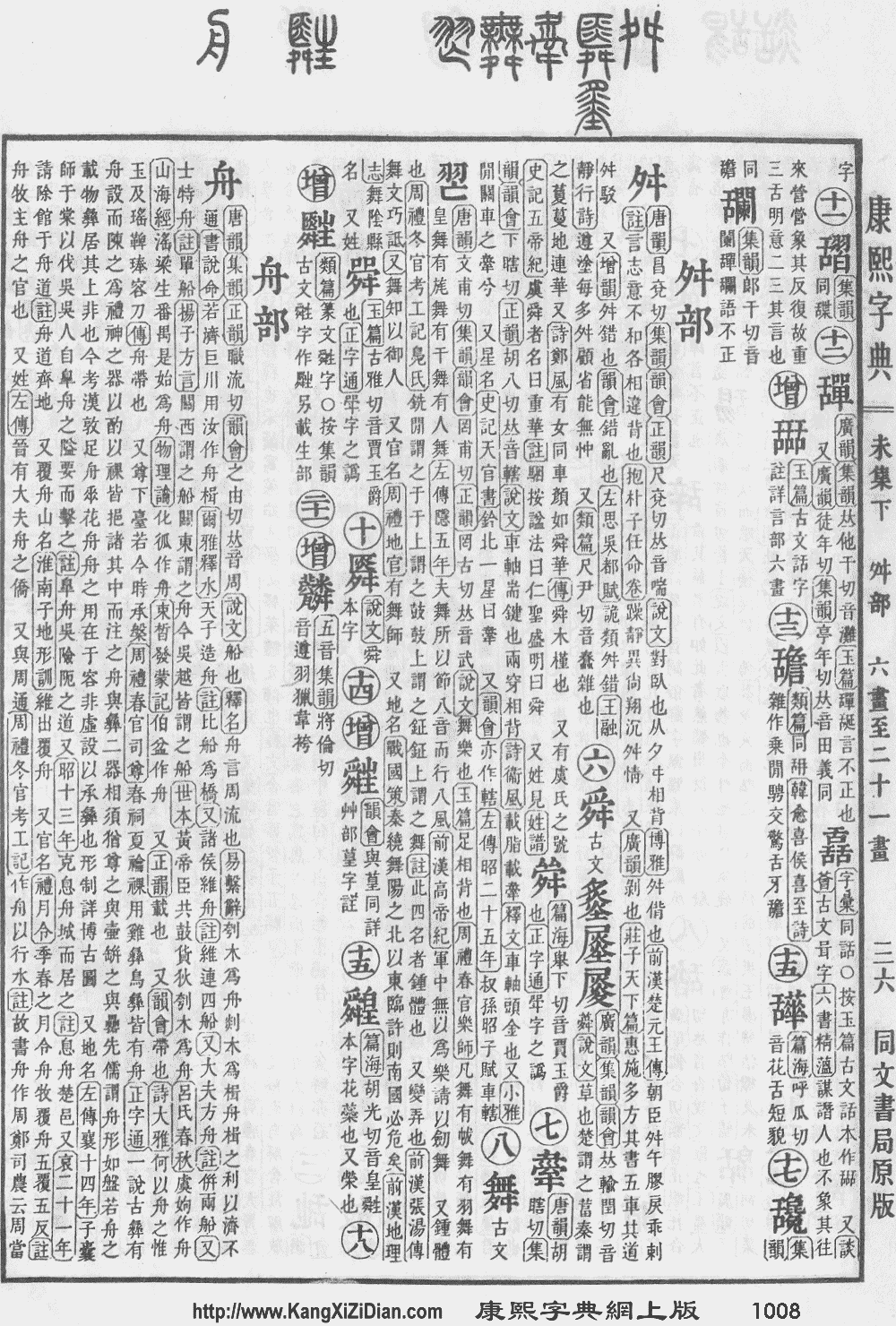
- KangXi: page 1008, character 24
- Dai Kanwa Jiten: character 30350
- Dae Jaweon: page 1466, character 6
- Hanyu Da Zidian (first edition): volume 5, page 3055, character 1
- Unihan data for U+821F
Chinese
| simp. and trad. |
舟 | |
|---|---|---|
| 2nd round simp. | 𠔾 | |
| alternative forms | 𣍝 | |
Glyph origin
| Historical forms of the character 舟 | |||
|---|---|---|---|
| Shang | Western Zhou | Shuowen Jiezi (compiled in Han) | Liushutong (compiled in Ming) |
| Oracle bone script | Bronze inscriptions | Small seal script | Transcribed ancient scripts |
 |
 |
 |
 |
Characters in the same phonetic series (舟) (Zhengzhang, 2003)
Pictogram (象形) – a boat.
Etymology
According to Schuessler (2007), a loan from Proto-Mon-Khmer *ɗuuk ~ *ɗuk (“boat, canoe”), whence Khmer ទូក (tuuk) and Vietnamese nốc (< Proto-Vietic *ɗoːk (“boat”)). Foreign closed syllables having a long main vowel often correspond to open syllables in Old Chinese.
Possibly cognate of 輈 (OC *tɯw, “trunk, pole”) (Schuessler, 2007).
Yang Xiong's Fangyan says that Old Chinese 舟 (OC *tjɯw) is common in central and eastern China, while its synonym 船 (OC *ɦljon) is used in western China.
Pronunciation
Definitions
舟
- (literary) boat
- 同舟共濟/同舟共济 ― tóngzhōugòngjì ― to pull together in times of trouble (literally, “to cross a river in the same boat”)
- 二子乘舟,泛泛其景。 [Pre-Classical Chinese, trad. and simp.]
- From: The Classic of Poetry, c. 11th – 7th centuries BCE, translated based on James Legge's version
- Èr zǐ chéng zhōu, fàn fàn qí yǐng. [Pinyin]
- The two youths got into their boats,
Whose shadows floated about [on the water].
- (obsolete) to ride in a boat; to sail a boat
- a surname
Synonyms
- (boat):
Dialectal synonyms of 船 (“watercraft; vessel”) [map]
Compounds
Derived terms from 舟
|
|
References
- “舟”, in 漢語多功能字庫 (Multi-function Chinese Character Database), 香港中文大學 (the Chinese University of Hong Kong), 2014–
- Dictionary of Chinese Character Variants (教育部異體字字典), A03410
Japanese
Etymology 1
| Kanji in this term |
|---|
| 舟 |
| ふね Grade: S |
| kun’yomi |
Synonyms
- 舟艇 (shūtei)
Etymology 2
| Kanji in this term |
|---|
| 舟 |
| ふな Grade: S |
| kun’yomi |
Korean
Vietnamese
This article is issued from Wiktionary. The text is licensed under Creative Commons - Attribution - Sharealike. Additional terms may apply for the media files.