船
| ||||||||
Translingual
| Stroke order | |||
|---|---|---|---|
 | |||
Alternative forms
The top-right part can be either 八 or 几, depending on the script; Japanese: 船, mainland China: 船, traditional Chinese: 船, Korean: 船; see Han unification.
Han character
船 (Kangxi radical 137, 舟+5, 11 strokes, cangjie input 竹卜金口 (HYCR) or 竹卜竹弓口 (HYHNR), four-corner 28460, composition ⿰舟㕣)
References
- KangXi: page 1010, character 17
- Dai Kanwa Jiten: character 30407
- Dae Jaweon: page 1468, character 15
- Hanyu Da Zidian (first edition): volume 5, page 3060, character 1
- Unihan data for U+8239

Chinese
| trad. | 船 | |
|---|---|---|
| simp. # | 船 | |
| alternative forms | 舩/船 | |
Glyph origin
| Historical forms of the character 船 | |
|---|---|
| Western Zhou | Shuowen Jiezi (compiled in Han) |
| Bronze inscriptions | Small seal script |
 |
 |
Phono-semantic compound (形聲, OC *ɦljon) : semantic 舟 (“boat”) + phonetic 㕣 (OC *lon).
Etymology
From Proto-Sino-Tibetan *m-lawŋ (“boat”). Compare Burmese လောင်း (laung:, “long and narrow boat”).
Sagart (1999) interprets Old Chinese 船 (OC *ɦljon) as a nominal derivate of the verb 沿 (OC *lon, “to go downstream a river”). The Fangyan states that this word was commonly used in western China, but, by Han times, it had completely displaced the earlier 舟 (OC *tjɯw), used in central and eastern China.
Alternatively, the Proto-Sino-Tibetan root could be a loan from Proto-Mon-Khmer *d₂lu(u)ŋ ~ *d₂l(u)əŋ (“boat”), whence Mon ဂၠုၚ် (klɜ̀ŋ, “canoe, small boat”), perhaps a derivate of Proto-Mon-Khmer *luŋh ~ *luuŋh ~ *ləŋh (“to hollow, excavate, bore”), see Khmer លុង (lung, “to dig a hole”) and Vietnamese trũng (“concave”) (Sidwell, 2006; Schuessler, 2007).
Pronunciation
Definitions
船
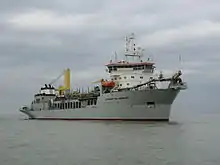
- watercraft; vessel (including ships, boats, sailing ships, hovercrafts; sometimes including submarines) (Classifier: 條/条 m; 艘 m; 隻/只 m)
- an object with a shape or function similar to watercraft
- (obsolete) alcohol cup
- (obsolete) to carry by watercraft
- (obsolete, dialectal) button
- a surname: Chuan
- (Hong Kong, colloquial) scholarship
Synonyms
- (watercraft):
Compounds
|
|
|
Japanese
| Shinjitai | 船 | |
| Kyūjitai [1] |
船󠄂 船+ 󠄂?(Adobe-Japan1) |
 |
| 船󠄄 船+ 󠄄?(Hanyo-Denshi) (Moji_Joho) | ||
| The displayed kanji may be different from the image due to your environment. See here for details. | ||
Readings
Etymology 1
| Kanji in this term |
|---|
| 船 |
| ふね Grade: 2 |
| kun’yomi |
From Old Japanese 船 (pune2), from Proto-Japonic *punay.
Possibly derived from 船 (funa, “ship”), via fusion of emphatic nominal particle い (i).
Synonyms
- 船舶 (senpaku)
Etymology 2
| Kanji in this term |
|---|
| 船 |
| ふな Grade: 2 |
| kun’yomi |
From Old Japanese. Possibly the older form of 船 (fune, “ship”).
References
- 1914, 漢和大辭書 (Kanwa Dai Jisho, “The Great Kanji-Japanese Dictionary”) (in Japanese), page 1790 (paper), page 947 (digital), Tōkyō: 興文社 (Kōbunsha)
- 2006, 大辞林 (Daijirin), Third Edition (in Japanese), Tōkyō: Sanseidō, →ISBN
- 1998, NHK日本語発音アクセント辞典 (NHK Japanese Pronunciation Accent Dictionary) (in Japanese), Tōkyō: NHK, →ISBN
Korean
Etymology
(This etymology is missing or incomplete. Please add to it, or discuss it at the Etymology scriptorium. Particularly: “what is its historical reading?”)
Kunigami
Etymology
Inherited from Proto-Ryukyuan *pune, from Proto-Japonic *punay.
Pronunciation
- IPA(key): /pʰuniː/
Miyako
Etymology
Inherited from Proto-Ryukyuan *pune, from Proto-Japonic *punay.
Pronunciation
- IPA(key): /fu̥ni/
Okinawan
Etymology
Inherited from Proto-Ryukyuan *pune, from Proto-Japonic *punay.
Pronunciation
- IPA(key): /ɸuni/
Yaeyama
Etymology
Inherited from Proto-Ryukyuan *pune, from Proto-Japonic *punay.
Pronunciation
- IPA(key): /ɸuni/
Yonaguni
Etymology
Inherited from Proto-Ryukyuan *pune, from Proto-Japonic *punay.
Pronunciation
- IPA(key): /nni/