乘

See also: 乗, 椉, and 埀
乘 U+4E58, 乘
CJK UNIFIED IDEOGRAPH-4E58
← 乗
[U+4E57]
CJK Unified Ideographs 乙 →
[U+4E59]

Translingual

Japanese 乗
Simplified 乘
Traditional 乘

Han character

乘 (Kangxi radical 4, 丿+9, 10 strokes, cangjie input 竹木中心 (HDLP), four-corner 20901, composition ⿻禾北 or ⿻乖人)

Derived characters

Descendants

  • (chiefly Japanese): 乗

References

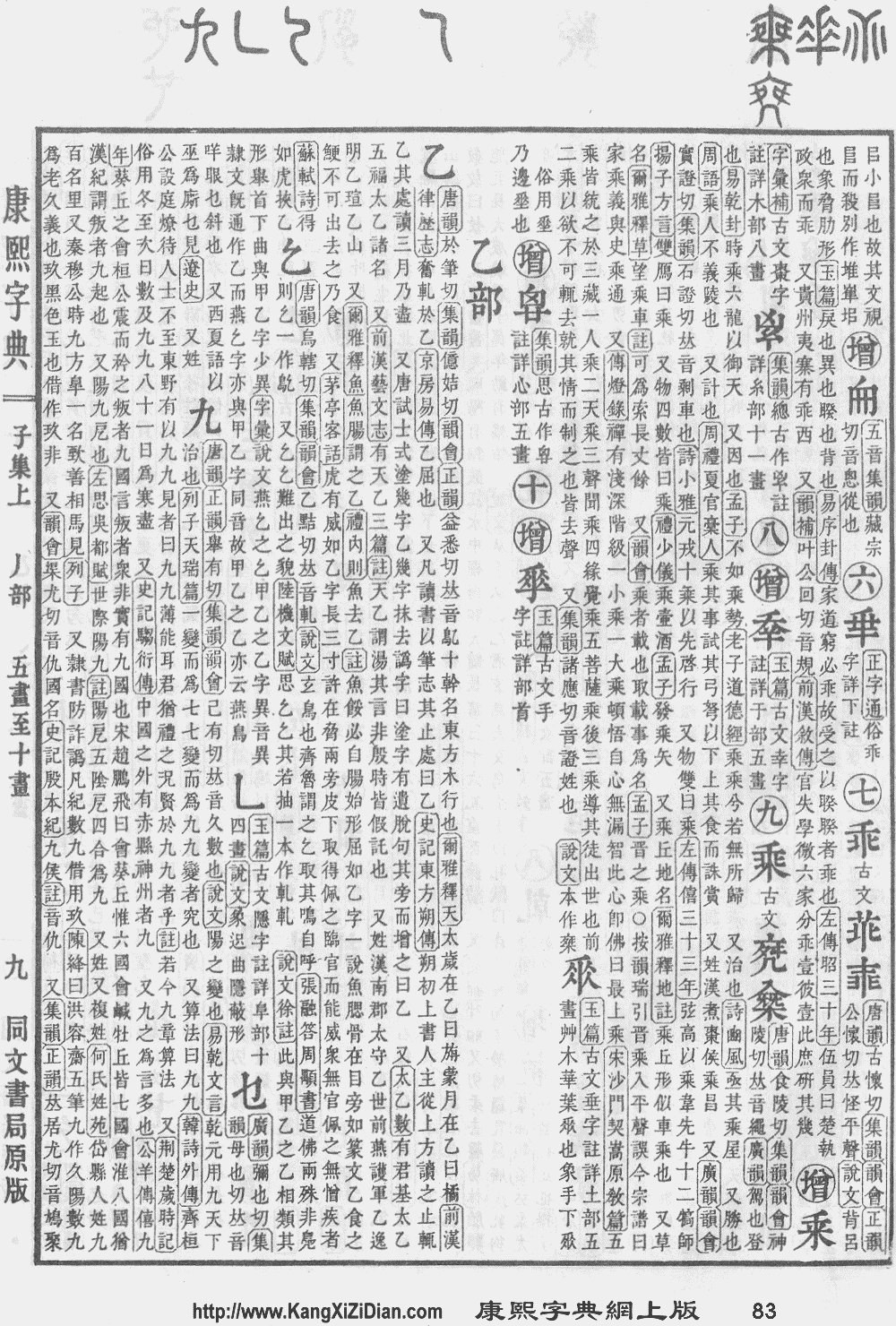
  • KangXi: page 83, character 9
  • Dai Kanwa Jiten: character 154
  • Dae Jaweon: page 166, character 40
  • Hanyu Da Zidian (first edition): volume 1, page 40, character 1
  • Unihan data for U+4E58

Chinese

trad. 乘
simp. # 乘
alternative forms 乗
椉/乘

Glyph origin

Historical forms of the character 乘
Shang Western Zhou Shuowen Jiezi (compiled in Han) Liushutong (compiled in Ming)
Oracle bone script Bronze inscriptions Small seal script Transcribed ancient scripts


References:

Mostly from Richard Sears' Chinese Etymology site (authorisation),
which in turn draws data from various collections of ancient forms of Chinese characters, including:

  • Shuowen Jiezi (small seal),
  • Jinwen Bian (bronze inscriptions),
  • Liushutong (Liushutong characters) and
  • Yinxu Jiaguwen Bian (oracle bone script).

Pictogram (象形) – a person 大 climbing a tree 木, with the feet visible. Etymology clearer in alternative form 椉. In this form, simplified to 禾 (“tree and top”) + 北 (“feet”).

Pronunciation 1


Note:
  • 2tshen - vernacular;
  • 3zen - literary.

  • Dialectal data
Variety Location 乘
Mandarin Beijing /ʈ͡ʂʰəŋ³⁵/
Harbin /ʈ͡ʂʰəŋ²⁴/ ~法
/ʈ͡ʂʰəŋ⁵³/ ~車
Tianjin /ʈ͡ʂʰəŋ⁴⁵/
/t͡sʰəŋ⁴⁵/
Jinan /ʈ͡ʂʰəŋ⁴²/
Qingdao /tʃʰəŋ⁴²/
Zhengzhou /ʈ͡ʂʰəŋ⁴²/
Xi'an /ʈ͡ʂʰəŋ²⁴/
Xining /ʈ͡ʂʰə̃²⁴/
Yinchuan /ʈ͡ʂʰəŋ⁵³/
Lanzhou /ʈ͡ʂʰə̃n⁵³/
Ürümqi /ʈ͡ʂʰɤŋ²¹³/
Wuhan /t͡sʰən²¹³/
Chengdu /sən³¹/
/t͡sʰən³¹/
Guiyang /t͡sʰen²¹/
Kunming /ʈ͡ʂʰə̃³¹/
Nanjing /ʈ͡ʂʰən²⁴/
Hefei /ʈ͡ʂʰən⁵⁵/
Jin Taiyuan /t͡sʰəŋ¹¹/
Pingyao /ʈ͡ʂʰəŋ¹³/
Hohhot /t͡sʰə̃ŋ³¹/
Wu Shanghai /zəŋ²³/
Suzhou /zən¹³/
Hangzhou /d͡zen²¹³/
Wenzhou /zeŋ³¹/
Hui Shexian /t͡ɕʰiʌ̃⁴⁴/
Tunxi /t͡ɕʰiɛ⁴⁴/
/t͡ɕʰian⁴⁴/
Xiang Changsha /ʂən¹³/
Xiangtan /ʂən¹²/
Gan Nanchang /sɨn⁴⁵/
Hakka Meixian /sən¹¹/
Taoyuan /ʃen⁵⁵/
Cantonese Guangzhou /seŋ²¹/
Nanning /seŋ²¹/
Hong Kong /siŋ²¹/
Min Xiamen (Min Nan) /siŋ³⁵/
Fuzhou (Min Dong) /siŋ⁵³/
Jian'ou (Min Bei) /t͡sʰeiŋ²¹/
Shantou (Min Nan) /seŋ⁵⁵/
Haikou (Min Nan) /seŋ³¹/

Rime
Character 乘
Reading # 1/2
Initial (聲) 船 (27)
Final (韻) 蒸 (133)
Tone (調) Level (Ø)
Openness (開合) Open
Division (等) III
Fanqie 食陵切
Reconstructions
Zhengzhang
Shangfang
/ʑɨŋ/
Pan
Wuyun
/ʑɨŋ/
Shao
Rongfen
/ʑieŋ/
Edwin
Pulleyblank
/ʑiŋ/
Li
Rong
/d͡ʑiəŋ/
Wang
Li
/d͡ʑĭəŋ/
Bernard
Karlgren
/d͡ʑʰi̯əŋ/
Expected
Mandarin
Reflex
shéng
Expected
Cantonese
Reflex
sing4
Baxter–Sagart system 1.1 (2014)
Character 乘
Reading # 1/3
Modern
Beijing
(Pinyin)
chéng
Middle
Chinese
‹ zying ›
Old
Chinese
/*Cə.ləŋ/
English ride (v.)

Notes for Old Chinese notations in the Baxter–Sagart system:

* Parentheses "()" indicate uncertain presence;
* Square brackets "[]" indicate uncertain identity, e.g. *[t] as coda may in fact be *-t or *-p;
* Angle brackets "<>" indicate infix;
* Hyphen "-" indicates morpheme boundary;

* Period "." indicates syllable boundary.
Zhengzhang system (2003)
Character 乘
Reading # 1/2
No. 1452
Phonetic
component
乘
Rime
group
蒸
Rime
subdivision
0
Corresponding
MC rime
繩
Old
Chinese
/*ɦljɯŋ/

Definitions

乘

  1. (literary) to ascend; to go up
  2. (literary) to drive (a horse, cart, etc.)
  3. to take (a form of transport)
    乘船  ―  chéngchuán  ―  to ride a boat
    乘火車去上海/乘火车去上海  ―  chéng huǒchē qù shànghǎi  ―  to ride a train to Shanghai
  4. to make use of; to take advantage of
    乘機/乘机  ―  chéngjī  ―  to seize the opportunity
    乘敵不備/乘敌不备  ―  chéng dí bùbèi  ―  to take the enemy unawares
  5. (literary) to pursue; to attack
  6. (arithmetic) to multiply
    加減乘除/加减乘除  ―  jiā jiǎn chéng chú  ―  addition, subtraction, multiplication, division
    二乘八等於十六。/二乘八等于十六。  ―  Èr chéng bā děngyú shíliù.  ―  Two times eight equals sixteen.
  7. a surname
Antonyms
  • (to multiply): 除 (chú)

Compounds

Pronunciation 2


Note: chéng - Mainland standard for the Buddhism sense.

Rime
Character 乘
Reading # 2/2
Initial (聲) 船 (27)
Final (韻) 蒸 (133)
Tone (調) Departing (H)
Openness (開合) Open
Division (等) III
Fanqie 實證切
Reconstructions
Zhengzhang
Shangfang
/ʑɨŋH/
Pan
Wuyun
/ʑɨŋH/
Shao
Rongfen
/ʑieŋH/
Edwin
Pulleyblank
/ʑiŋH/
Li
Rong
/d͡ʑiəŋH/
Wang
Li
/d͡ʑĭəŋH/
Bernard
Karlgren
/d͡ʑʰi̯əŋH/
Expected
Mandarin
Reflex
shèng
Expected
Cantonese
Reflex
sing6
Baxter–Sagart system 1.1 (2014)
Character 乘
Reading # 2/3
Modern
Beijing
(Pinyin)
shèng
Middle
Chinese
‹ zyingH ›
Old
Chinese
/*Cə.ləŋ-s/
English vehicle

Notes for Old Chinese notations in the Baxter–Sagart system:

* Parentheses "()" indicate uncertain presence;
* Square brackets "[]" indicate uncertain identity, e.g. *[t] as coda may in fact be *-t or *-p;
* Angle brackets "<>" indicate infix;
* Hyphen "-" indicates morpheme boundary;

* Period "." indicates syllable boundary.
Zhengzhang system (2003)
Character 乘
Reading # 2/2
No. 1458
Phonetic
component
乘
Rime
group
蒸
Rime
subdivision
0
Corresponding
MC rime
乗
Old
Chinese
/*ɦljɯŋs/

Definitions

乘

  1. (literary) war chariot drawn by four horses; (imperial) carriage
  2. (literary) Classifier for carriages drawn by four horses.
  3. (literary) history book
    史乘  ―  shǐshèng  ―  historical records
  4. (Buddhism) vehicle; creed; yana

Compounds

References

Japanese

Shinjitai

乗

Kyūjitai

乘

Kanji

乘

(“Jinmeiyō” kanji used for names, kyūjitai kanji, shinjitai form 乗)

Readings

Korean

Hanja

乘 (eumhun 탈 승 (tal seung))

  1. to mount, to ride
  2. to take (a form of transport)
  3. (arithmetic) exponent

References

Vietnamese

Han character

乘: Hán Nôm readings: thừa, thặng, thắng

  1. This term needs a translation to English. Please help out and add a translation, then remove the text {{rfdef}}.

References

This article is issued from Wiktionary. The text is licensed under Creative Commons - Attribution - Sharealike. Additional terms may apply for the media files.