寢

See also: 寝
寢 U+5BE2, 寢
CJK UNIFIED IDEOGRAPH-5BE2
← 寡
[U+5BE1]
CJK Unified Ideographs 寣 →
[U+5BE3]

Translingual

Stroke order

Han character

寢 (Kangxi radical 40, 宀+11, 14 strokes, cangjie input 十女一水 (JVME), four-corner 30247, composition ⿱宀⿰爿𠬶)

References

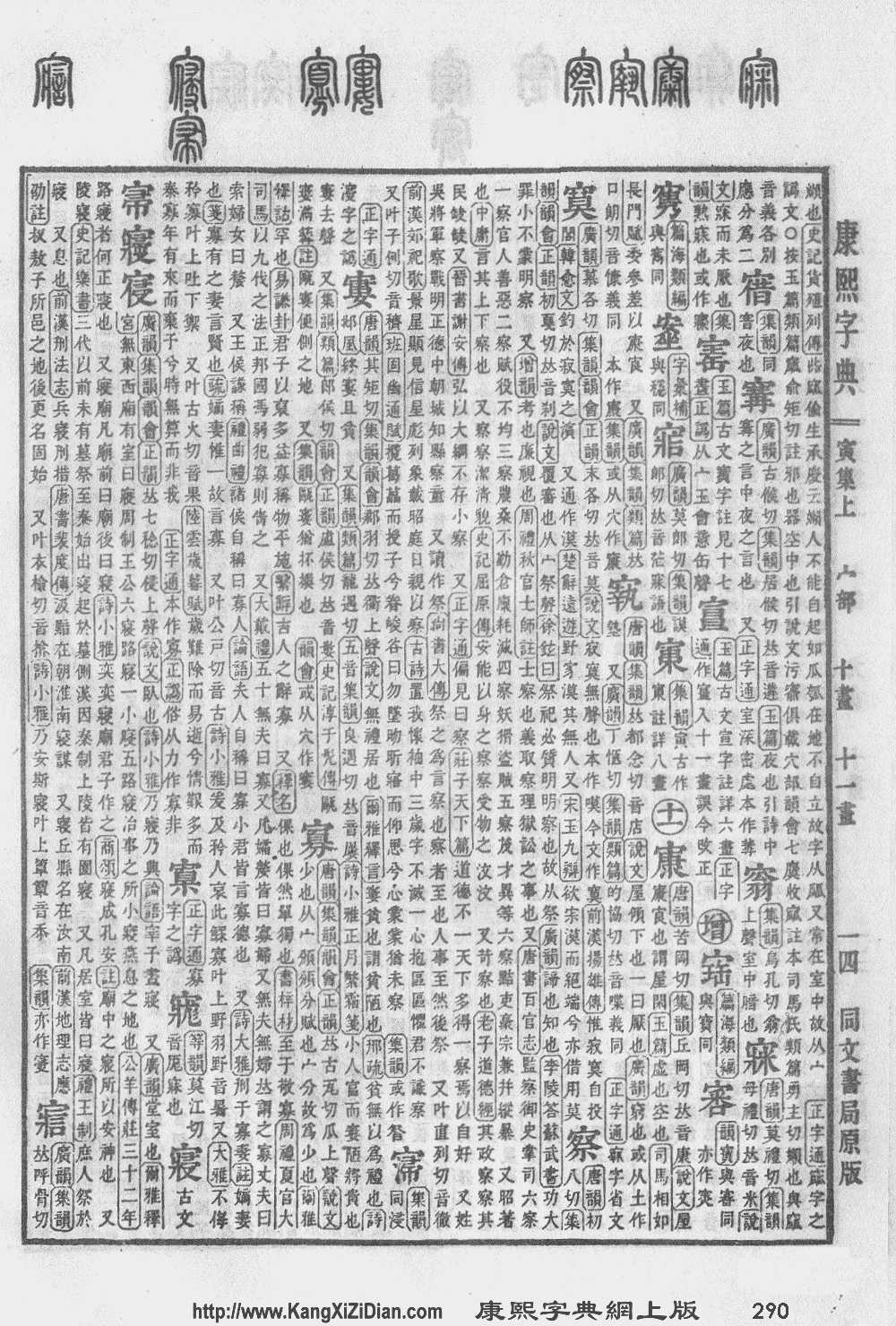
  • KangXi: page 290, character 22
  • Dai Kanwa Jiten: character 7289
  • Dae Jaweon: page 575, character 2
  • Hanyu Da Zidian (first edition): volume 2, page 951, character 1
  • Unihan data for U+5BE2

Chinese

trad. 寢
simp. 寝
alternative forms
 
㝲
寑/寝
𡫒
𡩠
𡨦
㝲
寑/寝
𡫒
𡩠
𡨦
𡨞

Glyph origin

Phono-semantic compound (形聲, OC *sʰimʔ) and ideogrammic compound (會意) : semantic 宀 (“roof”) + semantic 爿 (“bed”) + phonetic 𠬶 (“broom and hand”).

Etymology

From Proto-Sino-Tibetan *g-(d)z(i/u)m (“sleep”) (STEDT). Cognate with Tibetan གཟིམ་པ (gzim pa, “to sleep; to fall asleep”).

Pronunciation


Rime
Character 寢
Reading # 1/1
Initial (聲) 清 (14)
Final (韻) 侵 (139)
Tone (調) Rising (X)
Openness (開合) Open
Division (等) III
Fanqie 七稔切
Reconstructions
Zhengzhang
Shangfang
/t͡sʰiɪmX/
Pan
Wuyun
/t͡sʰimX/
Shao
Rongfen
/t͡sʰjemX/
Edwin
Pulleyblank
/t͡sʰimX/
Li
Rong
/t͡sʰiəmX/
Wang
Li
/t͡sʰĭĕmX/
Bernard
Karlgren
/t͡sʰi̯əmX/
Expected
Mandarin
Reflex
qǐn
Expected
Cantonese
Reflex
cam2
Baxter–Sagart system 1.1 (2014)
Character 寢
Reading # 1/1
Modern
Beijing
(Pinyin)
qǐn
Middle
Chinese
‹ tshimX ›
Old
Chinese
/*[tsʰ]imʔ/
English sleep

Notes for Old Chinese notations in the Baxter–Sagart system:

* Parentheses "()" indicate uncertain presence;
* Square brackets "[]" indicate uncertain identity, e.g. *[t] as coda may in fact be *-t or *-p;
* Angle brackets "<>" indicate infix;
* Hyphen "-" indicates morpheme boundary;

* Period "." indicates syllable boundary.
Zhengzhang system (2003)
Character 寢
Reading # 1/1
No. 10488
Phonetic
component
侵
Rime
group
侵
Rime
subdivision
2
Corresponding
MC rime
寑
Old
Chinese
/*sʰimʔ/
Notes 注:經典同寑

Definitions

寢

  1. to sleep; to lie down
  2. bedroom
  3. (literary) to stop; to halt
  4. (historical) imperial tomb; ancestral chamber

Compounds

  • 內寢/内寝
  • 共寢/共寝 (gòngqǐn)
  • 問寢/问寝
  • 園寢/园寝
  • 壽終內寢/寿终内寝
  • 壽終正寢/寿终正寝 (shòuzhōngzhèngqǐn)
  • 安寢/安寝 (ānqǐn)
  • 寢不安席/寝不安席
  • 寢不能寐/寝不能寐
  • 寢不遑安/寝不遑安
  • 寢丘之志/寝丘之志
  • 寢兵/寝兵
  • 寢具/寝具 (qǐnjù)
  • 寢室/寝室 (qǐnshì)
  • 寢宮/寝宫 (qǐngōng)
  • 寢廟/寝庙
  • 寢息/寝息 (qǐnxī)
  • 寢殿/寝殿
  • 寢疾/寝疾
  • 寢皮食肉/寝皮食肉
  • 寢苫枕塊/寝苫枕块
  • 憨寢/憨寝
  • 按甲寢兵/按甲寝兵
  • 晏寢/晏寝
  • 晝寢/昼寝 (zhòuqǐn)
  • 枕戈寢甲/枕戈寝甲
  • 桂宮柏寢/桂宫柏寝
  • 正寢/正寝
  • 歸寢/归寝
  • 疾終正寢/疾终正寝
  • 篠寢/筱寝
  • 美食甘寢/美食甘寝
  • 臨寢/临寝
  • 色衰愛寢/色衰爱寝
  • 薦寢席/荐寝席
  • 貌寢/貌寝
  • 陵寢/陵寝 (língqǐn)
  • 雞鳴問寢/鸡鸣问寝
  • 靈寢/灵寝 (língqǐn)
  • 食肉寢皮/食肉寝皮 (shíròuqǐnpí)
  • 高枕安寢/高枕安寝

Japanese

Shinjitai

寝

Kyūjitai

寢

Kanji

寢

(“Jinmeiyō” kanji used for names, kyūjitai kanji, shinjitai form 寝)

  1. This term needs a translation to English. Please help out and add a translation, then remove the text {{rfdef}}.

Readings

  • On (unclassified): しん (shin)
  • Kun: ねる (neru, 寢る)

Korean

Hanja

寢 • (chim) (hangeul 침, revised chim, McCune–Reischauer ch'im)

  1. This term needs a translation to English. Please help out and add a translation, then remove the text {{rfdef}}.

Compounds

Vietnamese

Han character

寢: Hán Nôm readings: tẩm

  1. This term needs a translation to English. Please help out and add a translation, then remove the text {{rfdef}}.
This article is issued from Wiktionary. The text is licensed under Creative Commons - Attribution - Sharealike. Additional terms may apply for the media files.