忽

忽 U+5FFD, 忽
CJK UNIFIED IDEOGRAPH-5FFD
← 忼
[U+5FFC]
CJK Unified Ideographs 忾 →
[U+5FFE]

Translingual

Han character

忽 (Kangxi radical 61, 心+4, 8 strokes, cangjie input 心竹心 (PHP), four-corner 27332, composition ⿱勿心)

Derived characters

  • 𬾠, 唿, 𡝲, 惚, 㧾, 淴, 㺀, 𣇤, 𪲨, 𬊡, 𤙹, 𤦏, 𦜩, 𥇰, 𦁕(𰬦), 𦖟, 𰃒, 𧩓, 鍃,(锪), 𧇰, 𩋚, 䬍(𬲀), 𪍃, 𫜚
  • 𢽨, 𪯏, 𭞿, 𪂒, 𫻜, 𡱽, 䓤, 䨚, 𩭳, 𫆒

References

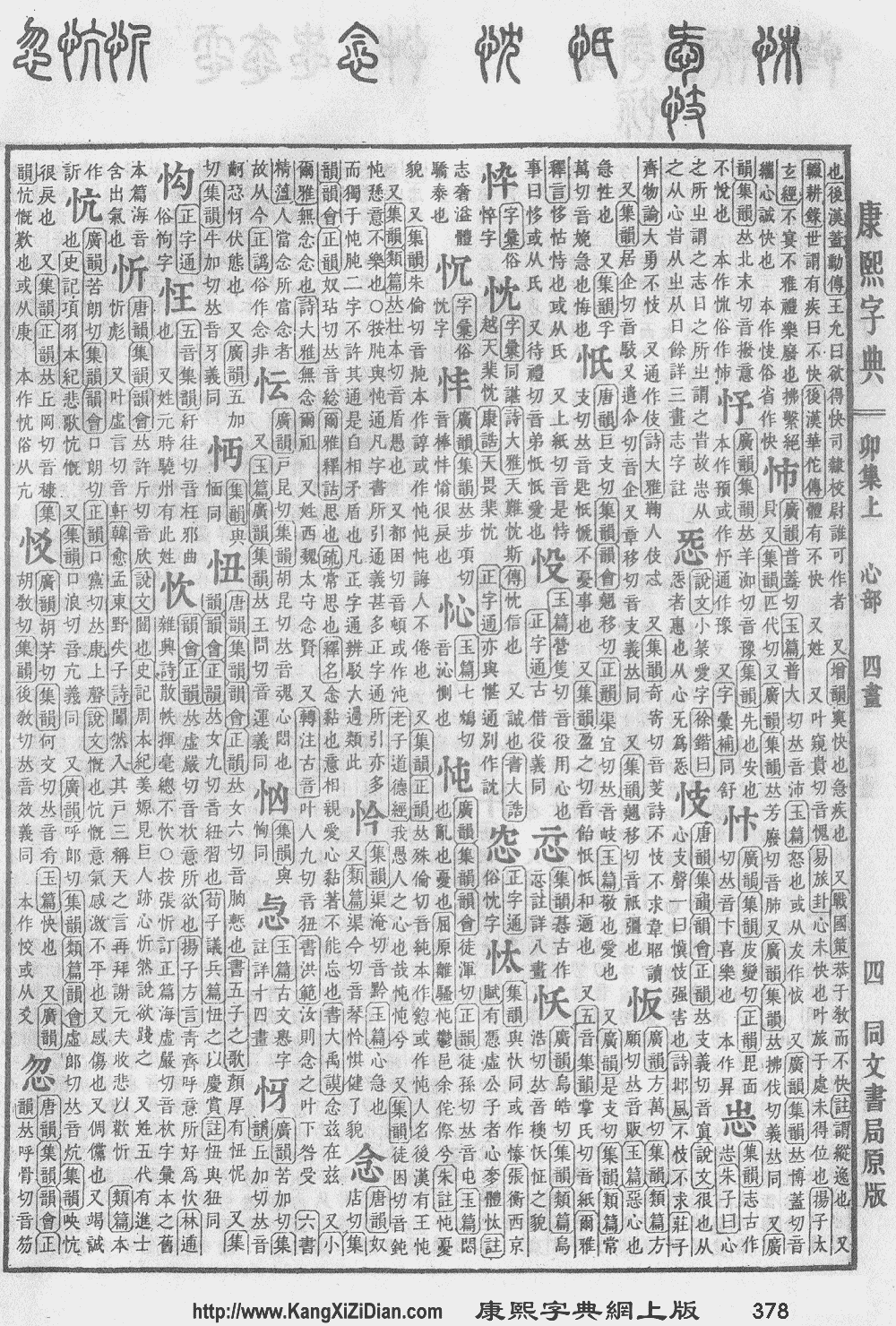
  • KangXi: page 378, character 34
  • Dai Kanwa Jiten: character 10405
  • Dae Jaweon: page 707, character 5
  • Hanyu Da Zidian (first edition): volume 4, page 2274, character 9
  • Unihan data for U+5FFD

Chinese

Glyph origin

Historical forms of the character 忽
Warring States Shuowen Jiezi (compiled in Han)
Bronze inscriptions Small seal script

Historically and academically considered a phono-semantic compound (形聲, OC *hmɯːd) : phonetic 勿 (OC *mɯd) + semantic 心 (“heart”). Incorrectly colloquially explained as an ideogrammic compound (會意) : 勿 (“not”) + 心 (“heart”).

Etymology 1

simp. and trad.
忽
alternative forms 芴

Pronunciation


  • Dialectal data
Variety Location 忽
Mandarin Beijing /xu⁵⁵/
Harbin /xu⁴⁴/
Tianjin /xu²¹/
Jinan /xu²¹³/
Qingdao /xu⁵⁵/
Zhengzhou /xu²⁴/
Xi'an /xu²¹/
Xining /xv̩⁴⁴/
Yinchuan /xu¹³/
Lanzhou /xu³¹/
Ürümqi /xu⁴⁴/
Wuhan /xu²¹³/
Chengdu /fu³¹/
Guiyang /fu²¹/
Kunming /xu³¹/
Nanjing /xuʔ⁵/
Hefei /xuəʔ⁵/
Jin Taiyuan /xuəʔ²/
Pingyao /xuʌʔ¹³/
Hohhot /xuəʔ⁴³/
Wu Shanghai /hoʔ⁵/
Suzhou /huəʔ⁵/
Hangzhou /hoʔ⁵/
Wenzhou /ɕy²¹³/
Hui Shexian /xuʔ²¹/
Tunxi /xu⁵/
Xiang Changsha /fu²⁴/
Xiangtan /ɸu²⁴/
Gan Nanchang /fɨʔ⁵/
Hakka Meixian /fut̚¹/
Taoyuan
Cantonese Guangzhou /fɐt̚⁵/
Nanning /fɐt̚⁵⁵/
Hong Kong /fut̚⁵/
Min Xiamen (Min Nan) /hut̚³²/
Fuzhou (Min Dong) /huɔʔ²³/
Jian'ou (Min Bei) /xo²⁴/
Shantou (Min Nan) /huk̚²/
Haikou (Min Nan) /hut̚⁵/

Rime
Character 忽
Reading # 1/1
Initial (聲) 曉 (32)
Final (韻) 魂 (56)
Tone (調) Checked (Ø)
Openness (開合) Closed
Division (等) I
Fanqie 呼骨切
Baxter xwot
Reconstructions
Zhengzhang
Shangfang
/huət̚/
Pan
Wuyun
/huot̚/
Shao
Rongfen
/xuət̚/
Edwin
Pulleyblank
/hwət̚/
Li
Rong
/xuət̚/
Wang
Li
/xuət̚/
Bernard
Karlgren
/xuət̚/
Expected
Mandarin
Reflex
hu
Expected
Cantonese
Reflex
fat1
Baxter–Sagart system 1.1 (2014)
Character 忽
Reading # 1/1
Modern
Beijing
(Pinyin)
hū
Middle
Chinese
‹ xwot ›
Old
Chinese
/*m̥ˁut/
English careless; confused

Notes for Old Chinese notations in the Baxter–Sagart system:

* Parentheses "()" indicate uncertain presence;
* Square brackets "[]" indicate uncertain identity, e.g. *[t] as coda may in fact be *-t or *-p;
* Angle brackets "<>" indicate infix;
* Hyphen "-" indicates morpheme boundary;

* Period "." indicates syllable boundary.
Zhengzhang system (2003)
Character 忽
Reading # 1/1
No. 13211
Phonetic
component
勿
Rime
group
物
Rime
subdivision
1
Corresponding
MC rime
忽
Old
Chinese
/*hmɯːd/

Definitions

忽

  1. suddenly; abruptly
  2. to neglect; to ignore
  3. a surname

Compounds

  • 恍忽
  • 恍恍忽忽
  • 悠忽
  • 悠悠忽忽
  • 暴忽
  • 杪忽
  • 玩忽 (wánhū)
  • 疏忽 (shūhu)
  • 眇眇忽忽
  • 秒忽
  • 粗忽
  • 罕忽
  • 翕忽
  • 荒忽
  • 行行忽忽
  • 超忽
  • 迷忽忽
  • 陵忽
  • 黑忽忽 (hēihūhū)
  • 一忽兒/一忽儿
  • 倏來忽往/倏来忽往
  • 忽冷忽熱/忽冷忽热 (hūlěnghūrè)
  • 忽喜忽憂/忽喜忽忧
  • 忽忽不樂/忽忽不乐
  • 忽明忽滅/忽明忽灭
  • 忽東忽西/忽东忽西
  • 忽見/忽见 (hūjiàn)
  • 忽視/忽视 (hūshì)
  • 忽閃/忽闪 (hūshǎn)
  • 忽隱忽現/忽隐忽现
  • 忽魯魯/忽鲁鲁
  • 怠忽職守/怠忽职守
  • 恤近忽遠/恤近忽远
  • 沒忽的/没忽的
  • 瞻前忽後/瞻前忽后
  • 禍生於忽/祸生于忽
  • 簡忽/简忽
  • 行蹤飄忽/行踪飘忽
  • 軋忽/轧忽
  • 輕忽/轻忽 (qīnghū)
  • 這忽兒/这忽儿
  • 連朦帶忽/连朦带忽
  • 飄忽/飘忽 (piāohū)
  • 飄忽不定/飘忽不定 (piāohūbùdìng)
  • 驀忽/蓦忽
  • 驀忽間/蓦忽间

Etymology 2

simp. and trad.
忽
alternative forms 窟

Pronunciation

Definitions

忽 (Cantonese)

  1. place
  2. part

Compounds

  • 東一忽西一忽/东一忽西一忽
  • 邊忽/边忽

Goguryeo

Etymology

Possibly related to Middle Korean 골〯 (kwǒl) and Middle Korean ᄀᆞ옳 (kòwòlh).[1] A possible Wanderwort; see Proto-Uralic *kota for more.[2]

Noun

忽 or 忽 (*kuru or *kolo) (Records of the Three Kingdoms 溝漊).[3][4]

  1. castle, fortress

Japanese

Kanji

忽

(“Jinmeiyō” kanji used for names)

  1. in a moment
  2. instantly
  3. all of a sudden
  4. neglect
  5. disregard

Readings

  • On (unclassified): こつ (kotsu)
  • Kun: ゆるがせ (yurugase, 忽せ); たちまち (tachimachi, 忽ち)

Korean

Hanja

忽 • (hol) (hangeul 홀)

  1. This term needs a translation to English. Please help out and add a translation, then remove the text {{rfdef}}.

Vietnamese

Han character

忽: Hán Nôm readings: hốt

  1. This term needs a translation to English. Please help out and add a translation, then remove the text {{rfdef}}.
  1. Lim, Byung-joon (1999) (A) Study on the borrowed writings of the dialect of Koguryo Dynasty in Ancient Korean (MA), Konkuk University
  2. Vovin, Alexander (2013), “From Koguryo to T'amna”, in Korean Linguistics‎ (PDF), volume 15, issue 2, John Benjamins Publishing Company, →DOI, pages 222-240
  3. Lim, Byung-joon (1999) (A) Study on the borrowed writings of the dialect of Koguryo Dynasty in Ancient Korean (MA), Konkuk University
  4. Vovin, Alexander (2013), “From Koguryo to T'amna”, in Korean Linguistics‎ (PDF), volume 15, issue 2, John Benjamins Publishing Company, →DOI, pages 222-240
This article is issued from Wiktionary. The text is licensed under Creative Commons - Attribution - Sharealike. Additional terms may apply for the media files.