拭
| ||||||||
Translingual
Han character
拭 (Kangxi radical 64, 手+6, 9 strokes, cangjie input 手戈心一 (QIPM), four-corner 53040, composition ⿰扌式)
Derived characters
- 𢁊
References
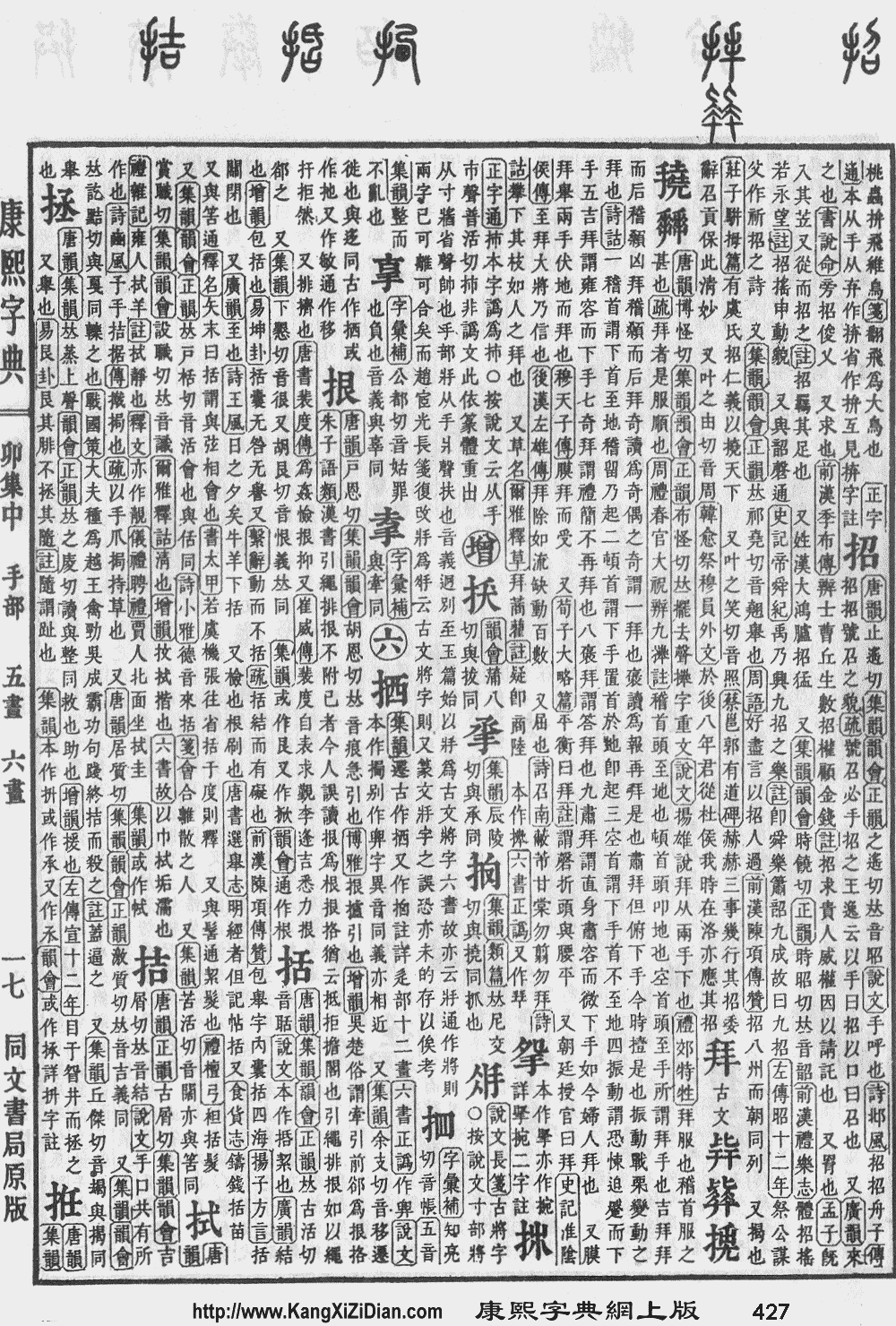
- KangXi: page 427, character 20
- Dai Kanwa Jiten: character 11989
- Dae Jaweon: page 776, character 17
- Hanyu Da Zidian (first edition): volume 3, page 1865, character 3
- Unihan data for U+62ED
Chinese
| simp. and trad. |
拭 | |
|---|---|---|
Glyph origin
Characters in the same phonetic series (弋) (Zhengzhang, 2003)
| Old Chinese | |
|---|---|
| 戴 | *ʔl'ɯːɡs |
| 襶 | *tɯːɡs |
| 貸 | *l̥ʰɯːɡs |
| 代 | *l'ɯːɡs |
| 袋 | *l'ɯːɡs |
| 岱 | *l'ɯːɡs |
| 黛 | *l'ɯːɡs |
| 玳 | *l'ɯːɡs |
| 帒 | *l'ɯːɡs |
| 甙 | *l'ɯːɡs |
| 酨 | *l'ɯːs, *zlɯːs |
| 試 | *hljɯɡs |
| 弒 | *hljɯɡs |
| 忒 | *l̥ʰɯːɡ |
| 貣 | *l̥ʰɯːɡ, *l'ɯːɡ |
| 鴏 | *l'ɯːɡ |
| 栻 | *l̥ʰɯɡ, *hljɯɡ |
| 侙 | *l̥ʰɯɡ |
| 恜 | *l̥ʰɯɡ |
| 式 | *hljɯɡ |
| 軾 | *hljɯɡ |
| 拭 | *hljɯɡ |
| 鉽 | *hljɯɡ |
| 烒 | *hljɯɡ |
| 弋 | *lɯɡ |
| 芅 | *lɯɡ |
| 黓 | *lɯɡ |
| 隿 | *lɯɡ |
| 杙 | *lɯɡ |
| 釴 | *lɯɡ |
Pronunciation
Synonyms
Dialectal synonyms of 擦 (“to wipe”) [map]
| Variety | Location | Words |
|---|---|---|
| Formal (Written Standard Chinese) | 擦 | |
| Mandarin | Beijing | 擦, 抹 |
| Taiwan | 擦, 抹 | |
| Xi'an | 擦, 搌 | |
| Wuhan | 之, 揩, 抹, 搌 | |
| Chengdu | 揩, 抹, 擦 | |
| Yangzhou | 擦, 揩, 抹 | |
| Hefei | 擦, 揩, 抹 | |
| Malaysia | 擦 | |
| Singapore | 擦, 抹 | |
| Cantonese | Guangzhou | 擦, 抹, 捽 |
| Hong Kong | 擦, 抹, 捽 | |
| Yangjiang | 拭, 擦 | |
| Penang (Guangfu) | 擦 | |
| Singapore (Guangfu) | 擦 | |
| Gan | Nanchang | 揩, 抹, 擦 |
| Hakka | Meixian | 捽 |
| Miaoli (N. Sixian) | 捽 | |
| Pingtung (Neipu; S. Sixian) | 捽 | |
| Hsinchu County (Zhudong; Hailu) | 捽 | |
| Taichung (Dongshi; Dabu) | 捽 | |
| Hsinchu County (Qionglin; Raoping) | 捽 | |
| Yunlin (Lunbei; Zhao'an) | 捽 | |
| Kuching (Hepo) | 捽 | |
| Jin | Taiyuan | 揩, 擦 |
| Min Bei | Jian'ou | 拭 |
| Min Dong | Fuzhou | 拭, 挸 |
| Min Nan | Xiamen | 拭, 揉 |
| Quanzhou | 拭, 揉 | |
| Zhangzhou | 拭, 揉 | |
| Tainan | 拭, 揉 | |
| Penang (Hokkien) | 拭, 揉 | |
| Singapore (Hokkien) | 拭 | |
| Chaozhou | 拭, 㧫, 抙 | |
| Raoping | 拭, 㧫 | |
| Shantou | 㧫 | |
| Shantou (Chenghai) | 㧫 | |
| Jieyang | 拭, 㧫, 抙 | |
| Wu | Suzhou | 揩 |
| Wenzhou | 擦, 𢄺 | |
| Xiang | Changsha | 湊, 抹, 揩 |
| Shuangfeng | 揩, 抹 | |
Japanese
Kanji
拭
- This term needs a translation to English. Please help out and add a translation, then remove the text
{{rfdef}}.
Korean
Etymology
From Middle Chinese 拭 (MC ɕɨk̚). Recorded as Middle Korean 식〮 (sík) (Yale: sik) in Hunmong Jahoe (訓蒙字會 / 훈몽자회), 1527.
Vietnamese
Han character
拭: Hán Nôm readings: rị
- This term needs a translation to English. Please help out and add a translation, then remove the text
{{rfdef}}.
This article is issued from Wiktionary. The text is licensed under Creative Commons - Attribution - Sharealike. Additional terms may apply for the media files.