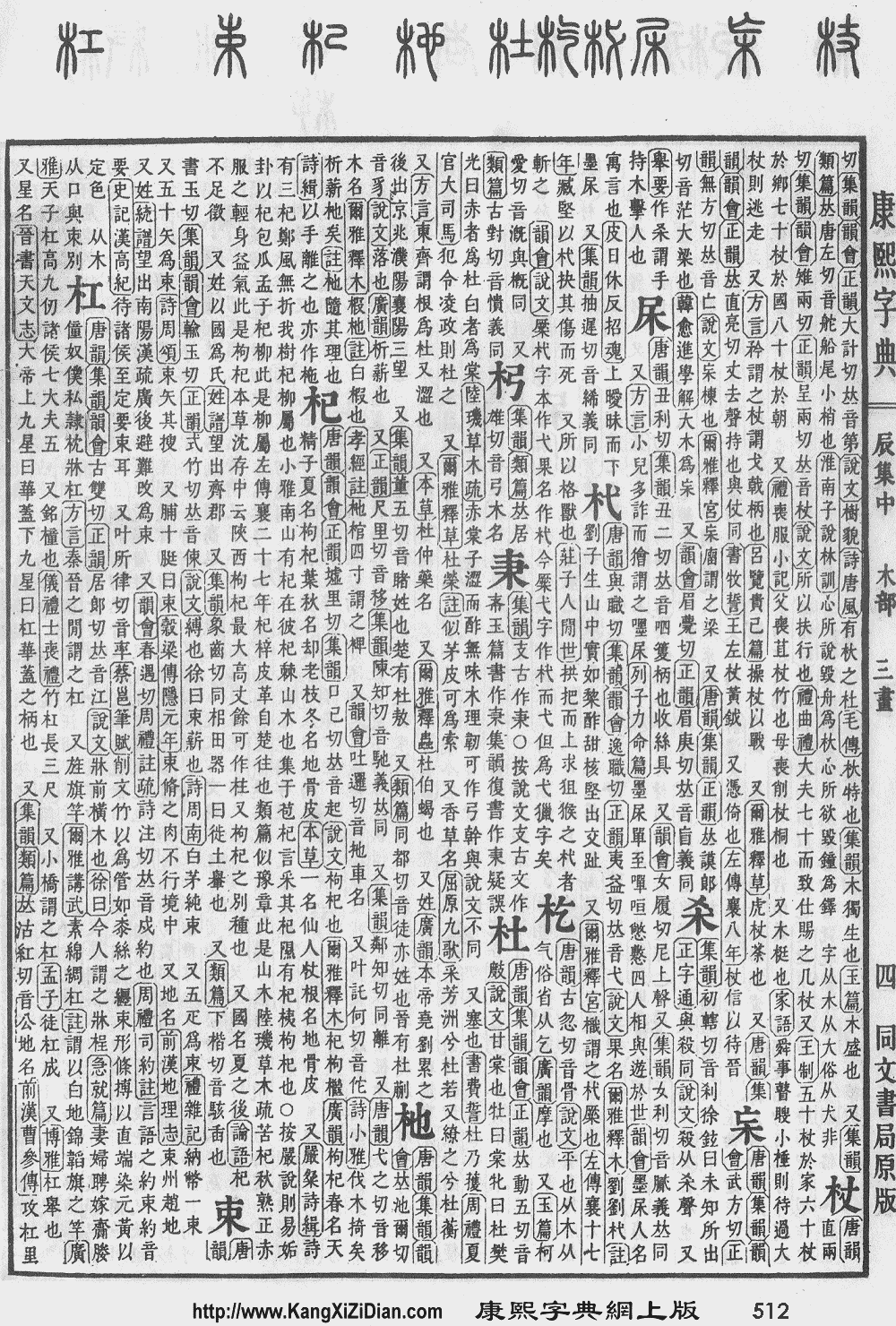
杖

杖 U+6756, 杖
CJK UNIFIED IDEOGRAPH-6756
← 杕
[U+6755]
CJK Unified Ideographs 杗 →
[U+6757]

杖 U+FA94, 杖
CJK COMPATIBILITY IDEOGRAPH-FA94
← 望
[U+FA93]
CJK Compatibility Ideographs 歹 →
[U+FA95]

Translingual

Han character

杖 (Kangxi radical 75, 木+3, 7 strokes, cangjie input 木十大 (DJK), four-corner 45900, composition ⿰木丈)

References

Chinese

simp. and trad.
杖
alternative forms 𨥅

Glyph origin

Phono-semantic compound (形聲, OC *daŋʔ) : semantic 木 + phonetic 丈 (OC *daŋʔ).

Etymology

Thought to be the same word as 丈 (OC *daŋʔ) "gentleman, older man, husband", i.e. "someone who walks with, or leans on, a staff"; though unlikely.

According to Schuessler (2007), this is an areal word. Compare Mizo tiang (“staff, stick, crutch”), Old Khmer toŋ (“shaft, stock, shank”), -toṅa (“stock, stem, stick”), and Khmer ដង (dɑɑng, “pole, shaft, handle, yoke, body, trunk”). Benedict (1976) also compares this to Proto-Tai *de:ŋ ~ *tʰe:ŋ (“stick, bar”), Malay tiang (“pillar, post, pole”), Fijian ndia (“stick, handle”), and to reconstructed Proto-Austro-Tai *(n)ti(j)aŋ.

A derivative, attested in Zuozhuan as 杖, is the verb 仗 (OC daŋs) "to lean on", with suffix *-s → *-h → 去聲/去声 (qùshēng).

Pronunciation


Note:
  • thn̄g/thňg - vernacular;
  • tiōng/tiǒng/tiāng - literary.

Rime
Character 杖
Reading # 1/1
Initial (聲) 澄 (11)
Final (韻) 陽 (105)
Tone (調) Rising (X)
Openness (開合) Open
Division (等) III
Fanqie 直兩切
Reconstructions
Zhengzhang
Shangfang
/ɖɨɐŋX/
Pan
Wuyun
/ɖiɐŋX/
Shao
Rongfen
/ȡiɑŋX/
Edwin
Pulleyblank
/ɖɨaŋX/
Li
Rong
/ȡiaŋX/
Wang
Li
/ȡĭaŋX/
Bernard
Karlgren
/ȡʱi̯aŋX/
Expected
Mandarin
Reflex
zhàng
Expected
Cantonese
Reflex
zoeng6
Baxter–Sagart system 1.1 (2014)
Character 杖
Reading # 1/1
Modern
Beijing
(Pinyin)
zhàng
Middle
Chinese
‹ drjangX ›
Old
Chinese
/*m-[t]raŋʔ/
English stick (Sagart & Ma, 2020)

Notes for Old Chinese notations in the Baxter–Sagart system:

* Parentheses "()" indicate uncertain presence;
* Square brackets "[]" indicate uncertain identity, e.g. *[t] as coda may in fact be *-t or *-p;
* Angle brackets "<>" indicate infix;
* Hyphen "-" indicates morpheme boundary;

* Period "." indicates syllable boundary.
Zhengzhang system (2003)
Character 杖
Reading # 1/1
No. 16837
Phonetic
component
丈
Rime
group
陽
Rime
subdivision
0
Corresponding
MC rime
丈
Old
Chinese
/*daŋʔ/

Definitions

杖

  1. walking stick
  2. staff; rod; cane; wand
  3. (historical) flogging with a stick
  4. † to flog (a prisoner)
  5. † to support; to prop
  6. † to hold; to grasp
  7. † Alternative form of 仗 (zhàng, “to rely on; to depend on”).
  8. (Min Dong) Classifier for segments of sugarcane.

Compounds

  • 不杖期夫
  • 串杖
  • 伯俞泣杖
  • 倚杖
  • 兵杖
  • 刀杖器械
  • 刑杖
  • 哀杖
  • 廷杖 (tíngzhàng)
  • 手杖 (shǒuzhàng)
  • 扶杖 (fúzhàng)
  • 拄杖 (zhǔzhàng)
  • 拐杖 (guǎizhàng)
  • 搏杖
  • 明杖
  • 杖履
  • 杖戟
  • 杖期
  • 杖期夫
  • 杖策
  • 杖莫如信
  • 杖藜
  • 杖限
  • 杖鼓 (zhànggǔ)
  • 束杖理民
  • 枴杖
  • 柱杖
  • 泣杖
  • 笞杖
  • 策杖 (cèzhàng)
  • 脊杖
  • 苴杖
  • 藜杖 (lízhàng)
  • 藤杖
  • 虎杖 (hǔzhàng)
  • 行杖
  • 邛杖
  • 重杖
  • 魔杖 (mózhàng)
  • 几杖
  • 大杖則走/大杖则走
  • 夾杖/夹杖
  • 拿刀動杖/拿刀动杖
  • 持刀動杖/持刀动杖
  • 撇杖兒/撇杖儿
  • 擀麵杖/擀面杖 (gǎnmiànzhàng)
  • 擔杖/担杖 (dànzhàng)
  • 杖子頭/杖子头
  • 杖屨/杖屦
  • 杖斷/杖断
  • 杖錢/杖钱
  • 杖頭/杖头
  • 杖頭木偶/杖头木偶
  • 杖頭資/杖头资
  • 杖頭錢/杖头钱
  • 權杖/权杖 (quánzhàng)
  • 滿杖/满杖
  • 禪杖/禅杖 (chánzhàng)
  • 竹杖成龍/竹杖成龙
  • 簳麵杖/簳面杖
  • 綠玉杖/绿玉杖
  • 葦戟桃杖/苇戟桃杖
  • 葦杖/苇杖
  • 賣杖搖鈴/卖杖摇铃
  • 錫杖/锡杖 (xīzhàng)
  • 雙頭火杖/双头火杖
  • 鳩杖/鸠杖
  • 麵杖/面杖 (miànzhàng)
  • 麵杖吹火/面杖吹火
  • 齒杖/齿杖
  • 龍頭拐杖/龙头拐杖

Descendants

  • → Mongolian: зан (zan), ᠵᠠᠩ (ǰaŋ)
  • → Manchu: ᠵᠠᠩ (jang)

Japanese

Kanji

杖

(“Jinmeiyō” kanji used for names)

Readings

Etymology 1

Kanji in this term
杖
つえ
Jinmeiyō
kun’yomi

⟨tuwe⟩ → /tuwe/ → /t͡suwe/ → /t͡suje/ → /t͡sue/

From Old Japanese. Found in the Man'yōshū, completed some time after 759 CE.[1]

Alternative forms

Pronunciation

Noun

杖(つえ) • (tsue) ←つゑ (tuwe)?

  1. staff, stick, walking stick, cane, stave, strove, rod, wand
    • 2000 March 1, “古(こ)代(だい)魔(ま)導(どう)士(し) [Ancient Mage]”, in BOOSTER 7, Konami:
      数(かず)多(おお)くの杖(つえ)を持(も)ち、それぞれを使(つか)い分(わ)け多(た)彩(さい)な攻(こう)撃(げき)をする。
      Kazuōku no tsue o mochi, sorezore o tsukaiwake tasai na kōgeki o suru.
      He wields an array of wands, each of which is used for a distinctive attack.
  2. something one leans on, a support
  3. a cane used for corporal punishment
  4. a particularly shaped stirring stick used to make New Year's porridge
    Synonym: 粥杖 (kayuzue)
  5. the stem of a pear
  6. (historical) a traditional unit of length
    1. (historical) approximately 3 meters
    2. (historical) seven 尺 (shaku, traditional Japanese foot) and five 寸 (sun, traditional Japanese inch), or approximately 2.3 meters
  7. (historical) a traditional unit of area
    1. (historical) one-fifth of a 段 (tan, traditional Japanese paddy size, roughly half of an English acre), or around 237m²
Usage notes

The Japanese term tsue can refer generally to a stick or staff of various lengths, as expressed by the range of English meanings apparent in the senses above.

Etymology 2

Kanji in this term
杖
じょう
Jinmeiyō
on’yomi

From Middle Chinese 杖 (MC ɖɨɐŋX).

Pronunciation

Noun

杖(じょう) • (jō) ←ぢやう (dyau)?

  1. a jo: a fighting staff, a little over 4 尺 (shaku, “a traditional unit of measure, about 30 cm or a foot”) long, shorter than a 棒 (bō, “quarterstaff”)
  2. (historical) under the ancient Ritsuryō system, caning as a form of corporal punishment
  3. (historical) a traditional unit of area: one-fifth of a 段 (tan, traditional Japanese paddy size, roughly half of an English acre), or around 237m²
Coordinate terms

Compounds

References

  1. c. 759, Man'yōshū (book 5, poem 804), text here
  2. 2006, 大辞林 (Daijirin), Third Edition (in Japanese), Tōkyō: Sanseidō, →ISBN
  • 1988, 国語大辞典(新装版) (Kokugo Dai Jiten, Revised Edition) (in Japanese), Tōkyō: Shogakukan

Korean

Hanja

杖 • (jang) (hangeul 장, revised jang, McCune–Reischauer chang, Yale cang)

  1. This term needs a translation to English. Please help out and add a translation, then remove the text {{rfdef}}.

Vietnamese

Han character

杖: Hán Nôm readings: trượng, rường

  1. This term needs a translation to English. Please help out and add a translation, then remove the text {{rfdef}}.
This article is issued from Wiktionary. The text is licensed under Creative Commons - Attribution - Sharealike. Additional terms may apply for the media files.