浴

See also: 溶
浴 U+6D74, 浴
CJK UNIFIED IDEOGRAPH-6D74
← 浳
[U+6D73]
CJK Unified Ideographs 浵 →
[U+6D75]

Translingual

Han character

浴 (Kangxi radical 85, 水+7, 10 strokes, cangjie input 水金人口 (ECOR), four-corner 38168, composition ⿰氵谷)

References

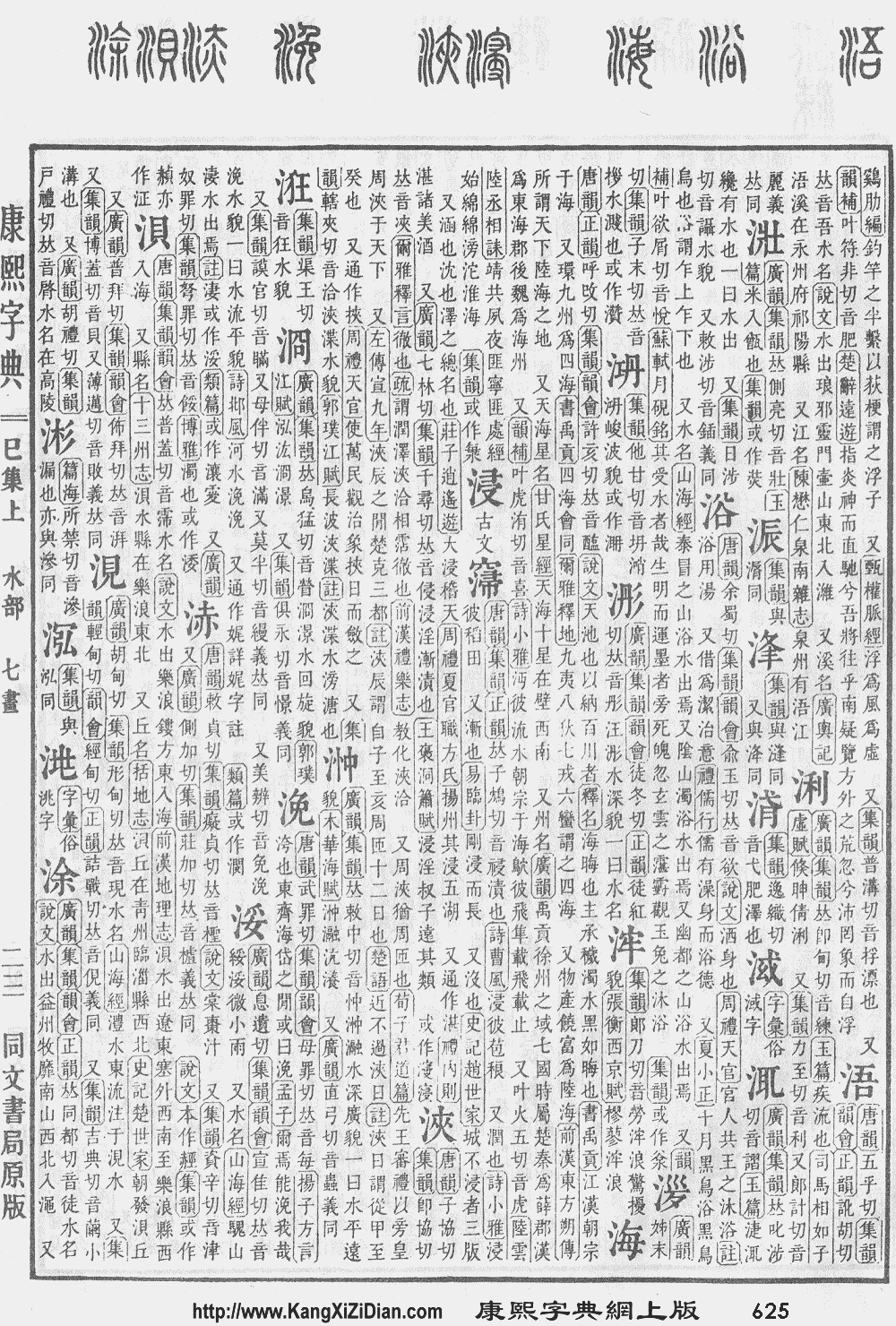
  • KangXi: page 625, character 9
  • Dai Kanwa Jiten: character 17496
  • Dae Jaweon: page 1023, character 6
  • Hanyu Da Zidian (first edition): volume 3, page 1629, character 3
  • Unihan data for U+6D74

Chinese

simp. and trad.
浴

Glyph origin

Historical forms of the character 浴
Warring States Shuowen Jiezi (compiled in Han)
Chu slip and silk script Small seal script

Phono-semantic compound (形聲, OC *loɡ) : semantic 氵 (“water”) + phonetic 谷 (OC *ɦkroːɡ, *kloːɡ, *ɡ·loːɡ) – bathe in water.

Etymology

Schuessler (2007) considers it to be an area word.

Within Sino-Tibetan, Chinese, Tibetan, and Tani have a final *-k, while other Tibeto-Burman languages have open syllables; compare Tibetan ལྡུགས (ldugs, “to pour”), Proto-Tani *lɯk (“to pour”), Proto-Sino-Tibetan *r-lu(w) (“to pour; to bathe”) (whence Angami [script needed] (rəlu, “to pour”), Garo rua (“to pour”), S'gaw Karen [script needed] (lu, “to pour”), Karbi [Term?] (iŋ lú, “to bathe; to wash”)) (Schuessler, 2007; STEDT).

Outside of Sino-Tibetan, compare words in the Pearic languages, such as Chong [script needed] (kʰruk, “to pour”) (Schuessler, 2007).

It is unclear how and whether 冶 (OC *laːʔ, “to smelt; to cast”) is related (Schuessler, 2007).

Pronunciation


Note:
  • ia̍k/e̍k - vernacular;
  • io̍k - literary;
  • hia̍k - in 洗浴.
Note:
  • êg8 - vernacular;
  • iog8 - literary.
  • Wu
    • (Shanghainese)
      • Wiktionary: 5hhioq; 5hhyq
      • Sinological IPA (key): /ɦi̯ʊʔ¹²/, /ɦɥ̯ɪʔ¹²/

Rime
Character 浴
Reading # 1/1
Initial (聲) 以 (36)
Final (韻) 鍾 (8)
Tone (調) Checked (Ø)
Openness (開合) Open
Division (等) III
Fanqie 余蜀切
Baxter yowk
Reconstructions
Zhengzhang
Shangfang
/jɨok̚/
Pan
Wuyun
/jiok̚/
Shao
Rongfen
/iok̚/
Edwin
Pulleyblank
/juawk̚/
Li
Rong
/iok̚/
Wang
Li
/jĭwok̚/
Bernard
Karlgren
/i̯wok̚/
Expected
Mandarin
Reflex
wù
Expected
Cantonese
Reflex
juk6
Zhengzhang system (2003)
Character 浴
Reading # 1/1
No. 4304
Phonetic
component
谷
Rime
group
屋
Rime
subdivision
0
Corresponding
MC rime
欲
Old
Chinese
/*loɡ/

Definitions

浴

  1. to bathe; to wash; to take a bath
  2. to bathe (in the sun, wind, etc.)
  3. bath

Compounds

  • 沐浴春風/沐浴春风
  • 沐浴鹽/沐浴盐
  • 浴佛節/浴佛节
  • 浴場/浴场 (yùchǎng)
  • 浴療/浴疗 (yùliáo)
  • 浴蘭時節/浴兰时节
  • 浴血奮戰/浴血奋战
  • 浴鐵/浴铁
  • 海水浴場/海水浴场 (hǎishuǐ yùchǎng)
  • 淨浴/净浴
  • 溫泉浴/温泉浴
  • 空氣浴/空气浴
  • 芬蘭浴/芬兰浴
  • 蒸氣浴/蒸气浴
  • 藥浴/药浴
  • 衛浴設備/卫浴设备
  • 補天浴日/补天浴日
  • 釁浴/衅浴
  • 風浴/风浴
  • 齋戒沐浴/斋戒沐浴 (zhāijièmùyù)

Japanese

Kanji

浴

(grade 4 “Kyōiku” kanji)

  1. bathe

Readings

Compounds

Korean

Hanja

浴 (eumhun 목욕할 욕 (mogyokhal yok))

  1. Hanja form? of 욕 (“bathing”).

Vietnamese

Han character

浴: Hán Nôm readings: dục

  1. This term needs a translation to English. Please help out and add a translation, then remove the text {{rfdef}}.
This article is issued from Wiktionary. The text is licensed under Creative Commons - Attribution - Sharealike. Additional terms may apply for the media files.