舅

舅 U+8205, 舅
CJK UNIFIED IDEOGRAPH-8205
← 舄
[U+8204]
CJK Unified Ideographs 舆 →
[U+8206]

Translingual

Han character

舅 (Kangxi radical 134, 臼+7, 13 strokes, cangjie input 竹X田大尸 (HXWKS), four-corner 77427, composition ⿱臼男)

Derived characters

  • 𡀭, 𭒥, 𬄵, 𧒺

References

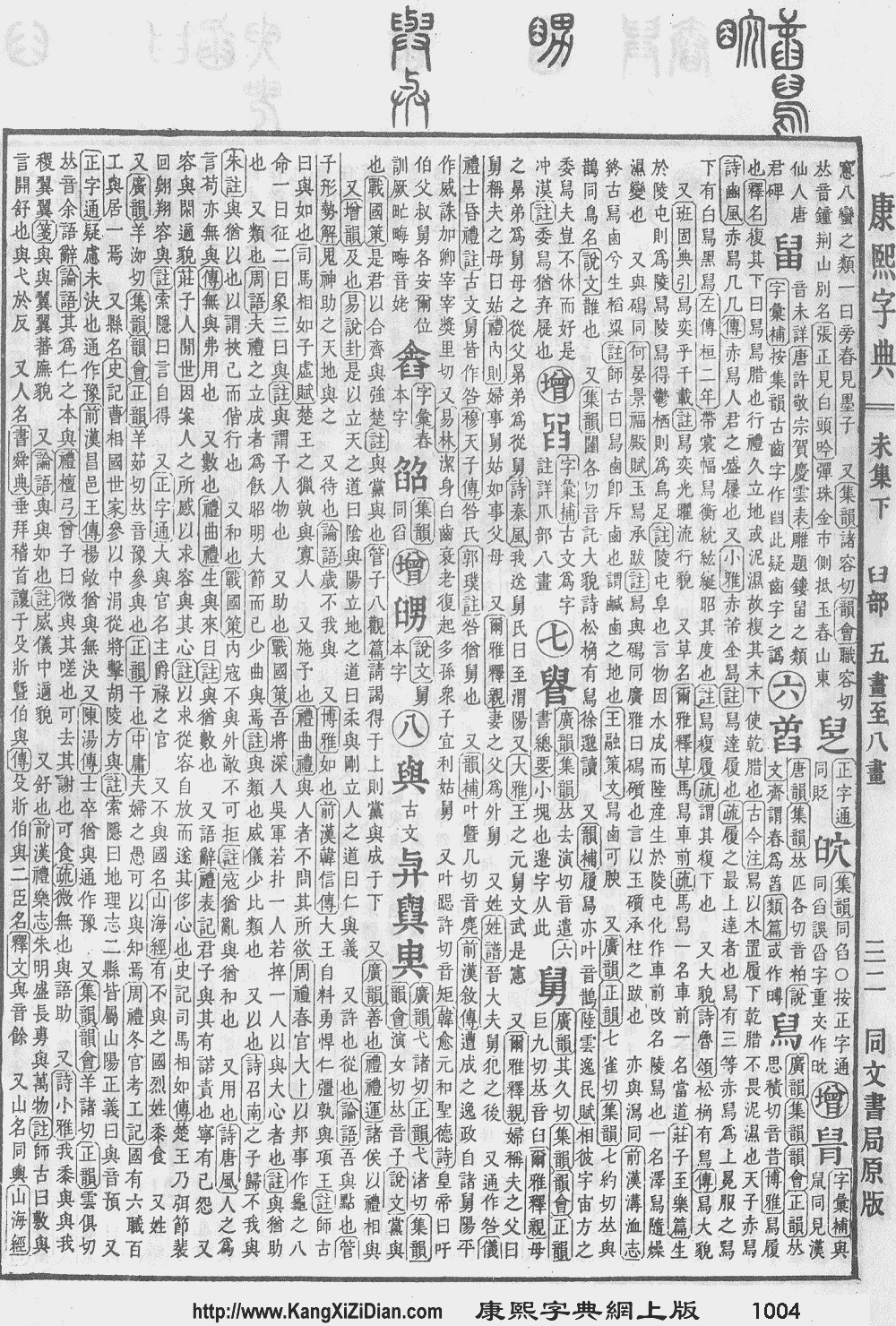
  • KangXi: page 1004, character 9
  • Dai Kanwa Jiten: character 30208
  • Dae Jaweon: page 1460, character 24
  • Hanyu Da Zidian (first edition): volume 5, page 3040, character 3
  • Unihan data for U+8205

Chinese

simp. and trad.
舅
alternative forms
 
𦥶
𦦊
𤽲
𠢎
𤰧
𦥶
𦦊
𤽲
𠢎
𤰧
旧

Glyph origin

Phono-semantic compound (形聲, OC *ɡuʔ) : phonetic 臼 (OC *ɡuʔ) + semantic 男 (“male; man”).

Etymology

Possibly from Proto-Sino-Tibetan *(g/k)əw-n (“elder brother; senior male relative”); compare Tibetan ཨ་ཁུ (a khu), ཁུ་བོ (khu bo, “father's brother”) (Sagart, 2017d; STEDT). Possibly related to 舊 (OC *ɡʷɯs, “old; ancient”), 昆 (OC *kuːn, “elder brother”) (Sagart, 1999; STEDT); see there for more.

Pronunciation


Note:
  • kū/kǔ - vernacular;
  • kiū/kiǔ - literary.
Note:
  • jiou5 - vernacular;
  • jiou4 - literary.

  • Dialectal data
Variety Location 舅
Mandarin Beijing /t͡ɕiou⁵¹/
Harbin /t͡ɕiou⁵³/
Tianjin /t͡ɕiou⁵³/
Jinan /t͡ɕiou²¹/
Qingdao /t͡ɕiou⁴²/
Zhengzhou /t͡ɕiou³¹²/
Xi'an /t͡ɕiou⁴⁴/
Xining /t͡ɕiɯ²¹³/
Yinchuan /t͡ɕiəu¹³/
Lanzhou /t͡ɕiou¹³/
Ürümqi /t͡ɕiɤu²¹³/
Wuhan /t͡ɕiəu³⁵/
Chengdu /t͡ɕiəu¹³/
Guiyang /t͡ɕiəu²¹³/
Kunming /t͡ɕiəu²¹²/
Nanjing /t͡ɕiəɯ⁴⁴/
Hefei /t͡ɕiɯ⁵³/
Jin Taiyuan /t͡ɕiəu⁴⁵/
Pingyao /t͡ɕiəu³⁵/
Hohhot /t͡ɕiəu⁵⁵/
Wu Shanghai /d͡ʑiɤ²³/
Suzhou /d͡ʑiɤ³¹/
Hangzhou /d͡ʑiø¹³/
Wenzhou /d͡ʑau³⁵/
Hui Shexian /t͡ɕiu³⁵/
Tunxi /t͡ɕʰiu²⁴/
Xiang Changsha /t͡ɕiəu⁵⁵/
/t͡ɕiəu¹¹/
Xiangtan /d͡ʑiəɯ²¹/
Gan Nanchang /t͡ɕʰiu²¹/
Hakka Meixian /kʰiu⁴⁴/
Taoyuan /kʰiu²⁴/
Cantonese Guangzhou /kʰɐu²³/
Nanning /kʰɐu²⁴/
Hong Kong /kʰɐu¹³/
Min Xiamen (Min Nan) /kiu²²/
/ku²²/
Fuzhou (Min Dong) /kiɛu²⁴²/
Jian'ou (Min Bei) /kiu⁴⁴/
Shantou (Min Nan) /ku³⁵/
Haikou (Min Nan) /ku³³/
/ku³¹/

Rime
Character 舅
Reading # 1/1
Initial (聲) 群 (30)
Final (韻) 尤 (136)
Tone (調) Rising (X)
Openness (開合) Open
Division (等) III
Fanqie 其九切
Reconstructions
Zhengzhang
Shangfang
/ɡɨuX/
Pan
Wuyun
/ɡiuX/
Shao
Rongfen
/ɡiəuX/
Edwin
Pulleyblank
/guwX/
Li
Rong
/ɡiuX/
Wang
Li
/ɡĭəuX/
Bernard
Karlgren
/gi̯ə̯uX/
Expected
Mandarin
Reflex
jiù
Expected
Cantonese
Reflex
gau6
Baxter–Sagart system 1.1 (2014)
Character 舅
Reading # 1/1
Modern
Beijing
(Pinyin)
jiù
Middle
Chinese
‹ gjuwX ›
Old
Chinese
/*[ɡ](r)uʔ/
English mother"s brother

Notes for Old Chinese notations in the Baxter–Sagart system:

* Parentheses "()" indicate uncertain presence;
* Square brackets "[]" indicate uncertain identity, e.g. *[t] as coda may in fact be *-t or *-p;
* Angle brackets "<>" indicate infix;
* Hyphen "-" indicates morpheme boundary;

* Period "." indicates syllable boundary.
Zhengzhang system (2003)
Character 舅
Reading # 1/1
No. 6980
Phonetic
component
臼
Rime
group
幽
Rime
subdivision
1
Corresponding
MC rime
舅
Old
Chinese
/*ɡuʔ/

Definitions

舅

  1. maternal uncle (mother's brother)
  2. brother-in-law (wife's brother)
  3. † father-in-law (wife's father)
  4. † father-in-law (husband's father)
  5. † feudal prince of a different surname (to an emperor)
  6. † official of a different surname (to a feudal prince)
  7. a surname

Synonyms

Compounds

  • 表舅
  • 豺舅
  • 郎舅
  • 阿舅 (ājiù)
  • 國舅/国舅 (guójiù)
  • 大舅爺/大舅爷
  • 姑舅作親/姑舅作亲
  • 從考舅/从考舅
  • 從舅/从舅
  • 曹國舅/曹国舅
  • 烏舅/乌舅
  • 烏舅金奴/乌舅金奴
  • 繼舅/继舅
  • 舅媽/舅妈 (jiùmā)
  • 舅爺/舅爷 (jiùyé)
  • 舅老爺/舅老爷
  • 諸舅/诸舅
  • 謝舅/谢舅
  • 魚舅/鱼舅
  • 鴉舅/鸦舅

Japanese

Kanji

舅

(uncommon “Hyōgai” kanji)

  1. This term needs a translation to English. Please help out and add a translation, then remove the text {{rfdef}}.

Readings

  • On (unclassified): きゅう (kyū)
  • Kun: しゅうと (shūto, 舅)

Etymology 1

/sihi1to2/: [shipitwo] → [shiɸitwo] → [shiɸito]. See next entry.

Noun

舅(しひと) • (shihito) 

  1. a father-in-law

Etymology 2

From shihito: [shipitwo] → [shiɸitwo] → [shiɸito] → [shiɸuto] → [shiwuto] → [shiuto] → [shuːto].

Noun

舅(しゅうと) • (shūto) ←しうと (siuto)?

  1. a father-in-law

Korean

Hanja

舅 • (gu) (hangeul 구, revised gu, McCune–Reischauer ku, Yale kwu)

  1. This term needs a translation to English. Please help out and add a translation, then remove the text {{rfdef}}.

Vietnamese

Han character

舅: Hán Việt readings: cữu
舅: Nôm readings: cậu, cữu

  1. Nôm form of cậu (“maternal uncle, young male master, younger male stranger”).
This article is issued from Wiktionary. The text is licensed under Creative Commons - Attribution - Sharealike. Additional terms may apply for the media files.