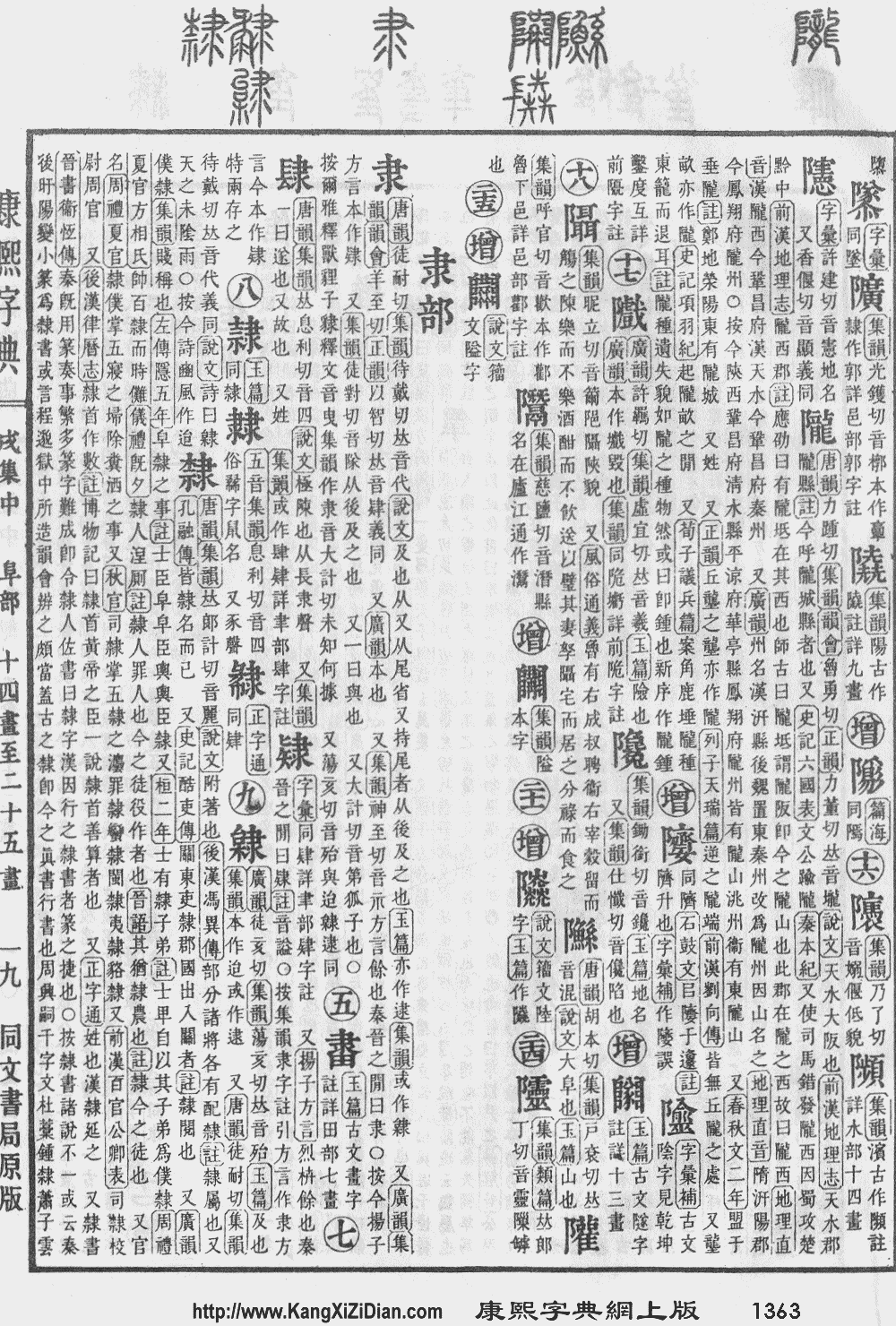
隸

See also: 隷 and 隶
隸 U+96B8, 隸
CJK UNIFIED IDEOGRAPH-96B8
← 隷
[U+96B7]
CJK Unified Ideographs 隹 →
[U+96B9]
隸 U+F9B8, 隸
CJK COMPATIBILITY IDEOGRAPH-F9B8
← 醴
[U+F9B7]
CJK Compatibility Ideographs 惡 →
[U+F9B9]

Translingual

Traditional 隸
Shinjitai 隷
Simplified 隶

Han character

隸 (Kangxi radical 171, 隶+9, 17 strokes, cangjie input 木火中水 (DFLE), four-corner 45932, composition ⿰柰隶)

Alternative forms

The Kangxi dictionary lists another character 隷 as being equivalent to this character.

References

Chinese

trad. 隸
simp. 隶*
alternative forms 隷/隶
𨾀
𨽻
𥛬

Glyph origin

柰 + 隶.

Pronunciation


  • Dialectal data
Variety Location 隸
Mandarin Beijing /li⁵¹/
Harbin /li⁵³/
Tianjin /li⁵³/
Jinan /li²¹/
Qingdao /li⁴²/
Zhengzhou /li³¹²/
Xi'an /li⁴⁴/
Xining /l̩²¹³/
Yinchuan /li¹³/
Lanzhou /li¹³/
Ürümqi /li²¹³/
Wuhan /ti³⁵/
Chengdu /ti¹³/
Guiyang /ti²¹³/
Kunming /li²¹²/
Nanjing /li⁴⁴/
Hefei /zz̩⁵³/
Jin Taiyuan /li⁵³/
Pingyao /li³⁵/
Hohhot /li⁵⁵/
Wu Shanghai /di²³/
Suzhou /di³¹/
Hangzhou /li²/
Wenzhou /lei²²/
Hui Shexian /li²²/
Tunxi /le¹¹/
Xiang Changsha /tʰi⁵⁵/
Xiangtan /tʰi⁵⁵/
Gan Nanchang /liʔ⁵/
Hakka Meixian /li⁵³/
Taoyuan
Cantonese Guangzhou /tɐi²²/
Nanning /tɐi²²/
Hong Kong /tɐi²²/
Min Xiamen (Min Nan) /le²²/
Fuzhou (Min Dong) /lɑ²⁴²/
Jian'ou (Min Bei) /li⁴⁴/
Shantou (Min Nan) /ti³⁵/
Haikou (Min Nan) /li³⁵/
/li²³/

Rime
Character 隸
Reading # 1/1
Initial (聲) 來 (37)
Final (韻) 齊 (39)
Tone (調) Departing (H)
Openness (開合) Open
Division (等) IV
Fanqie 郎計切
Reconstructions
Zhengzhang
Shangfang
/leiH/
Pan
Wuyun
/leiH/
Shao
Rongfen
/lɛiH/
Edwin
Pulleyblank
/lɛjH/
Li
Rong
/leiH/
Wang
Li
/lieiH/
Bernard
Karlgren
/lieiH/
Expected
Mandarin
Reflex
lì
Expected
Cantonese
Reflex
lai6
Baxter–Sagart system 1.1 (2014)
Character 隸
Reading # 1/1
Modern
Beijing
(Pinyin)
lì
Middle
Chinese
‹ lejH ›
Old
Chinese
/*[r]ˁə[p]-s/
English subordinate

Notes for Old Chinese notations in the Baxter–Sagart system:

* Parentheses "()" indicate uncertain presence;
* Square brackets "[]" indicate uncertain identity, e.g. *[t] as coda may in fact be *-t or *-p;
* Angle brackets "<>" indicate infix;
* Hyphen "-" indicates morpheme boundary;

* Period "." indicates syllable boundary.
Zhengzhang system (2003)
Character 隸
Reading # 1/1
No. 7960
Phonetic
component
隶
Rime
group
隊
Rime
subdivision
1
Corresponding
MC rime
麗
Old
Chinese
/*rɯːds/

Definitions

隸

  1. (historical) A class of lowly persons or servants in ancient China.
    奴隸/奴隶  ―  núlì  ―  slave [in general]
  2. to be subordinate
    隸屬/隶属  ―  lìshǔ  ―  to be affiliated to; to belong to; to be subordinate
  3. clerical script
    隸書/隶书  ―  lìshū  ―  clerical script

Compounds

  • 下隸/下隶
  • 今隸/今隶
  • 分隸/分隶
  • 分隸偶存/分隶偶存
  • 北直隸/北直隶
  • 古隸/古隶
  • 司隸/司隶 (sīlì)
  • 司隸校尉/司隶校尉 (sīlì xiàowèi)
  • 奚隸/奚隶
  • 女隸/女隶
  • 奴隸/奴隶 (núlì)
  • 徒隸/徒隶
  • 楷隸/楷隶
  • 氓隸/氓隶
  • 漢隸/汉隶 (hànlì)
  • 皁隸/皁隶 (zàolì)
  • 直隸/直隶 (zhílì)
  • 秦隸/秦隶
  • 罪隸/罪隶
  • 草隸/草隶
  • 萌隸/萌隶
  • 配隸/配隶

References

Japanese

Kanji

隸

(uncommon “Hyōgai” kanji)

  1. Alternative form of 隷.

Readings

  • On (unclassified): れい (rei); い (i)
  • Kun: しもべ (shimobe); したがう (shitagau)

Korean

Hanja

隸 (eumhun 종 례 (jong rye), South Korea 종 예 (jong ye))

  1. Hanja form? of 례/예 (“be subserviant to, servant”).

Vietnamese

Han character

隸: Hán Nôm readings: lệ

  1. This term needs a translation to English. Please help out and add a translation, then remove the text {{rfdef}}.
This article is issued from Wiktionary. The text is licensed under Creative Commons - Attribution - Sharealike. Additional terms may apply for the media files.