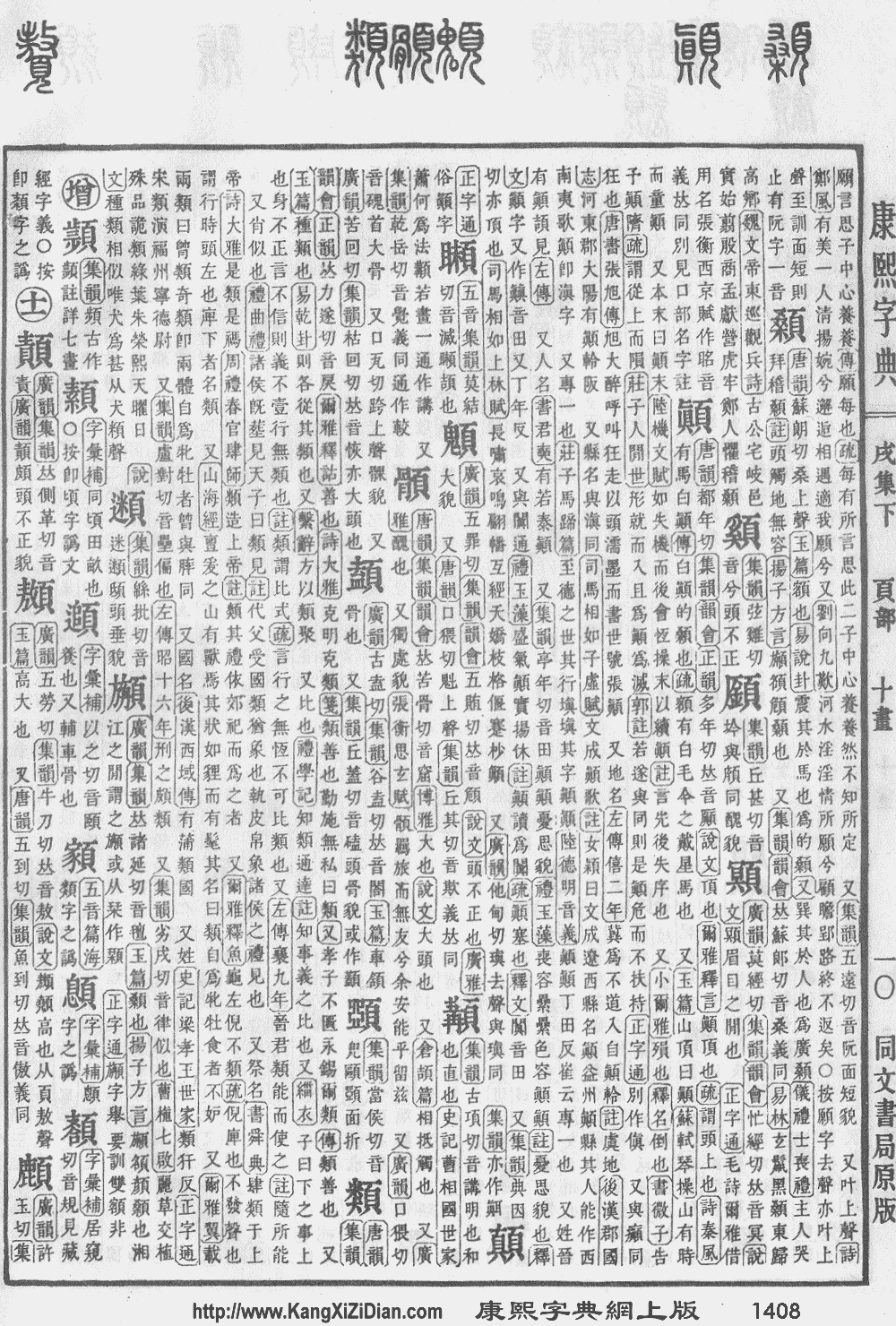
類

See also: 类
類 U+985E, 類
CJK UNIFIED IDEOGRAPH-985E
← 顝
[U+985D]
CJK Unified Ideographs 顟 →
[U+985F]

類 U+F9D0, 類
CJK COMPATIBILITY IDEOGRAPH-F9D0
← 紐
[U+F9CF]
CJK Compatibility Ideographs 六 →
[U+F9D1]

Translingual

Japanese 類
Simplified 类
Traditional 類

Han character

類 (Kangxi radical 181, 頁+10 in Chinese, 頁+9 in Japanese, 19 strokes in Chinese, 18 strokes in Japanese, cangjie input 火大一月金 (FKMBC), four-corner 91486, composition ⿰类頁)

Derived characters

References

Chinese

trad. 類
simp. 类
alternative forms 类
𩔖

Glyph origin

Phono-semantic compound (形聲, OC *ruːls, *ruds) : phonetic 頪 (OC *roːds) + semantic 犬.

Etymology

From Proto-Sino-Tibetan *rus (“bone”) (STEDT).

Pronunciation


  • Dialectal data
Variety Location 類
Mandarin Beijing /lei⁵¹/
Harbin /lei⁵³/
Tianjin /lei⁵³/
Jinan /luei²¹/
Qingdao /le⁴²/
Zhengzhou /luei³¹²/
Xi'an /luei⁴⁴/
Xining /luɨ²¹³/
Yinchuan /luei¹³/
Lanzhou /luei¹³/
Ürümqi /luei²¹³/
Wuhan /nei³⁵/
Chengdu /nuei¹³/
Guiyang /nuei²¹³/
Kunming /nuei²¹²/
Nanjing /luəi⁴⁴/
Hefei /le⁵³/
Jin Taiyuan /luei⁴⁵/
Pingyao /luei³⁵/
Hohhot /luei⁵⁵/
Wu Shanghai /le²³/
Suzhou /le̞³¹/
Hangzhou /lei¹³/
Wenzhou /løy²²/
Hui Shexian /le²²/
/ly²²/
Tunxi /lə¹¹/
Xiang Changsha /lei⁵⁵/
Xiangtan /nəi⁵⁵/
Gan Nanchang /lui²¹/
Hakka Meixian /lui⁵³/
Taoyuan /lui⁵⁵/
Cantonese Guangzhou /løy²²/
Nanning /lui²²/
Hong Kong /løy²²/
Min Xiamen (Min Nan) /lui²²/
Fuzhou (Min Dong) /luɔi²⁴²/
Jian'ou (Min Bei) /ly⁴⁴/
Shantou (Min Nan) /lui³¹/
Haikou (Min Nan) /lui³³/

Rime
Character 類
Reading # 1/1
Initial (聲) 來 (37)
Final (韻) 脂 (16)
Tone (調) Departing (H)
Openness (開合) Closed
Division (等) III
Fanqie 力遂切
Baxter ljwijH
Reconstructions
Zhengzhang
Shangfang
/liuɪH/
Pan
Wuyun
/lʷiH/
Shao
Rongfen
/ljuɪH/
Edwin
Pulleyblank
/lwiH/
Li
Rong
/luiH/
Wang
Li
/lwiH/
Bernard
Karlgren
/lwiH/
Expected
Mandarin
Reflex
lèi
Expected
Cantonese
Reflex
leoi6
Baxter–Sagart system 1.1 (2014)
Character 類
Reading # 1/1
Modern
Beijing
(Pinyin)
lèi
Middle
Chinese
‹ lwijH ›
Old
Chinese
/*[r]u[t]-s/
English category

Notes for Old Chinese notations in the Baxter–Sagart system:

* Parentheses "()" indicate uncertain presence;
* Square brackets "[]" indicate uncertain identity, e.g. *[t] as coda may in fact be *-t or *-p;
* Angle brackets "<>" indicate infix;
* Hyphen "-" indicates morpheme boundary;

* Period "." indicates syllable boundary.
Zhengzhang system (2003)
Character 類 類
Reading # 1/2 2/2
No. 7770 7772
Phonetic
component
頪 頪
Rime
group
微 隊
Rime
subdivision
2 3
Corresponding
MC rime
纇 類
Old
Chinese
/*ruːls/ /*ruds/

Definitions

類

  1. class; group; kind; category
  2. Classifier for types of things: type, kind, sort
    這類問題/这类问题  ―  zhè lèi wèntí  ―  this type of question
    Synonym: 種/种 (zhǒng)
  3. (set theory) class
    由所有集合構成的類不是集合。 [MSC, trad.]
    由所有集合构成的类不是集合。 [MSC, simp.]
    Yóu suǒyǒu jíhé gòuchéng de lèi bùshì jíhé. [Pinyin]
    The class of all sets is not a set.
  4. (object-oriented programming) class

Compounds

Japanese

Shinjitai 類
Kyūjitai
[1]

類
&#xF9D0;
or
類+&#xFE00;?
類󠄀
類+&#xE0100;?
(Adobe-Japan1)
類󠄃
類+&#xE0103;?
(Hanyo-Denshi)
(Moji_Joho)
The displayed kanji may be different from the image due to your environment.
See here for details.

Kanji

類

(grade 4 “Kyōiku” kanji, shinjitai kanji, kyūjitai form 類)

  1. kind, sort, type, class, genus, order, family
  2. similar example, parallel

Readings

Usage notes

  • As in historical readings "すゐ", "ずゐ", "つゐ", and "ゆゐ", most dictionaries do not have "るゐ", as a historical reading for 類. According to historical data, the on-reading of 類 is the modern "るい". However, the Dai Kanwa Jiten, has the "るゐ" and related -wi historical on-readings.

Compounds

Etymology 1

Kanji in this term
類
るい
Grade: 4
on’yomi
Alternative spelling
類 (kyūjitai)

Pronunciation

  • (Tokyo) る​い [rúꜜì] (Atamadaka – [1])
  • IPA(key): [ɾɯ̟ᵝi]

Noun

類(るい) • (rui) 

  1. kind, sort, type, the like
  2. a similar thing, parallel
    過去(かこ)に類(るい)を見(み)ない出来事(できごと)
    kako ni rui o minai dekigoto
    an event that has no parallel in history
  3. (taxonomy) a conventional grouping that corresponds to a class or an order
  4. (logic) Short for 類概念 (ruigainen).
Derived terms
  • 類(るい)は友(とも)を呼(よ)ぶ (rui wa tomo o yobu)
  • 類(るい)を以(もっ)て集(あつ)まる (rui o motte atsumaru)
  • 酸桃(すもも)も桃(もも)も桃(もも)の類(るい) (sumomo mo momo mo momo no rui)

Etymology 2

Kanji in this term
類
たぐ(い)
Grade: 4
kun’yomi
Alternative spelling
類 (kyūjitai)
For pronunciation and definitions of 類 – see the following entry.
【類たぐい】
[noun] sort, kind, type
Alternative spellings
比い, 類, 比, 属
(This term, 類, is an alternative spelling of the above term.)

References

  1. “類”, in 漢字ぺディア (Kanjipedia)‎ (in Japanese), 日本漢字能力検定協会, 2015—2023

Korean

Hanja

類 (eumhun 무리 류 (muri ryu), South Korea 무리 유 (muri yu))

  1. Hanja form? of 류/유 (“kind, sort, type, class, genus, order, family”).
  2. Hanja form? of 류/유 (“similar example, parallel”).

Compounds

Vietnamese

Han character

類: Hán Nôm readings: loại, loài, nòi

  1. This term needs a translation to English. Please help out and add a translation, then remove the text {{rfdef}}.
This article is issued from Wiktionary. The text is licensed under Creative Commons - Attribution - Sharealike. Additional terms may apply for the media files.