< Reconstruction:Proto-Slavic
Reconstruction:Proto-Slavic/plugъ

Proto-Slavic
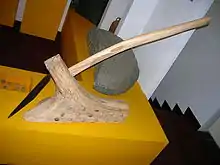
*plugъ (museum exhibit)
Etymology
Borrowed from a Germanic language[1] (compare Old High German pfluog), from Proto-Germanic *plōgaz ~ *plōguz. Also loaned into Lithuanian plūgas.
Usage notes
The term may have originally referred to frame-ploughs, invented around 1st cent. AD by the Romans. It was probably intended for plowing tougher soils, which could not be handled by simpler tools such as *ordlo and *soxa. According to Schuster-Šewc, the tool had spread from Raetia or Eastern Gallia into the Langobards and from them into the remaining Germanic and Central European people.
Declension
Declension of *plùgъ (hard o-stem, accent paradigm a)
| Singular | Dual | Plural | |
|---|---|---|---|
| Nominative | *plùgъ | *plùga | *plùdzi |
| Accusative | *plùgъ | *plùga | *plùgy |
| Genitive | *plùga | *plùgu | *plùgъ |
| Locative | *plùdzě | *plùgu | *plùdzě̄xъ |
| Dative | *plùgu | *plùgoma | *plùgomъ |
| Instrumental | *plùgъmь, *plùgomь* | *plùgoma | *plùgȳ |
| Vocative | *plùže | *plùga | *plùdzi |
* -ъmь in North Slavic, -omь in South Slavic.
See also
Descendants
- East Slavic:
- South Slavic:
- West Slavic:
References
- Pronk-Tiethoff, Saskia E. (2013) The Germanic loanwords in Proto-Slavic (in English), Amsterdam - New York: Rodopi, →ISBN, page 86: “PSl. *plugъ ‘plough’ (m. o-stem); AP (a)”
- Olander, Thomas (2001), “plugъ”, in Common Slavic accentological word list, Copenhagen: Editiones Olander: “a (SA 155; PR 131; RPT 97, 101)”
- Snoj, Marko (2016), “plug”, in Slovenski etimološki slovar3 (in Slovene), https://fran.si: “Pslovan. *plűgъ”
Further reading
- Blažek, Václav; Dufková, Kristýna (2016), “Psl. *plugъ < z germ. *plōgu-/*plōga- < kelt.?”, in Linguistica Brunensia, volume 64, issue 2, page 55
- Verweij, Arno (1994), “Quantity Patterns of Substantives in Czech and Slovak”, in Dutch Contributions to the Eleventh International Congress of Slavists, Bratislava (Studies in Slavic and General Linguistics), volume 22, Editions Rodopi B.V., page 525, 530
- Vasmer, Max (1964–1973), “плуг”, in Этимологический словарь русского языка [Etymological Dictionary of the Russian Language] (in Russian), transl. and suppl. by Oleg Trubachyov, Moscow: Progress
- Duridanov I., Račeva M., Todorov T., editor (1996), “плуг”, in Български етимологичен речник [Bulgarian Etymological Dictionary] (in Bulgarian), volume 5, Sofia: Bulgarian Academy of Sciences, page 365
- “plūgas”, in Lietuvių kalbos etimologinio žodyno duomenų bazė [Lithuanian etymological dictionary database], 2007–2012
This article is issued from Wiktionary. The text is licensed under Creative Commons - Attribution - Sharealike. Additional terms may apply for the media files.